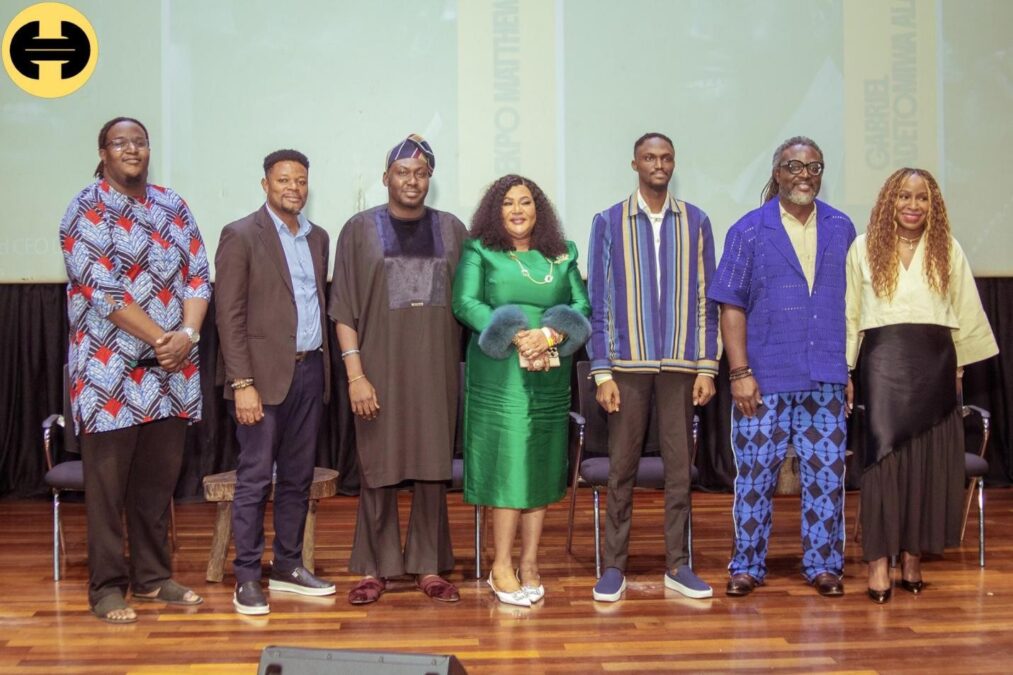
In a glass-walled auditorium at the Mike Adenuga Centre, a room full of educators, filmmakers and technology executives spent an afternoon arguing over a single question: can Africa build its own artificial intelligence future, or will it once again import someone else’s?
The event, called Claiming Tomorrow: The Next Gen Collective, was convened by Nsibidi Fables, a Lagos-based creative technology and education studio, and drew a cross-section of Nigeria’s cultural and business establishment — among them Regina Ezefuna, proprietor of Dream Schools International; Perky Noah-Effik, chief brand officer of Nsibidi Fables; and Lanre Adisa, founder of Noah’s Ark Communications.
The pitch from organisers was unapologetically historical. Tony Effik, the studio’s founder, opened proceedings by invoking two indigenous systems of knowledge — the Nsibidi script of southeastern Nigeria and the Ifa divination system’s binary logic — as evidence that the continent has repeatedly built the intellectual scaffolding for major technological leaps, only to see the gains captured elsewhere.
“If nobody knows the future, why can’t we make the future ourselves?” Effik told the gathering. “No more discarded potential.”
The event landed at a moment when Nigeria’s creative sector is generating real revenue, even if the underlying infrastructure remains thin. The country’s music industry pulled in close to $395 million from international touring and live performances last year, according to figures cited at the event, while streaming platforms have paid out more than ₦58 billion to Nigerian artists since 2023. Nollywood, meanwhile, continues to churn out thousands of titles annually — volume that organisers argued has outpaced the systems needed to train, finance and technologically support the people making the work.
Education emerged as the conference’s other throughline. UNESCO estimates that Sub-Saharan Africa will need 15 million additional teachers by 2030 to meet basic education targets, a gap speakers said AI-assisted tools could help narrow rather than close entirely.
Ezefuna offered a classroom-level account of what that looks like in practice, describing reactions to AI-supported coursework run through Nsibidi Academy. “Parents did not believe their children produced the work they created using AI,” she said. “It strengthened critical thinking, decision-making, collaboration and emotional intelligence. The students wanted these classes every day.”
A separate panel turned to animation and production, where filmmakers and studio executives disagreed on how far automation should reach into the creative process — but converged on the idea that AI should sit alongside human judgment rather than substitute for it. Noah-Effik framed that as company doctrine. “Technology is a powerful tool, but it is never the author,” she said. “Human-in-the-loop will continue to define everything we build.”
The studio pointed to its own production data as a test case: AI-assisted workflows, it said, have cut animation timelines from roughly six months to four weeks, with human reviewers retained at each stage to preserve creative quality.
Looking ahead, Nsibidi Fables said it plans to keep building out Nsibidi Academy, its tutoring marketplace, and to expand the proprietary AI tools it uses in production. Executives described the event itself as the first in a series intended to keep education, technology and creative industry figures talking to one another as the continent’s digital economy scales.
Whether that coordination translates into the kind of ownership speakers called for — rather than another cycle of local invention and outside capture — is the open question the studio says it intends to keep testing.

Join BusinessDay whatsapp Channel, to stay up to date
Open In Whatsapp