For many Nigerians who grew up in the late 1970s and early 1980s, Cock Crow at Dawn was more than a television programme. It was part of the rhythm of national life. It belonged to that era when the Nigerian Television Authority, NTA, was not merely a broadcaster but a national meeting point; a place where families gathered, values were negotiated, and the country saw versions of itself reflected on screen.
Although often remembered as a programme of the late 1970s to mid-1980s, the series is widely associated with the early 1980s, when Nigerian public television still carried a strong developmental and cultural mission. Written and produced by Peter Igho and directed by Matt Dadzie, Cock Crow at Dawn emerged in the period of the Green Revolution, when agriculture, food production and rural development were central to national policy conversation.
What made Cock Crow at Dawn remarkable was the way it turned agriculture into drama. At a time when national development was often discussed in slogans, policy speeches and government campaigns, the programme brought the subject home through character, family conflict, rural ambition and everyday struggle. It showed that farming was not merely a government message; it was a way of life, an economic choice, a moral discipline and a possible route to dignity.
The story follows Bello, a businessman who relocates his family from Lagos to a rural community to pursue farming. Around him were characters such as Mama Bitrus, Bitrus, Lare and others who gave the programme its emotional and social texture. The cast included George Menta, Ene Oloja, Sadiq Daba, Tola Awobode and Kasimu Yero, names that would become part of Nigeria’s television memory.
The genius of Cock Crow at Dawn was its simplicity. It did not need expensive spectacle or excessive melodrama to hold attention. Its power came from recognisable human situations: a family adjusting to change, young people negotiating duty and desire, communities dealing with tradition and modernity, and individuals learning that progress often requires patience, sacrifice and integrity.
As an edutainment series, it worked because it did not preach from a distance. The message of agriculture, rural development and self-reliance was embedded in the lives of the characters. Viewers were not simply told that farming mattered; they saw its difficulties, its promise and its relationship to national survival. This gave the programme a credibility that many government-backed campaigns often lack.
The rural setting was also significant. Nigerian television at the time was still finding its language, and Cock Crow at Dawn helped expand what could count as a national story. It did not treat the village as a backward space to be escaped from. Instead, it presented the rural community as a serious site of enterprise, culture, conflict and possibility. In doing so, it gave dignity to the countryside and reminded viewers that Nigeria’s future could not be built only from its cities.
The Soundtrack That Became the Soul of the Programme
No serious review of Cock Crow at Dawn is complete without attention to its music. In fact, the programme’s soundtrack was not merely an accompaniment to the drama; it became one of the strongest carriers of its memory. Long after many viewers had forgotten particular scenes or dialogue, Bongos Ikwue’s theme remained lodged in the national imagination.
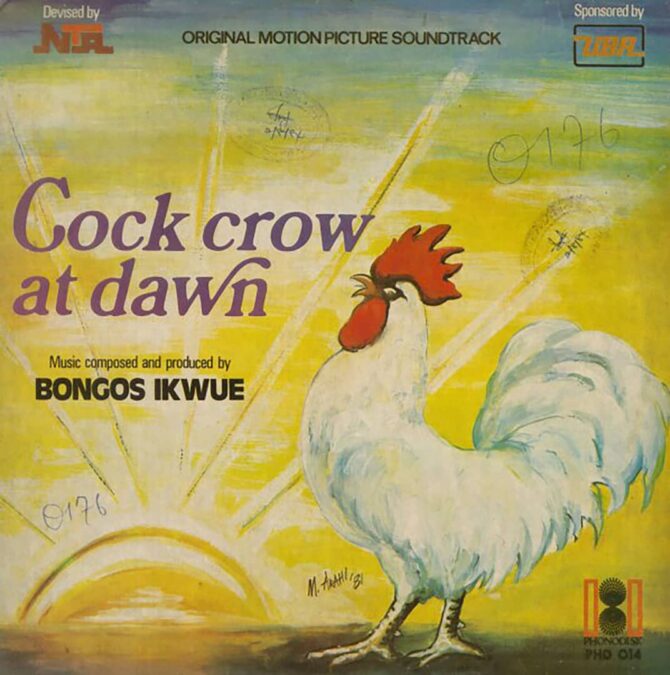
The Cock Crow at Dawn original soundtrack gave the programme an identity beyond the screen. The music did not function as background filler. It became part of the programme’s emotional architecture. It announced not only the beginning of an episode, but the world into which the viewer was being invited: rural Nigeria, morning labour, family life, moral struggle and the slow dignity of work.
This is why the soundtrack cover is an appropriate image to illustrate any review of the programme. For many viewers, Cock Crow at Dawn is inseparable from its sound. The music became a cultural trigger. One heard the opening strains and immediately entered the world of the series: the farm, the family, the village, the call to work and the moral seriousness of dawn.
Bongos Ikwue’s theme song carried the same values the drama sought to communicate. It was gentle, reflective and rooted, yet it also had movement, optimism and a quiet sense of national purpose. It gave the programme emotional warmth and helped soften what could otherwise have felt like an official agricultural campaign. Through music, the message of farming and rural self-reliance became intimate, memorable and human.
Bongos Ikwue’s Guitar Work and the Sound of Rural Memory
The genius of Bongos Ikwue’s composition lies in restraint. The guitar work does not overwhelm the song. It opens space. It moves with the unhurried confidence of folk music, allowing the melody and atmosphere to breathe. Rather than building the theme around heavy orchestration or dramatic excess, Ikwue uses the guitar to create intimacy. The instrument feels close to the listener, almost conversational.
Technically, the guitar functions as both rhythm and scenery. Its picking and strumming patterns evoke movement without hurry. There is a pastoral quality to the sound: clean, melodic, warm and uncluttered. It suggests morning without needing to imitate it literally. The guitar lines carry the feeling of sunrise, open air, footpaths, birds, water and human activity beginning again.
This was what made the song so effective as television music. A good theme tune must do more than sound beautiful; it must prepare the viewer emotionally for the story. Bongos Ikwue understood this. His guitar work created the right psychological temperature for the programme. It was neither urban highlife exuberance nor solemn orchestral drama. It sat somewhere between folk, soul, country-inflected balladry and Nigerian popular music, giving the series a sound that was both local and broadly accessible.
Read also: Africa’s Travel Indaba to showcase continent’s diverse tourism offering
The composition also benefits from Ikwue’s vocal style. His voice carries a mellow, reflective tone, almost as if he is narrating rather than performing. That vocal restraint works beautifully with the guitar. Together, they produce a sound that is nostalgic without being weak, moral without being preachy, and emotional without becoming sentimental.
As a song, “Cock Crow at Dawn” succeeds because of the balance between melody, imagery and mood. Its structure is simple, but its simplicity is deliberate. The melodic line is easy to remember, which is essential for a television theme. It does not depend on vocal acrobatics. Instead, it depends on phrasing, warmth and repetition.
The arrangement appears designed to serve narrative rather than spectacle. The guitar establishes the tonal centre and emotional mood, while the vocal melody carries the lyrical imagery. The song’s pacing mirrors the programme’s broader dramatic rhythm: calm, patient, observational and human. It does not rush the listener. It allows the idea of dawn to unfold.
Thematically, the song works with natural imagery: the bird, the morning, water, the sun and the awakening of the world. These images are not decorative. They reinforce the programme’s central concern with rural life and the dignity of productive labour. The cockcrow is both literal and symbolic. It is the sound of morning, but it is also a summons: wake up, work, begin again.
This makes the song one of the most successful examples of theme music in Nigerian television history. It does exactly what a great theme should do. It condenses the meaning of the programme into sound. Before the story begins, the viewer already understands the emotional universe of the drama.
A Programme of Message, Memory and Nationhood
The fusion of drama and music gave Cock Crow at Dawn unusual staying power. The programme promoted agriculture, rural enterprise and national self-reliance. But Bongos Ikwue’s music gave those themes emotional legitimacy. It made the message feel lived, not imposed. It turned policy into atmosphere.
That is why the soundtrack remains one of the most authentic symbols of the programme. It represents the sound that carried the series into Nigerian homes and into Nigerian memory. To review Cock Crow at Dawn without its soundtrack is to miss part of its power. The drama gave Nigeria a story about land, family and work. Bongos Ikwue gave that story its soul.
But Cock Crow at Dawn was not perfect. Seen from today’s perspective, some of its pacing may feel slow, its production values modest, and its development message somewhat idealistic. It belonged to an era when public television still carried a strong national instructional function. The programme’s vision of agriculture sometimes leaned towards moral optimism: if citizens returned to the land, embraced discipline and worked hard, national prosperity would follow.
That message was powerful, but it also simplified deeper structural problems. Agriculture requires more than personal commitment. It needs infrastructure, credit, storage, roads, markets, technology, security and policy consistency. The programme captured the nobility of farming, but the Nigeria that followed showed that rural development could not be sustained by persuasion alone.
Even so, this does not diminish the programme’s achievement. If anything, it makes its legacy more important. Cock Crow at Dawn captured a moment when Nigerian television still believed it could shape national imagination. It showed that drama could educate without becoming dull, that public broadcasting could entertain without losing civic purpose, and that a television series could place ordinary Nigerians at the centre of a national development conversation.
Read also: ‘I Find The Defendant’ short film by The Trybe debuts in Lagos
Its relevance today is striking. Nigeria still struggles with food security, youth unemployment, rural neglect, urban congestion and the need to make agriculture attractive as a business. In that sense, Cock Crow at Dawn feels less like a closed chapter and more like an unfinished argument. The questions it raised in the 1980s remain urgent: Who will feed the nation? Can rural life become economically viable? Can television help change public attitudes towards work, production and self-reliance?
Any revival or contemporary reinterpretation of Cock Crow at Dawn would face a tougher assignment. It would have to speak to a Nigeria shaped by insecurity, climate pressure, migration, digital culture, agritech, food inflation and a younger generation less patient with official messaging. It would also need a musical identity strong enough to perform the same function as Bongos Ikwue’s theme performed for the original: to hold the emotional meaning of the story before the first line of dialogue is spoken.
The original Cock Crow at Dawn succeeded because it made development human. Its best lesson for today’s storytellers is not merely that agriculture should be promoted. It is when national issues become meaningful when they are carried by believable people, strong characters, emotionally honest storytelling and music that enters the public memory.
Decades after it first aired, Cock Crow at Dawn remains one of the great achievements of Nigerian public television. It was educational without being lifeless, patriotic without being empty, and simple without being shallow. It gave Nigeria a story about land, labour, family and nationhood. Most importantly, it reminded a generation that dawn is not only the beginning of a day; it is also a call to work.

Join BusinessDay whatsapp Channel, to stay up to date
Open In Whatsapp