
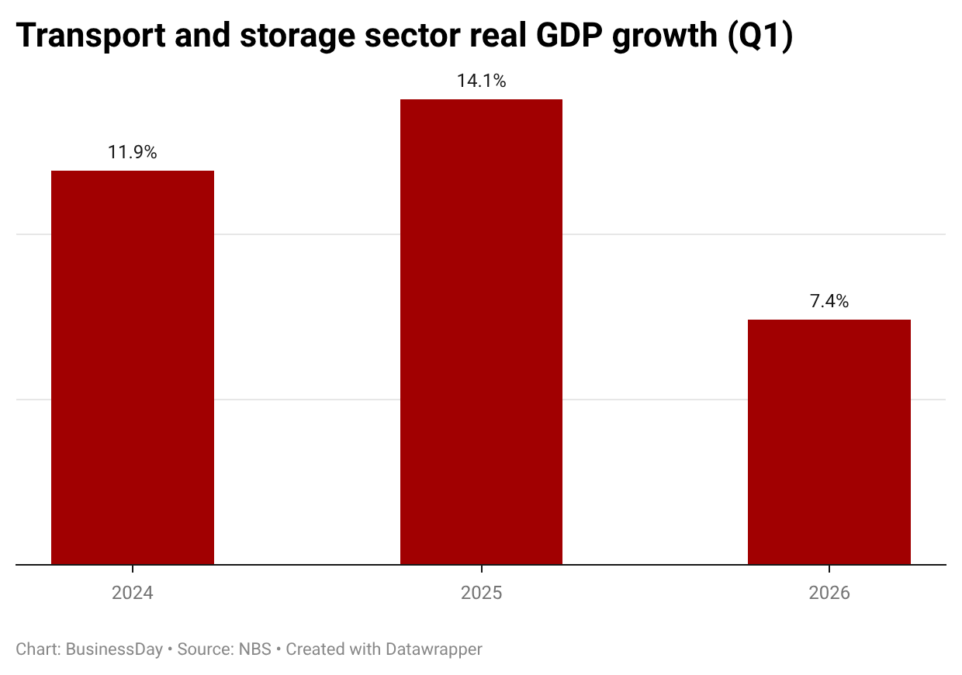
Nigeria’s transport and storage sector has recorded a sharp drop in its Gross Domestic Product (GDP) growth in the first quarter of 2026, as rising operating costs, infrastructure bottlenecks, and fuel price increases continue to squeeze operators in the country.
Data from the National Bureau of Statistics (NBS) Q1 2026 GDP report showed that the sector, seen as the backbone of trade and commercial activities, grew by 7.41 percent in real terms year on year, a decrease of 6.67 percentage points compared to the 14.08 percent recorded in the same quarter of the previous year and a decrease of 13.84 percentage points relative to the preceding quarter.
From haulage companies to warehouse operators, businesses across Nigeria’s transport and logistics value chain are grappling with higher operating expenses, a challenge reflected in the sector’s latest GDP growth.
The sector’s contribution to real GDP in Q1 2026 was 1.02 percent, higher than the 0.99 percent recorded in the preceding year and roughly the same as the 1.02 percent recorded in Q4 2025.
Read also: FX spending on transport services jumps 98% in two years
Six activities, including road transport, rail transport and pipelines, water transport, air transport, transport services, and post and courier services, make up the transportation and storage sector, but have yet to contribute meaningfully to the country’s GDP.
As transport in Nigeria remains heavily dependent on road haulage, subsequent fuel price increases have resulted in operators facing significantly higher running costs, such as rising fuel prices, fluctuating spare parts costs, poor road conditions, multiple levies, and insecurity.
According to NBS data, road transport grew by 9.64 percent in real terms in Q1 2026, down from 17.21 percent and 18.46 percent recorded in the corresponding periods of 2024 and 2025, respectively.
Rail transport and pipeline activities expanded by 6.03 percent in real terms year-on-year in the first quarter of 2026, down from the 28.95 percent and 68.73 percent growth recorded in the corresponding periods of 2024 and 2025, respectively, highlighting the persistent challenges facing Nigeria’s rail infrastructure.
Post and courier services grew in real terms in Q1 to 3.88 percent from the 3.72 percent recorded in the same period of 2025.
The NBS data underscores the growing challenges facing Nigeria’s transport and storage sector, with slower growth pointing to the impact of cost pressures and logistics constraints on the movement of goods and economic activity.

Join BusinessDay whatsapp Channel, to stay up to date
Open In Whatsapp