
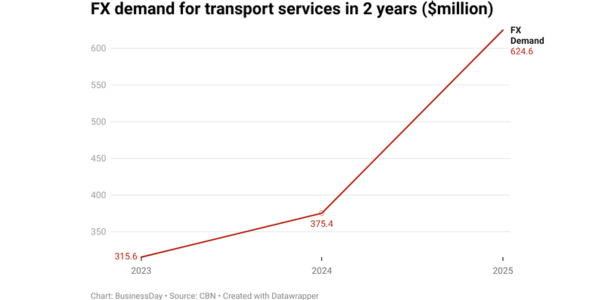
Foreign exchange (FX) spending on Nigeria’s transport services almost doubled in two years, indicating rising dollar demand in the sector amid surging international travel, shipping costs, and import-dependent transport operations.
Data from the Central Bank of Nigeria (CBN) showed that FX utilisation for transport services rose to $624.6 million in 2025 from $315.6 million in 2023, reflecting the sector’s growing exposure to external cost pressures as operators grapple with rising costs tied to air travel, freight, and logistics operations.
The CBN data also showed that FX demand for tourism- and travel-related payments more than doubled in a year, rising to about $3.7 million in 2025 from $1.5 million in 2024, highlighting increased mobility and service-sector activity during the period.
Despite the sharp increase, the flows remained below financial and business services, highlighting a broader recovery in travel, trade, and logistics activities.
Read also: https:Fx fears, rising demand fuel Nigeria’s vehicle import surge
CBN data, analysed by the Financial Markets Dealers Association (FMDA), also showed that total FX utilisation rose sharply to $47.17 billion in 2025 from $26.64 billion in 2024, driven primarily by invisible-related transactions, particularly demand for financial services.
“While the industrial sector remained the largest merchandise-related source of FX demand at $8.43 billion, invisible-related FX utilisation surged to $27.27 billion, exceeding total goods imports of $19.90 billion.”
“The increase in industrial-sector FX demand reflects expanding domestic production activities, which continued to drive reliance on imported machinery, industrial inputs, and intermediate goods required for manufacturing and infrastructure-related activities,” FMDA stated.
The data also showed that FX utilisation for financial services surged to $21.22 billion in 2025 from $4.96 billion in 2023, suggesting increased cross-border financial transactions and deeper participation within the formal FX market.
Oil-sector FX demand also increased significantly in 2025, likely reflecting higher refinery-related imports and energy-sector activities.
“Together, these trends indicate that Nigeria’s FX demand structure is becoming increasingly diversified, with invisible transactions now exerting greater influence on overall FX liquidity conditions alongside traditional merchandise imports,” FMDA stated.

Join BusinessDay whatsapp Channel, to stay up to date
Open In Whatsapp