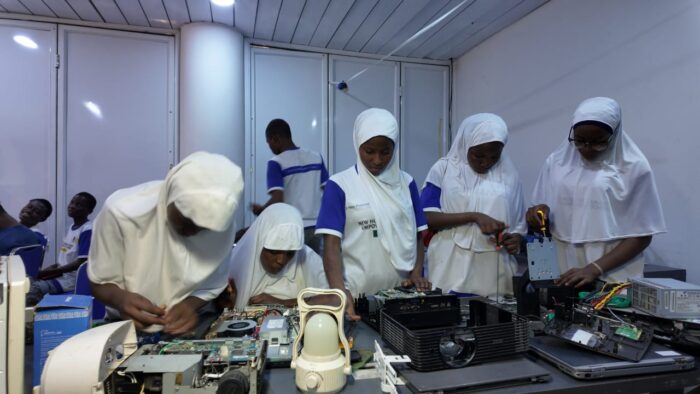
Nigeria’s emerging Almajiri-to-tech programme is pointing to a potentially scalable solution to youth vulnerability, as a pilot led by New Horizons Nigeria shows how targeted skills training and basic social support can quickly move street children into productive work and away from long-term social and security risks.
New Horizons Nigeria has invested more than N50 million to train a small group of 21 Almajiri children in Abuja, under its ‘Almajiri-to-Tech’ initiative, a three-month intensive programme combining technical skills, welfare support and mentoring.
Nigeria is estimated to have about 15 million Almajiri children, mostly boys sent away from home to study Islamic education but who often end up begging on the streets. The issue has long been linked to poverty, poor education and, in some cases, vulnerability to recruitment by armed groups.
Read also: New Horizons Nigeria launches N50m Almajiri-to-Tech scheme to tackle unemployment, insecurity
The pilot programme offers a different path. After three months of training, all 21 participants completed the course with no dropouts, achieving what the company described as full attendance and high knowledge retention. The trainees can now repair devices such as mobile phones, laptops, power banks and household electronics.
“From uncertainty to opportunity, this is true transformation in action,” said Tim Akano, chief executive of New Horizons Nigeria.
The trainees will begin a two-month internship on April 16, where they will offer repair services to the public, turning their new skills into income.
Changing the narrative
The programme goes beyond technical training. Participants were provided with meals, stipends and new clothing, basic support that organisers say helped unlock focus and discipline.
One key finding, according to the organisers, is that the Almajiri children showed strong learning ability despite language barriers. Some who could not speak English were still able to master electronic repairs within the short training period.
The initiative also revealed gender potential often overlooked. Two of the top-performing trainees were girls, with one discovering a talent for poetry alongside her technical skills.
The programme included weekly visits by an Islamic scholar, blending Quranic education with modern ICT training, an approach the organisers say helped build trust and cultural acceptance.
Security and economic implications
Analysts say such initiatives could have wider implications for Nigeria’s security and economy if scaled.
For decades, large populations of out-of-school children have been seen as a risk factor for instability. Groups such as Boko Haram and Islamic State West Africa Province have historically recruited from vulnerable communities in northern Nigeria.
Akano said the 21 graduates from the programme are now economically empowered and unlikely to be drawn into violent groups.
“These individuals now have skills that can earn them up to N20,000 per day. They will not return to the streets,” he said.
Beyond security, the model also addresses Nigeria’s growing demand for technical skills in its digital economy, where device repairs and maintenance services are in high demand due to rising smartphone and electronics use.
Deeper structural challenges
However, the programme also exposed deeper social issues. Organisers said ethnic divisions and mistrust were visible even among the young trainees, pointing to a need for broader national reorientation. They also noted that the Almajiri problem is not limited to Nigeria, with participants in the Abuja programme coming from neighbouring countries such as Niger, Chad and Cameroon.
This cross-border dimension suggests that any long-term solution will require regional cooperation on education, migration and child welfare.
The programme further highlighted demographic pressures, with organisers pointing to high fertility rates among affected communities, which continue to expand the population of vulnerable children.
Read also: Jigawa partners NITDA to upskill Almajiri, out-of-school children digitally
A model for scale?
While the pilot involved only 21 participants, its success raises questions about scalability.
Experts say the main challenge will be funding and coordination. Scaling such programmes to reach even a fraction of the estimated 15 million Almajiri children would require significant government involvement, private sector investment and policy reform.
Still, the early results suggest that the issue may be less about ability and more about access.
“God does not create anyone useless,” Akano said, adding that poverty, lack of skills and opportunity, not intelligence, are the main barriers facing the children.
As Nigeria looks for solutions to youth unemployment and insecurity, the Almajiri-to-Tech model may offer a practical starting point, one that shifts the narrative from charity to skills, and from vulnerability to productivity.


Join BusinessDay whatsapp Channel, to stay up to date
Open In Whatsapp