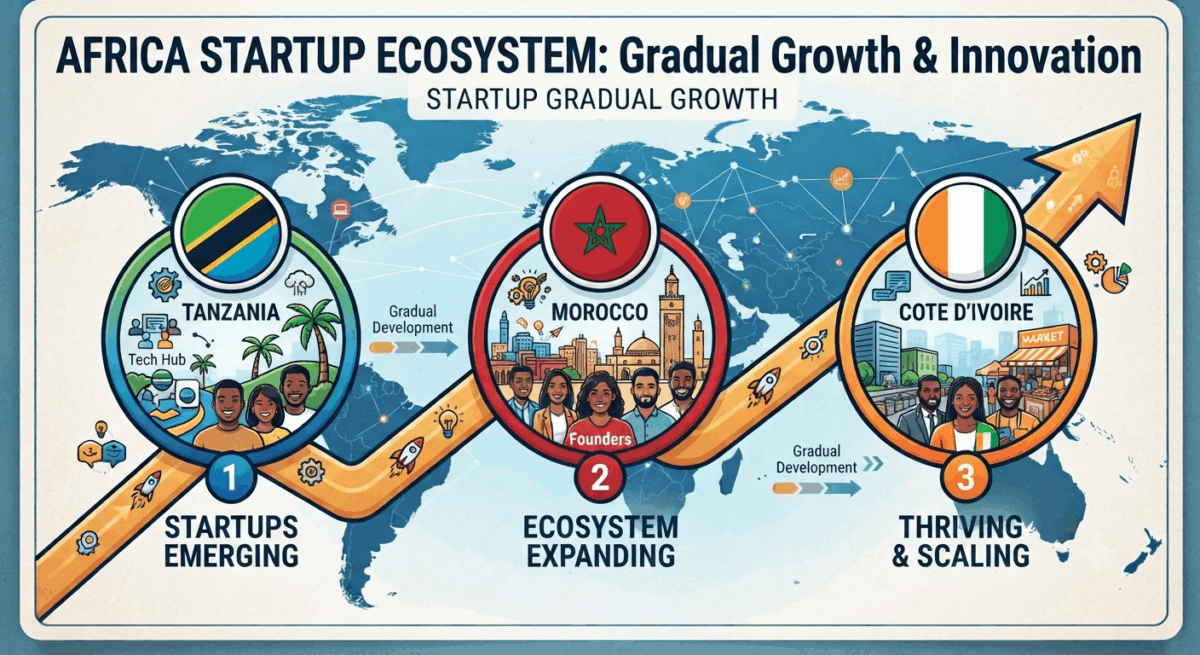
Africa’s startup investment landscape is beginning to shift beyond its traditional powerhouses, with countries such as Tanzania, Morocco and Côte d’Ivoire emerging as fast-growing venture capital destinations even as Nigeria and Egypt continue to dominate the continent’s funding rankings.
A new report by Africa: The Big Deal, shows that though Nigeria, Egypt, Kenya and South Africa remained Africa’s four largest startup ecosystems in the first half of 2026, investors are expanding into newer markets.
The four countries accounted for 58 percent of all startup funding raised across Africa during the first six months of the year, a smaller share than in previous years despite attracting most of the continent’s largest investment rounds.
Beyond the Big Four, Tanzania, Côte d’Ivoire and Morocco each attracted more than $25 million in startup funding during the period, highlighting growing investor appetite for markets that until recently sat on the fringes of Africa’s technology ecosystem.
Read also: Nigeria launches $350,000 startup funding programme to boost innovation
The report suggests Africa’s venture capital industry is becoming more geographically diverse as investors search for untapped opportunities outside the continent’s established hubs.
“Beyond the Big Four, three markets attracted more than $25 million in total funding in H1: Tanzania, Côte d’Ivoire and Morocco,” Max Cuvellier Giacomelli, founder of Africa: The Big Deal, stated.
The expansion is also reflected in startup activity.
Morocco, Tanzania and Ghana each recorded at least 10 startups raising $100,000 or more during the first half of the year, placing them among Africa’s most active emerging innovation ecosystems.
The figures indicate that while mega funding rounds remain concentrated in larger markets, entrepreneurial activity is beginning to spread across the continent.
The trend marks a gradual departure from a venture capital landscape that for years was dominated almost exclusively by Nigeria, Kenya, South Africa and Egypt.
Investors are increasingly looking beyond traditional technology hubs as startup valuations become more attractive in smaller markets and governments improve digital infrastructure, regulation and innovation policies.
Even so, the report shows the continent’s established leaders remain firmly ahead.
Egypt attracted $327 million in total startup funding during the period, followed by Nigeria with $254 million; Kenya raised $126 million and South Africa secured only $83 million.
When equity investments alone are considered, however, Nigeria ranked first with $214 million, ahead of Egypt’s $183 million.
While newer ecosystems are attracting greater attention, the report notes that Nigeria continues to lead Africa in the number of startups securing investment, underlining the depth of its entrepreneurial ecosystem.
The rise of smaller markets comes at a time when Africa’s overall venture capital industry is undergoing structural change.
According to Giacomelli, much of the continent’s funding recovery is being driven by larger, mature companies, while early-stage startups continue to struggle to secure investment.
“The drops we are seeing in the rest of the Big Four echo the concerns we have been raising repeatedly since the beginning of the year about the concentration of the money on larger deals and the lack of early-stage tickets, especially at the lower end of the range,” he said.
That means headline investment figures may mask a more uneven recovery beneath the surface.
While capital is spreading into new geographies, it is not necessarily reaching enough young companies to sustain the next generation of African technology firms.
For emerging ecosystems such as Tanzania, Morocco and Côte d’Ivoire, however, the latest figures represent an important milestone.
Read also: Africa’s startup funding slump fuels wave of mergers and acquisitions
Their growing share of venture capital suggests Africa’s innovation economy is no longer defined solely by its traditional leaders. Instead, investors are beginning to build a broader pipeline of opportunities across the continent, reducing dependence on a handful of markets and creating new centres of entrepreneurship.
If sustained, the trend could make Africa’s startup ecosystem more resilient by widening the pool of investable companies and lowering concentration risk. For founders outside the continent’s traditional technology capitals, the message is increasingly clear: global investors are no longer looking only to Lagos, Cairo, Nairobi and Johannesburg for Africa’s next generation of high-growth startups.


Join BusinessDay whatsapp Channel, to stay up to date
Open In Whatsapp