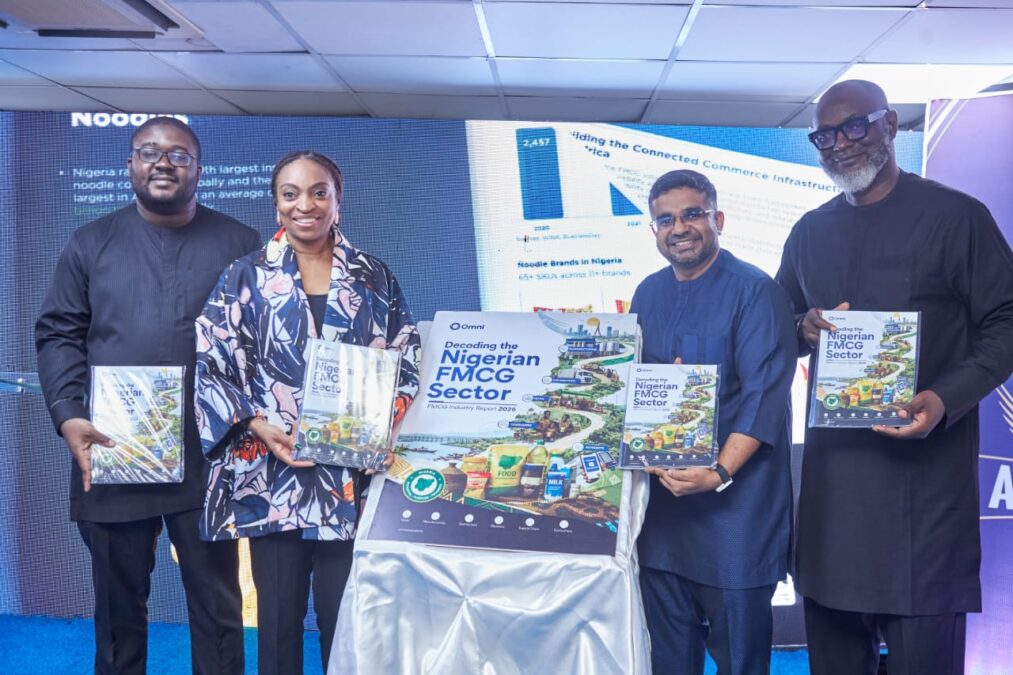
Nigeria’s $25 billion Fast-Moving Consumer Goods (FMCG) market is emerging as one of Africa’s most compelling growth stories, but the sector’s future may depend on how quickly technology and financing solutions can bridge longstanding structural bottlenecks, according to a new industry report released by Omni.
The report, unveiled on Friday at the Omni Insights Forum in Lagos as the company celebrated its seventh anniversary, paints a picture of a consumer market under pressure from economic headwinds but buoyed by favourable demographics, rapid urbanisation and accelerating digital adoption.
Read also: Weakening spending power forces FMCG firms to sell on credit
With a population estimated at 238 million people and more than half of residents living in urban areas, Nigeria remains one of the continent’s largest consumption hubs. Yet beneath the market’s scale lies a fragmented retail ecosystem where access to working capital continues to constrain growth.
According to the FMCG Industry Report 2026, about 74 percent of retailers surveyed identified access to finance as critical to sustaining their businesses, while only 18 percent reported obtaining formal loans. More than half said they face recurring working-capital shortages, highlighting one of the sector’s biggest growth constraints.
The findings underscore a broader challenge facing Nigeria’s retail economy. Despite growing consumer demand, many small retailers remain excluded from traditional banking channels due to limited collateral, poor documentation and inadequate credit histories.
“The FMCG industry is more than a commercial category; it is a critical driver of jobs, manufacturing growth, trade and consumer welfare. Strengthening visibility across the value chain and fostering collaboration among stakeholders will be essential to unlocking the sector’s full potential,” Jumoke Oduwole, the minister of Industry, Trade and Investment, said while inaugurating the report.
The report suggests that technology may offer a pathway around many of the sector’s structural limitations.
More than three-quarters of retailers now use digital payment channels, while 78 percent have adopted point-of-sale systems, creating digital transaction records that can be used to assess creditworthiness and unlock financing opportunities.
This growing digitisation is transforming the economics of trade by enabling embedded finance models, where credit decisions are based on real-time transaction data rather than conventional banking requirements.
For companies operating in commerce infrastructure, the shift represents a significant opportunity. As retailers digitise procurement, inventory management and payments, platforms that connect manufacturers, distributors and retailers are increasingly becoming critical channels for the movement of goods, capital and market intelligence.
“Technology-enabled distribution, embedded finance and digital commerce platforms are increasingly becoming the infrastructure through which goods, capital and market intelligence flow across the value chain,” the report stated.
The findings come at a time when investors are showing renewed interest in Africa’s commerce technology sector, particularly businesses focused on solving supply-chain inefficiencies and expanding financial inclusion for small enterprises.
Deepankar Rustagi, founder and chief executive officer, Omni, said the report was designed to provide a data-driven perspective on the realities shaping one of Africa’s most important industries.
“As we celebrate seven years of building technology infrastructure for commerce, we are proud to contribute something bigger than ourselves to the industry. The FMCG Industry Report 2026 provides a data-driven perspective on the realities, opportunities and future of one of Africa’s most important sectors,” Rustagi said.
Read also: FMCG firms deepen expansion as capital spending hits five-year high
The report also highlights long-term demand drivers that continue to support optimism despite macroeconomic volatility. Nigeria’s young population, expanding cities, rising internet penetration and growing adoption of digital financial services are expected to sustain consumption growth over the coming decade.
For policymakers, the findings reinforce the need for reforms that improve access to credit, strengthen supply-chain efficiency and deepen digital infrastructure. For investors, they point to opportunities extending beyond consumer brands into the technology and financial systems that support commerce.
As Nigeria seeks to diversify economic growth beyond oil, the report suggests that the future of the FMCG sector may be determined not only by what consumers buy, but by how effectively technology can connect the millions of retailers who keep goods moving across one of Africa’s largest consumer market.


Join BusinessDay whatsapp Channel, to stay up to date
Open In Whatsapp