Nigeria’s fast-moving consumer goods firms are reporting stronger profits, but beneath the rise in earnings lies a growing problem that is exposing the fragility of the country’s consumer economy, as the cash is no longer coming in fast enough.
The findings suggest Nigeria’s consumer goods companies are increasingly becoming financiers of the market itself, extending more products on credit to distributors and retailers struggling with liquidity pressure.
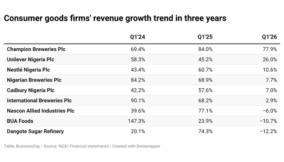
The review, covering 10 leading consumer companies’ first-quarter (Q1) 2026 financial statements, including BUA Foods, Nestle Nigeria, Unilever Nigeria, Nascon Allied Industries Plc, Dangote Sugar Refinery, Nigerian Breweries, International Breweries, Guinness Nigeria, Cadbury Nigeria, and Champion Breweries, shows that combined profit rose to N307.5 billion in the first quarter of 2026, a 19.6 percent increase from N255.2 billion in the same quarter of 2025.
However, revenues remained largely flat, increasing only marginally from N1.76 trillion to N1.78 trillion despite widespread price increases across food, beverages, and household products during the period.
More significantly, trade receivables across the companies surged to N515.3 billion from N423.4 billion, indicating that a growing portion of sales is now being made on credit rather than through immediate cash payments.
At the same time, operating cash flow weakened sharply across several firms, revealing growing pressure on collections and liquidity within the consumer goods value chain.
For analysts, the numbers highlight the hidden reality beneath Nigeria’s FMCG earnings recovery.
“Credit sales are now a survival tool for the sector,” said Uchenna Uzo, professor of marketing at Lagos Business School. “It helps manufacturers keep products in circulation while giving retailers breathing room, even though it exposes companies to higher risks of defaults.”
He added that consumers are not buying in large volumes, as more people are choosing to buy in smaller packs than before.
Inflation is reshaping Nigeria’s consumer economy
The growing dependence on credit sales reflects the deepening pressure facing Nigerian households and businesses following the country’s recent economic reforms and the widening impact of the US-Iran conflict on Nigeria’s import and energy costs.
According to the National Bureau of Statistics (NBS), Nigeria’s annual inflation rate rose to 15.38 percent from 15.06 percent in February, ending an 11-month disinflation trend, according to the NBS CPI report published on April 15, 2026. Transport inflation rose to 16.9 percent year-on-year from 14.7 percent in February, while food inflation accelerated to 14.31 percent from 12.12 percent.
The month-on-month CPI increase of 4.2 percent was the steepest since January 2025, according to FocusEconomics. The Strait of Hormuz blockade, imposed by Iran following US-Israeli strikes that began on February 28, was the principal trigger, disrupting an estimated 20 percent of global oil supply and feeding directly into domestic fuel and logistics costs.
However, industry analysts say the inflation rate for April is expected to rise by 15.60 percent, representing a 22 basis points increase.
Muda Yusuf, chief executive of the Centre for the Promotion of Private Enterprise, said the outlook for April is not favourable. He identified energy shocks linked to the US-Iran conflict as the primary driver, compounded by supply chain disruptions affecting shipping costs and product availability.
“These pressures are global but have direct domestic implications, feeding into cost-push inflation,” he said.
A recent report by the World Bank warned that inflationary pressures and macroeconomic adjustments pushed approximately 140 million Nigerians deeper into poverty in 2025, representing roughly 63 percent of the population.
The impact is becoming increasingly visible within the consumer goods sector.
Distributors who previously purchased inventory upfront are now requesting longer payment terms, retailers are cutting inventory purchases due to slower turnover, and consumers are increasingly shifting toward smaller product sizes or cheaper alternatives.
To sustain sales and defend market share, FMCG manufacturers are increasingly extending credit throughout the distribution chain.
“The consumer market has become extremely liquidity-constrained,” a senior executive at a Lagos-based distribution company said.
“Manufacturers know that if they tighten credit aggressively, volumes will slow even further. So many of them are extending more flexible payment arrangements just to keep products moving.”
The trend is becoming increasingly visible within company financial statements. At Nestlé Nigeria Plc, profit rose to N38.9 billion in the first quarter of 2026 from N30.1 billion in the same period in 2025, while revenue surged to N326.1 billion. Yet cash generated from operations fell sharply to N56.8 billion from N114.3 billion
At the same time, the company’s trade receivables surged almost fivefold to N26.9 billion from N5.4 billion, indicating that the company generated more sales on credit than cash.
At BUA Foods Plc, profit increased to N142.3 billion in Q1’26 from N125.2 billion in Q1’25 despite revenue declining to N394.6 billion from N442.1 billion.
However, cash generated from operations weakened significantly to N8.4 billion from N29.1 billion, while receivables surged to N85.1 billion from N20.4 billion within one year.
At NASCON Allied Industries Plc, trade receivables more than tripled from N17.8 billion to N60.2 billion, while operating cash flow weakened by 58 percent despite improved profitability.
Unilever Nigeria reported a 35.3 percent rise in credit sales to N13.1 billion in Q1, with revenue rising to N59.1 billion from N46.9 billion in the same period of last year.
Tobi Adeniyi, managing director, Unilever Nigeria, speaking at the company’s 2025 annual general meeting, said, “Our trade receivables in absolute value would go up because our revenue has significantly gone up as well. But if we look at it in terms of days, we are actually doing much better than the previous year, operating at very optimal levels.”
Profits are rising, but cash conversion is weakening
In accounting terms, companies can recognise revenue once products are delivered, even if customers have not yet paid.
That means a company can report strong sales and rising profits while actual cash inflows remain weak if collections slow or receivables rise sharply.
Operating cash flow, therefore, becomes one of the clearest indicators of the underlying quality of earnings. What matters ultimately is whether the company is converting sales into cash. If receivables are growing much faster than revenue, it means companies are increasingly depending on credit-driven sales.
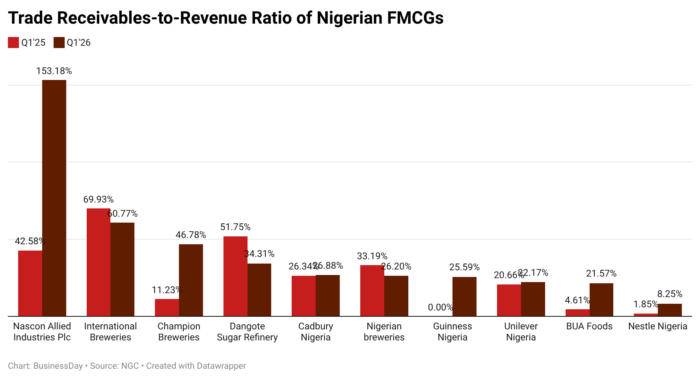
The receivables-to-revenue ratios of several Nigerian FMCGs have risen sharply, indicating growing exposure to credit sales.
At NASCON, receivables in Q1 2026 represented more than 150 percent of quarterly revenue, one of the highest levels within the sector.
International Breweries and Champion Breweries also recorded 60.7 percent and 46.7 percent elevated receivables relative to revenues, reflecting slower collections and greater dependence on trade credit.
By contrast, Nestlé Nigeria Plc maintained one of the lowest receivables-to-revenue ratios among major FMCGs despite the sharp increase in receivables.
The manufacturer’s 8.2 percent receivable ratio suggests that Nestlé converts more sales into cash faster than many peers.
Still, analysts say even stronger companies are not immune to the broader liquidity squeeze affecting the economy.
The trend reflects how inflation is fundamentally reshaping consumption patterns across Nigeria.
Over the past year, manufacturers implemented multiple rounds of price increases to offset rising costs linked to currency devaluation, imported raw materials, higher diesel prices, and elevated borrowing costs.
To keep up, Nigerian Breweries and Guinness Nigeria have rolled out sweeping plans to hike prices of some of their key products as part of a measure to mitigate the surging operating costs.
“As the country’s economic landscape continues to evolve, we want to inform you about an upcoming price adjustment,” Nigerian Breweries said in a letter dated March 13, 2026.
However, consumer incomes have failed to keep pace with inflation.
A consumer market report by Boston Consulting Group’s Africa Consumer Sentiment Survey 2025 disclosed that Nigeria’s consumer economy is under pressure, with 83 percent of households cutting back on discretionary purchases as inflation, weak income growth, and currency instability continue to erode purchasing power
The pullback places Nigeria among the most financially strained consumer markets in Africa, alongside Kenya and South Africa, and highlights the depth of stress facing households across Sub-Saharan Africa.
That pressure is forcing companies into a difficult balancing act.
Nigeria’s private sector slipped into contraction in April 2026, with the Purchasing Managers’ Index (PMI) falling to 49.4 points, marking the first decline in business activity after 16 consecutive months of expansion, according to the Central Bank of Nigeria (CBN).
The CBN stated that “the composite Purchasing Managers’ Index (PMI) for April 2026 stood at 49.4 points, marginally below the 50-point threshold, indicating a slight contraction in aggregate economic activity following sixteen (16) consecutive months of expansion.”
According to the Apex Bank, tight monetary conditions and high interest rates continue to pressure corporate borrowing costs across the economy.
Companies that are unable to generate sufficient operating cash may increasingly rely on short-term financing to support their working capital needs.
Some firms are managing the pressure better than others
Not all companies recorded worsening cash flow trends.
Dangote Sugar Refinery Plc recorded one of the strongest recoveries in operating cash generation, improving from negative N7.9 billion in the first quarter of 2025 to positive N139.5 billion in Q1 2026, while reducing receivables significantly and returning to profitability after years of losses.
Nigerian Breweries Plc also returned to positive operating cash flow N89.2 billion in Q1 after posting negative cash generation of N66.1 billion in the prior year.

Join BusinessDay whatsapp Channel, to stay up to date
Open In Whatsapp