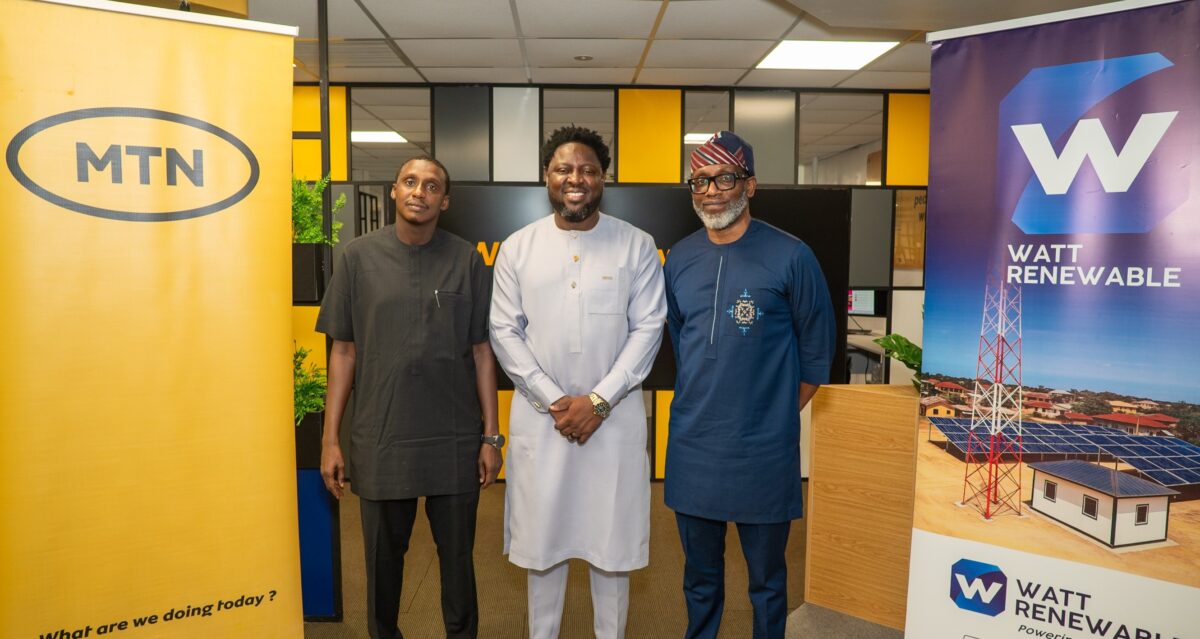
MTN Nigeria has taken a major step towards reducing its reliance on diesel-powered operations, announcing a strategic partnership with First WATT Renewable Limited to deploy large-scale solar and battery energy systems across critical telecommunications facilities nationwide.
The initiative, one of the most significant renewable energy deployments in Nigeria’s telecom sector, will provide approximately 34 megawatts-peak (MWp) of solar photovoltaic generation capacity and 40 megawatt-hours (MWh) of battery energy storage at selected MTN facilities, including data centres, switching centres, cable landing stations and customer service locations.
The partnership comes at a time when rising energy costs continue to pressure telecom operators, which spend hundreds of billions of naira annually on diesel and power generation to keep their networks running amid persistent electricity supply challenges.
The move signals a growing shift by telecom operators towards cleaner and more cost-effective energy sources as they seek to maintain service quality while reducing operating expenses.
Read also: MTN Nigeria leads AI rollout as 13 bots replace 200 SIM registration workers
The project is structured around two key components.
The first is an Energy-as-a-Service deployment that will install solar and battery storage infrastructure at critical MTN sites nationwide. These facilities form the backbone of the operator’s network and support millions of voice, data and financial service transactions daily.
The second component focuses on powering electric vehicle charging infrastructure. Under the arrangement, renewable energy systems will be supplied to support 60-kilowatt EV charging stations across eight MTN locations in Ikoyi, Matori, Ojota, Abuja, Port Harcourt, Asaba, Kano and Ibadan.
The combination of renewable power generation, battery storage and EV charging infrastructure positions the partnership at the intersection of Nigeria’s digital transformation and emerging clean mobility ecosystem.
Beyond reducing diesel consumption, the initiative is expected to improve network reliability by providing a more stable energy source for critical infrastructure. For telecom operators, uninterrupted power remains essential because even brief outages can affect service delivery, customer experience and business continuity.
As Nigeria’s digital economy expands and data consumption rises, the energy requirements of telecommunications networks continue to increase. Data centres, network switching facilities and transmission infrastructure require round-the-clock power to support growing demand for connectivity.
According to the partners, the programme is expected to avoid approximately 25,000 tonnes of carbon dioxide equivalent emissions over five years, subject to operational performance and final emissions assessments.
Speaking on the partnership, Oluwole Eweje, chief executive officer of WATT Renewable Corporation, described the project as a significant milestone for both companies and Nigeria’s energy transition efforts.
Eweje said the deployment of solar photovoltaic systems and battery energy storage infrastructure would strengthen power reliability at locations where uninterrupted operations are critical.
“This partnership is a defining milestone for First WATT and an important step in strengthening the energy infrastructure that supports Nigeria’s digital economy,” he said.
According to him, the EV charging component demonstrates how renewable energy can support the country’s transition towards lower-carbon transportation by ensuring cleaner and more reliable power supply for charging infrastructure.
For MTN Nigeria, the partnership aligns with broader sustainability and operational efficiency objectives.
Tobechukwu Okigbo, chief corporate services and sustainability officer at MTN Nigeria, said renewable energy would play an increasingly important role in building cleaner and more reliable infrastructure as Nigeria’s energy landscape evolves.
He noted that the initiative supports the company’s efforts to reduce diesel dependence, improve operational efficiency and strengthen the resilience of systems that power connectivity services.
“It is also aligned with Project Zero, under our Doing for Planet sustainability pillar, through which we are focused on reducing greenhouse gas emissions, improving energy efficiency, and increasing the use of renewable energy across our operations,” Okigbo said.
The agreement reflects a broader trend across Africa’s telecom industry, where operators are increasingly exploring renewable energy solutions to address rising fuel costs, energy security concerns and environmental commitments.
In Nigeria, energy remains one of the largest operational expenses for telecom companies. Thousands of base stations and network facilities rely on generators due to inadequate grid power, making diesel consumption a major cost burden.
Read also: MTN unbundles MoMo operations in Nigeria, Uganda to unlock new investor capital
The MTN-First WATT partnership therefore represents more than an environmental initiative. It is also a business strategy aimed at lowering long-term energy costs, improving operational resilience and protecting critical digital infrastructure from power disruptions.
The project could also serve as a model for other telecom operators, data centre providers and technology companies seeking alternatives to diesel-powered energy systems.
As Nigeria pushes deeper into the digital economy and prepares for increased demand from technologies such as 5G, cloud computing, artificial intelligence and electric mobility, investments in reliable and sustainable energy infrastructure are expected to become increasingly important.
For MTN, the deployment signals that the future of telecommunications may depend not only on spectrum and fibre networks, but also on securing cleaner and more dependable sources of power to keep the country’s digital ecosystem running.


Join BusinessDay whatsapp Channel, to stay up to date
Open In Whatsapp