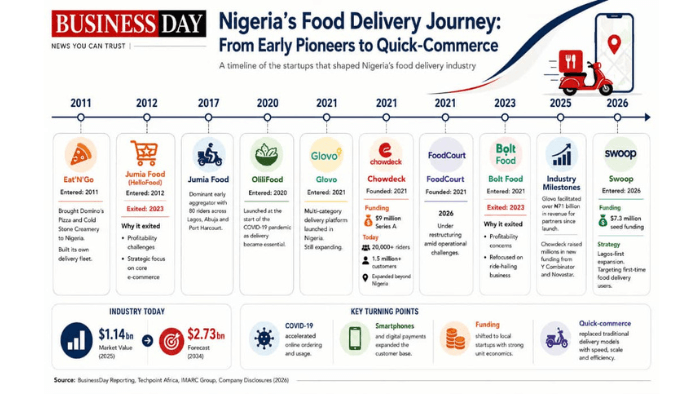
On paper, Nigeria’s online food delivery business should be one of Africa’s biggest technology success stories.
Industry estimates show the market reached $1.14 billion in 2025 and is projected to grow to $2.73 billion by 2034, expanding at a compound annual growth rate (CAGR) of 9.86 percent.
Rapid urbanisation, rising smartphone penetration, digital payments and a young population increasingly comfortable with online services continue to fuel expectations that ordering meals with a few taps on a smartphone will become an everyday habit.
For investors, the logic appears irresistible. People eat every day. Cities are becoming more congested. Young professionals are spending longer hours at work. Digital payments are becoming commonplace. Food delivery, on the surface, seems like a business with almost limitless demand.
Yet beneath the impressive projections lies a very different reality.
Over the past decade, Nigeria’s food delivery industry has produced as many business casualties as success stories. International brands with deep pockets have entered the market only to retreat.
Local startups have struggled with rising operating costs, restructuring and unpaid obligations. Even companies reporting rapid growth continue to battle a question that has haunted the sector since its emergence: Can food delivery become consistently profitable in Nigeria?
The answer lies in a contradiction that defines the industry today.
Demand is growing. Convenience is becoming part of urban culture. But making money remains remarkably difficult.
Unlike software companies that can scale with relatively little additional cost, food delivery is a logistics business disguised as a technology company.
Every order requires a rider, fuel, packaging, customer support, payment processing and real-time coordination between restaurants and customers. Each additional order generates additional costs, making profitability far more complicated than simply increasing the number of users.
That reality has humbled some of the industry’s biggest players.
Market growth hasn’t produced market winners
Nigeria’s modern food delivery business gathered momentum during the COVID-19 pandemic, when lockdowns accelerated demand for contactless shopping and home deliveries.
International operators saw opportunity.
Jumia Food, originally launched as HelloFood around 2012, spent years building one of the country’s largest restaurant delivery networks.
Bolt Food entered the market in 2021, hoping to leverage its ride-hailing ecosystem to capture urban consumers looking for speed and convenience.
Neither remained. By late 2023, Jumia shut down its food delivery operations across several African markets, including Nigeria, saying the business no longer aligned with its long-term strategy as it sought to concentrate resources on its core e-commerce operations.
Bolt Food also exited Nigeria, choosing to refocus on its ride-hailing business after struggling to achieve the scale and profitability investors had hoped for.
More recently, FoodCourt, once celebrated for its cloud-kitchen model, entered a difficult period marked by operational disruptions, unpaid salaries and vendor complaints before announcing a restructuring programme aimed at stabilising the business.
Their exits tell a story that glossy market projections rarely capture. Growing demand does not automatically produce profitable businesses.
Yet, even as some of the industry’s biggest names retreated, new investors are still betting that Nigeria’s food delivery market has room to grow.
One of the newest entrants is Swoop, an Eswatini-born startup that launched operations in Lagos in 2026 after raising $7.3 million in seed funding from international investors. The company is taking a different approach from earlier entrants, focusing first on Lagos before expanding across Nigeria and eventually the continent.
Demola Adesina, Swoop’s country manager, told BusinessDay that Nigeria represents the company’s most strategic market because success here would provide the operational scale and credibility needed for expansion across Africa.
“We are number one in Eswatini today, and our goal is to become number one in Nigeria. If we succeed here, expansion across Africa becomes much easier,” Adesina said.
Rather than seeing existing players as its biggest competitors, Adesina said Swoop is targeting Nigerians who have never used food delivery services before. “Our competition is not another app. Our competition is walking downstairs to buy food,” he said.
For many consumers, paying a delivery fee of a few thousand naira appears straightforward.
Behind every successful delivery, however, sits a complex cost structure that continues to squeeze operators.
Food delivery platforms typically earn between 15 percent and 30 percent commission from restaurants while charging customers separate delivery and service fees.
In theory, those revenues should cover operational expenses. In practice, they often do not.
Every order requires fuel, motorcycle maintenance, rider incentives, payment processing, customer support and technology infrastructure. If traffic delays deliveries or restaurants prepare meals late, costs rise further. Refunds, discounts and promotional campaigns designed to attract customers eat further into already thin margins.
Analyses of earlier Jumia Food operations showed that fulfilment costs frequently exceeded revenue generated from commissions, meaning the company lost money on individual orders despite processing thousands of deliveries.
The industry describes this as a unit economics problem, a situation where every additional sale contributes little or nothing to profitability.
Inflation has made those calculations even more difficult. The removal of petrol subsidies, higher transportation costs and persistent naira depreciation have significantly increased operating expenses across the logistics chain.
Packaging materials have become more expensive. Motorcycle spare parts cost more. Fuel prices fluctuate.
Consumers, meanwhile, are becoming increasingly sensitive to price, due to harsh economic.
That tension is changing not only how companies operate but also who actually uses food delivery services.
Industry leaders say the struggles facing food delivery platforms mirror the broader challenges confronting Nigeria’s digital economy.
Leo Stan Ekeh, chairman of Zinox Group, believes weak consumer spending has become the biggest obstacle to e-commerce businesses, including online food delivery.
According to him, households whose purchasing power has been eroded by inflation are increasingly prioritising essential expenses over discretionary purchases.
“The success of e-commerce depends on the economy. When people are confident enough to spend, the sector will perform much better,” Ekeh told BusinessDay.
Beyond weakening demand, he noted that operators are battling soaring operating costs that continue to erode already thin margins.
“Every business expects returns not only to survive but also to expand and keep pace with the changing dynamics of the industry. Otherwise, it dies,” he said.
Read also: Nigeria’s private sector expands for fifth straight month despite inflation pressures
The real customers are changing
Contrary to the assumption that food delivery appeals equally to everyone, interviews with consumers suggest the industry’s strongest customer base is becoming increasingly concentrated among young urban professionals.
For many members of Generation Z and younger millennials living alone, ordering food is no longer considered a luxury.
It is often a practical economic decision.
After spending hours commuting through Lagos traffic and returning home late from work, cooking for one person can become both expensive and time-consuming.
Buying ingredients in small quantities is rarely economical, while preparing balanced meals after long working hours is often unrealistic.
“I don’t order because I am trying to show off. Sometimes I am leaving the office around 7 p.m. By the time I get home, I am exhausted. Ordering a meal for N5,000 is actually cheaper than buying different ingredients, cooking for one person and wasting what I don’t finish. For people like me, the apps save both time and money,” said Tunde Adeyemi, a 29-year-old marketing executive in Ikeja, who spoke with BusinessDay.
For Adeyemi, convenience has become part of modern city living rather than an occasional indulgence.
He still cooks on weekends but estimates that food delivery accounts for several weekday meals every month.
That behavioural shift explains why investors remain optimistic despite the industry’s difficult economics.
The habit of ordering food online has become deeply embedded among many young Nigerians entering the workforce.
It is a cultural shift that may prove more durable than temporary economic cycles.
While young professionals continue to embrace food delivery, the economics change almost immediately when households begin to grow.
For newly married couples without children, food delivery often remains part of their lifestyle. Long working hours, demanding careers and limited time at home make ordering meals an attractive alternative to cooking after a stressful day.
Funke and Dele Mensah, both corporate professionals working in Lagos, told BusinessDay that food delivery still features in their routine, though not as frequently as before.
“During the week, we sometimes get home late and we are simply too tired to cook. On weekends, if we want to relax or spend time together, ordering food makes sense. You are paying for convenience more than anything else,” Funke said.
Her husband agrees. “When you are newly married and it is just the two of you, it doesn’t always make financial sense to buy different ingredients just to prepare one meal. Sometimes ordering is actually the easier option,” Dele said.
That calculation changes dramatically once children enter the picture.
Families with young children told BusinessDay they now cook most of their meals, not only because it is cheaper but because they have greater control over nutrition, portion sizes and food quality.
For them, food delivery has become an occasional luxury rather than an everyday service.
“When you have children, you are no longer thinking about feeding just two adults. You have to prepare balanced meals, think about vegetables, protein and what the children are eating. Ordering food for five people several times a week is simply too expensive. We only eat at eateries once in a while, when i feel like taking my family out. I don’t have delivery apps in my phone. I would rather drive to an eatery where we will all sit as family and eat,” said Ngozi Adebayo, a finance manager and mother of three living in Lekki.
Her experience reflects a broader shift in consumer behaviour.
As household sizes increase, convenience gradually gives way to economics. Cooking at home offers larger portions, healthier meal planning and significantly lower costs per person than ordering through an app.
That does not mean demand for food delivery disappears. Instead, it becomes more targeted.
Industry analysts say this is one of the biggest misconceptions about the sector. The future market may not be built around every Nigerian household ordering dinner every evening. Rather, it will depend on young professionals, students, dual-income couples and busy urban workers who place a premium on saving time.
“The market is finding its natural customer. Food delivery was never going to replace home cooking in Nigeria. It complements it,” said a consumer behaviour analyst who follows digital commerce trends.
Restaurants are recalculating their business models
Restaurants have also learned difficult lessons.While delivery platforms expose them to thousands of potential customers, the commissions charged by aggregators continue to squeeze already narrow margins.
Chinedu Eze, who owns restaurants in Lagos, said digital platforms have become an important marketing channel, but profitability remains challenging.
“They definitely increase visibility. Young people discover our restaurants through the apps. But when you are paying 20 percent to 30 percent commission, your margin shrinks immediately. Sometimes we are selling more food but making less money,” he said.
Many restaurant owners are responding by encouraging repeat customers to order directly through WhatsApp, Instagram or their own websites, reducing dependence on third-party platforms.
Others have adjusted menu prices on delivery apps to offset commission costs, although this sometimes discourages price-sensitive customers.
“The customer compares prices. If they notice that a meal costs more on an app than in the restaurant, some decide to pick it up themselves,” Eze said.
That trend is forcing delivery companies to rethink how they create value beyond simply connecting restaurants with customers.
Read also: Food Security: Nigeria seeks Israel’s support to strengthen agriculture, education, others
Riders carry the hidden cost of convenience
If customers pay the visible cost of delivery, riders absorb much of the hidden cost.
Every delay caused by traffic, flooding or poor road conditions reduces the number of deliveries they can complete in a day.
Fuel price increases directly affect their income, while motorcycle maintenance continues to become more expensive.
A rider operating in Surulere, who asked not to be named, described the work as increasingly unpredictable.
“Some days are very good, other days, traffic, rain and fuel finish everything. Customers want fast delivery, restaurants blame riders for delays, and riders also carry the pressure,” he told BusinessDay.
Lagos’ rainy season creates additional challenges. Flooded roads slow deliveries, increase accident risks and often lead to cancelled orders.
For businesses operating on already thin margins, every cancelled delivery represents another financial loss.
Investors still see opportunity
Despite repeated exits, investor confidence has not disappeared. Instead, it has become more selective.
Companies such as Chowdeck have demonstrated that disciplined expansion, strong operational controls and a relentless focus on unit economics can produce better outcomes than rapid expansion alone.
Rather than entering every city at once, the company has focused on building dense delivery networks, shortening delivery times and improving operational efficiency before expanding into new markets.
That approach has attracted investor confidence, including a $9 million Series A funding round, while helping the company build operations across Nigeria and Ghana.
For venture capital investors, the lesson is becoming increasingly clear. The next generation of winners will not be the companies offering the biggest discounts or chasing the highest number of downloads.
They will be the businesses that understand every naira spent on every order.
Read also: FoodCourt’s operational pause signals mounting pressure on Nigeria’s food-tech startups
Looking forward
The exits of Jumia Food and Bolt Food, together with the restructuring of FoodCourt, demonstrate that scale alone is not enough to build a sustainable food delivery business in Nigeria. Yet the arrival of Swoop, alongside the continued expansion of Chowdeck, suggests investors have not abandoned the market. Instead, they are backing operators that promise tighter execution, stronger localisation and healthier unit economics.
If inflation moderates, consumer purchasing power improves and operators continue refining their logistics models, Nigeria’s food delivery market could still realise its projected $2.73 billion potential by 2034, Jide Awe, a tech analyst told BusinessDay.
“The future of the industry is therefore unlikely to be defined by whether Nigerians stop ordering food online. Rather, it will depend on whether platforms can profitably serve a generation of young urban consumers who increasingly value convenience while balancing the interests of restaurants, riders and investors,” he advised.
In that sense, Nigeria’s food delivery story is not one of decline. It is one of evolution. The pioneers built the market, the casualties exposed its weaknesses, and a new generation of operators is now attempting to prove that convenience can, eventually, become a profitable business.


Join BusinessDay whatsapp Channel, to stay up to date
Open In Whatsapp