Nearly five years after Nigeria conducted one of Africa’s biggest 5G spectrum auctions, the country’s next-generation mobile revolution remains concentrated in a handful of cities, leaving billions of dollars in investments waiting for returns and delaying the wider economic gains government hoped would come from faster broadband.
The challenge is no longer simply about allocating radio spectrum.
Instead, industry executives, regulators and analysts say the bigger obstacles lie beneath the surface: inadequate fibre infrastructure, high deployment costs, expensive 5G smartphones, inconsistent Right of Way (RoW) policies across states, unreliable electricity and the enormous capital required to build nationwide networks.
The result is that while government has generated significant revenue from spectrum sales and operators have committed billions of naira to network expansion, the broader digital economy dividend expected from 5G remains largely unrealised.
For a country targeting a $1 trillion economy and positioning technology as a major growth engine, the delay is becoming an economic issue as much as a telecommunications challenge.
Read also: N75bn licence fee, frequency shortage, threaten 5G rollout in Nigeria
Billions committed, slower returns
Nigeria became one of Africa’s early 5G adopters after auctioning licences in the 3.5GHz spectrum band.
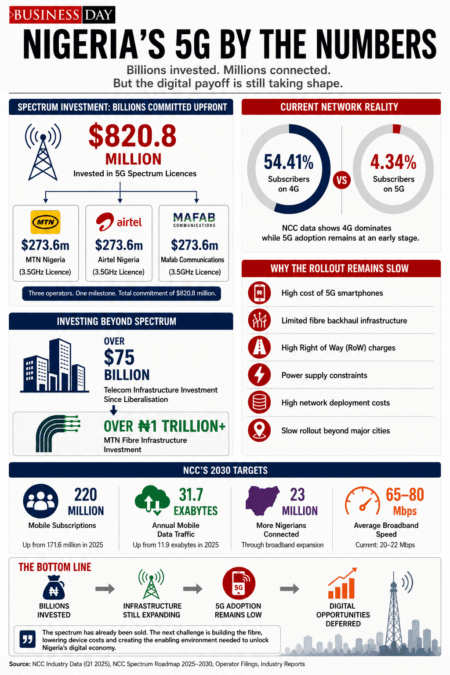
MTN Nigeria and Airtel Nigeria each paid about $273.6 million for 3.5GHz spectrum licences, while Mafab Communications also secured spectrum rights, bringing total commitments for the licences to about $820.8 million, according to industry records and NCC licensing information.
The auctions were widely regarded as a major milestone, generating substantial revenue for government while positioning Nigeria among Africa’s leading 5G markets.
Since then, operators have expanded 5G services to more than 150 cities and urban centres.
Yet nationwide deployment has progressed much more slowly than expected.
Large sections of Nigeria continue to depend on 4G networks, while millions of consumers remain outside effective 5G coverage.
The slow pace of adoption is evident in the NCC’s latest industry figures, which show that 54.41 percent of Nigerian mobile subscribers remain on 4G networks, while just 4.34 percent are connected to 5G despite years of investment in next-generation infrastructure.
Rather than generating rapid returns, much of the capital invested in spectrum and network deployment is taking longer to produce meaningful commercial value.
Government’s opportunity cost
The implications extend beyond telecom operators.
The Nigerian Communications Commission (NCC) notes in its Draft Spectrum Roadmap 2025–2030 that the ICT sector contributed 17.68 percent to Nigeria’s Gross Domestic Product as of late 2024, while telecommunications alone accounted for 14.4 percent.
The Commission also estimates that more than $75 billion has been invested in Nigeria’s telecommunications infrastructure since sector liberalisation.
Those figures underline how central telecommunications has become to economic growth.
Analysts say delays in nationwide 5G deployment risk postponing the next phase of productivity gains expected across manufacturing, financial technology, healthcare, agriculture, education, logistics and digital government services.
Industry reports also suggest that slower 5G adoption delays growth in telecom revenues, which could in turn postpone increases in Company Income Tax, Value Added Tax and other government revenues generated from expanding digital services.
Rather than representing direct financial losses, economists describe these as deferred economic opportunities, benefits that arrive later because the underlying infrastructure is not yet fully in place.
The fibre problem beneath the towers
For many industry executives, spectrum itself is no longer the biggest challenge.
Tobe Okigbo, MTN Nigeria’s chief corporate services and sustainability officer, says the real constraint lies underground.
According to him, 5G cannot function effectively without extensive fibre infrastructure connecting thousands of base stations to core internet networks.
He disclosed that MTN has committed more than N1 trillion to expanding its Fibre-to-the-Home (FTTH) infrastructure because fibre remains the foundation upon which high-capacity mobile broadband depends.
Okigbo explained that operators face enormous physical deployment requirements and lengthy investment recovery periods.
Combined with inflation, foreign exchange volatility, rising diesel prices and increasing operating costs, these realities naturally push operators to prioritise commercial centres where demand is highest and returns are more predictable.
“The economics have to work,” industry executives say, noting that building nationwide fibre networks requires years of sustained investment.
Why 5G remains concentrated in cities
Yahaya Ibrahim, MTN chief technical officer, says the concentration of 5G in Lagos, Abuja and other commercial hubs reflects technical realities rather than a lack of willingness by operators.
According to him, deploying expensive 5G infrastructure into locations where consumers own few compatible devices makes little commercial sense.
Industry estimates cited during stakeholder engagements indicate that Nigeria currently has about 4.9 million 5G-compatible smartphones despite having more than 170 million mobile subscriptions.
Ibrahim explained that 5G was designed to support extremely high data volumes generated by cloud computing, artificial intelligence, ultra-high-definition video streaming and other bandwidth-intensive applications.
He noted that MTN’s network already carries more than 25 petabytes of traffic every day, requiring dense fibre-connected infrastructure that is economically viable primarily in areas with heavy digital usage.
Industry analyses further suggest that substantial coverage gaps remain even in major cities, highlighting how infrastructure expansion continues to lag growing demand.
For instance, In Nigeria’s two biggest commercial hubs, Lagos and Abuja, the 5G network coverage gap stands at roughly 55.4 percent and 47.4 percent respectively. Tens of thousands of users possessing 5G-ready smartphones are actively blocked from using the network, cutting telcos off from high-tariff premium data revenue.
Read also: Data boom, 5G rollout lift telecoms to N18.5tn GDP mark in 2025
Device affordability slows adoption
Network coverage alone is not enough.
Dinesh Balsingh, Airtel Nigeria, chief executive officer believes affordability has become one of the biggest barriers to wider adoption.
“5G is not only about telecom infrastructure. It is an ecosystem where devices and networks must come together. Rolling out the network is important, but it’s just as crucial to ensure that consumers have access to 5G-enabled phones,” he said.
Industry reports estimate that entry-level 5G smartphones currently cost between N160,000 and N250,000, placing them beyond the reach of many Nigerians despite the increase in the national minimum wage.
To address the problem, Balsingh said Airtel is engaging global device manufacturers. “We are actively talking to device manufacturers. We are exploring ways to bring down the cost of a 5G device, how we can re-engineer the components, and how we can partner with them.”
Without cheaper smartphones, analysts believe network expansion alone will not significantly increase consumer adoption.
Infrastructure challenges remain
Beyond handset costs, operators continue to battle multiple structural obstacles.
Industry stakeholders cite, fibre cuts, high Right of Way charges imposed by some state governments, delays in obtaining permits, unreliable electricity supply, heavy dependence on diesel-powered base stations and foreign exchange volatility affecting imported telecom equipment.
Analysts also estimate that operators continue to face significant additional capital expenditure as they expand fibre backhaul, deploy thousands of additional base stations and modernise network infrastructure needed to support widespread 5G adoption.
These investments are occurring at a time when operators are also managing rising operating costs and pressure to maintain affordable services.
NCC’s roadmap seeks a reset
Recognising those realities, the NCC has shifted its attention beyond spectrum auctions.
Its Draft Spectrum Roadmap for 2025–2030 proposes releasing additional spectrum in the 450MHz, 600MHz, 6GHz and 60GHz bands to improve rural broadband and urban network capacity.
The roadmap targets broadband expansion to about 23 million Nigerians living in 87 unserved and underserved clusters.
It projects that active mobile subscriptions will rise from 171.6 million in 2025 to about 220 million by 2030, while national mobile data traffic is expected to almost triple from 11.9 exabytes to 31.7 exabytes during the same period.
The strategy is built around four pillars: bridging the digital divide, encouraging market-driven investment, improving quality of service and creating a regulatory environment that supports innovation through measures such as regulatory sandboxes and flexible spectrum management.
Aminu Maida. NCC executive vice chairman, described the roadmap as creating “a transparent, predictable and enabling regulatory environment that supports investment, encourages innovation, expands access and improves service quality for all Nigerians.”
He said the framework aligns spectrum management with Nigeria’s broader digital economy ambitions while helping bridge the country’s connectivity gap.
Read also: 5G rollout fails to deliver revenue for mobile operators
Beyond towers: Building the ecosystem
Idris Ibikunle Olorunnimbe, the commission’s chairman, believes solving the affordability challenge will require more than network expansion.
Speaking during the Digital Africa Summit Roundtable in Shanghai, he invited global smartphone manufacturers to establish production facilities in Nigeria, promising to seek presidential waivers and incentives for companies willing to begin construction before November.
“If any manufacturer in this room, or any manufacturer listening to these proceedings, will commit to building a factory in Nigeria… I will take that commitment to the President myself and seek the waivers and the support you need to make it happen,” he said.
According to him, local manufacturing would reduce dependence on imported devices and cushion consumers from exchange-rate volatility.
“When a device is built with Nigerian raw materials and Nigerian labour, more of its cost is denominated in naira. It stops rising and falling with every move in the dollar.”
He added that Nigeria would not compromise on quality. “The aim is to build phones in Nigeria that match the imported phones on quality and beat them on price. A locally made device that asks Nigerians to settle for less is not worth making.”
Olorunnimbe also linked affordable devices to the Commission’s push for zero-rated educational platforms, arguing that locally manufactured smartphones could support digital learning and wider access to government services.
Execution now matters more than auctions
For years, Nigeria’s telecom conversation centred on who won spectrum licences.
Today, the bigger question is whether government and industry can build the ecosystem needed to unlock their value.
Analysts say spectrum alone cannot deliver digital transformation.
Without faster fibre deployment; full implementation of the Critical National Information Infrastructure (CNII) to reduce fibre; harmonised Right of Way policies, stable electricity, affordable smartphones and sustained capital investment, the economic benefits of 5G will continue to arrive more slowly than policymakers and investors anticipated.
For government, that means waiting longer for stronger digital tax revenues, greater productivity gains and broader economic expansion.
For operators, it means taking more time to recover hundreds of millions of dollars invested in spectrum licences and billions of naira committed to network infrastructure.
And for millions of Nigerians, it means waiting longer for the faster broadband needed to power artificial intelligence, cloud computing, digital healthcare, precision agriculture, online education and the next generation of digital businesses.
The spectrum has already been sold. The bigger challenge now is ensuring Nigeria builds everything else needed to make it pay.


Join BusinessDay whatsapp Channel, to stay up to date
Open In Whatsapp