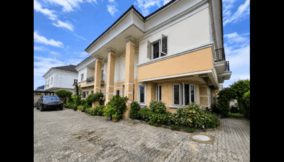
Recent data on rental yields in real estate submarkets of Lagos Island has shown that, contrary to assumptions, especially among investors, the highest-priced neighbourhoods are not the highest-return markets.
The data, compiled by Stears, a financial data and research provider, shows the Lekki corridor leading rental yields with Chevron axis of city recording 5.85 percent, while Ikoyi trails at 3.09 percent.
Other submarkets also give higher yields than Ikoyi which is clearly the most upscale and highest-priced neighbourhood in Lagos. They are Lekki Phase 1, 3.95 percent; Osapa London, 4.28 percent; Victoria Island: 4.59 percent; Oniru, 4.88 percent; Ikota Elegushi, 5.02 percent, and Chevron, 5.85 percent.
These findings challenge the assumption that prestige locations automatically translate into better investment returns. The findings also show that even though Ikoyi is Lagos most expensive address, it delivers the lowest rental yield.
Similarly, a recent Lagos Island Residential Market Report 2026 by Lagos Realty, which tracked residential rental prices, sales values and land costs across Ikoyi, Victoria Island, Lekki Phase 1 and Ikate between 2022 and 2026, affirms Lekki Phase 1 as the strongest-performing rental market.
The report shows that while Ikoyi remained Lagos Island’s premium residential market by rental, home sale and land values, Lekki Phase 1 recorded the strongest rental growth over a five-year period, highlighting sustained demand for residential properties in the neighbourhood.
The area leads other locations in residential rental market growth, recording approximately 36 percent compound annual growth rate over the last five years, and an average of N10 million per annum for a two-bedroom apartment, which is the highest in five years.
As against the area’s five-year rent compound average growth rate (CAGR) of 35.9 percent, Victoria Island has 33.5 percent, ahead of Ikate’s 29.6 percent and Ikoyi’s 22.6 percent.
Read also: Lekki Phase 1 leads residential rental market growth as yearly rent hits N10m
The report notes, however, that, despite the stronger growth, Ikoyi remained the most expensive rental market, with the average annual rent for a two-bedroom apartment at N17.25 million, followed by Victoria Island, N15 million, Lekki Phase 1, N10 million, and Ikate, N8.5 million.
Adebayo Folarin, an estate manager, affirmed that, for investors, this area is an irresistible destination as it has Lagos Island’s most liquid rental market, supported by the broadest renter base and highest transaction volumes.
This is because, in the last five years, average annual rents for one-bedroom apartments have risen from N2.5 million in 2022 to N7.5 million in 2026. Two-bedroom rents increased from N4 million to N10 million, while three-bedroom apartments climbed from N5 million to N15.5 million, representing a five-year CAGR of 32.7 percent.
Four-bedroom apartment rents rose from N5.5 million to N21.5 million, while five-bedroom units increased from N6.5 million to N25.7 million.
Over all, rent in Lagos has seen outrageous increases. Chudi Ubosi, principal partner at Ubosi Eleh & Company, confirmed to BusinessDay that, in the last 24 months, the rental market has recorded 50-200 percent increase, mostly in the residential market, blaming the increases on inflation and building materials costs which have pushed up construction costs.
Cement, for instance, has seen unimaginable price increase in the last 12 months, rising from between N7,700 and N9,000 for a 50kg bag by the second quarter of 2025 to its current retail price of between N12,500 and N15,000 in markets across Lagos, Abuja, and Abia, depending on location.
Close market watchers worry that, even though Nigeria produces a surplus of 25–30 million tonnes of cement annually, local prices are nearly double the African average, questioning why cement costs have remained aggressively high despite stabilization in other macroeconomic factors.
Fortren & Company’s recent findings show that Nigeria’s construction costs rose by 20 percent between December 2025 and May 2026 due to higher material and energy prices.
Martin Uche, the company’s Research Director and CEO, explained that, besides inflation and other macroeconomic factors, rising freight costs linked to the Iran-Israel conflict pushed up the prices of cement, steel and finishing materials, forcing some developers to delay projects, renegotiate contracts or scale back project specifications.
All these have compounded housing problems in Nigeria’s major cities, especially Lagos, which has an estimated three million housing units’ deficit. This partly explains why the city remains an active rental market where rent increases in recent time have pushed many residents out of the city centre due to affordability issues.
Analysts note that, though this is a dire situation for renters, it also presents a huge opportunity for investors who are out looking for good returns on their investment, and also looking for that part of the city where real estate actually turns property value into investor returns.

Join BusinessDay whatsapp Channel, to stay up to date
Open In Whatsapp