A long-awaited check to the gas suppliers
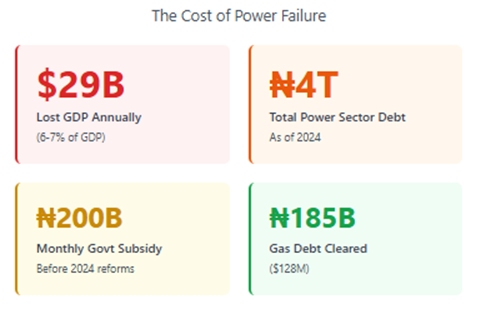
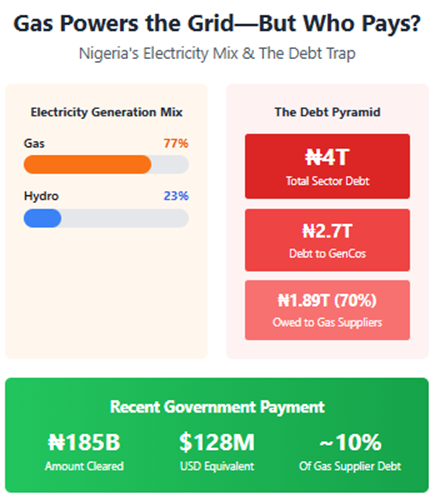
Few issues define Nigeria’s economic story more sharply than electricity. Unreliable power costs Nigeria around $29 billion annually in lost economic activity. The federal government’s recent decision to approve the payment of ₦185 billion in long-standing debts owed to gas producers has been widely welcomed as a decisive step to restore confidence in the gas-to-power value chain. The question is whether this marks the beginning of a structural fix or just another brief uptick in a chronically unstable system.
Gas at the heart of an unbalanced system
Gas fuels roughly 77 per cent of Nigeria’s grid electricity generation. When gas suppliers are not paid, they cut back deliveries. Industry estimates put cumulative debts to power generators at around ₦2.7 trillion by late 2024, with much of that burden linked to gas supply. Clearing a portion of this backlog is an attempt to unblock the first artery in a clogged circulatory system. But history suggests caution: the Nigerian power market’s problems run much deeper than arrears.

Read also: REA partners NBS on national energy survey to boost electricity access
A sector that is structurally insolvent
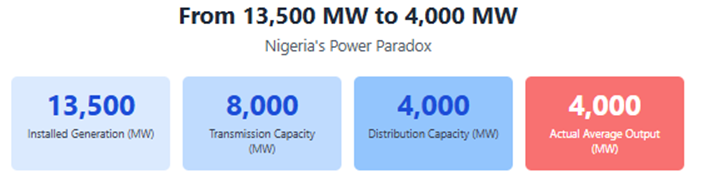
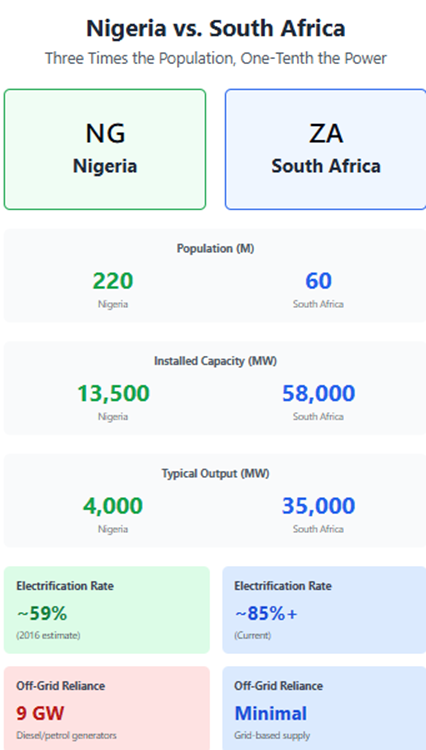
Nigeria’s power market is structurally unbalanced. While installed grid generation capacity is around 13,500 MW, actual power sent out averages closer to 4,000 MW. The sector is trapped in a circular failure: DisCos fail to collect enough revenue because tariffs are below cost-reflective levels; GenCos receive only partial payments and cannot service obligations to gas suppliers. Even after a targeted tariff increase in 2024, the government still faced an estimated tariff shortfall of ₦1.9 trillion in 2025. In such an environment, paying ₦185 billion in gas debts is an important signal but not a definitive cure.
The politics of price and the economics of trust
At the core of the dysfunction sits the political economy of electricity pricing. Tariffs need to reflect the true cost of supply, but reform is politically explosive amidst high inflation. The move towards “banded” pricing has generated additional revenue, yet many customers complain that service quality remains patchy. An economically sustainable tariff regime, therefore, requires improvements in supply reliability and credible regulation. Without a restoration of trust, price reforms will continue to be politically explosive and only partially implemented.
“An economically sustainable tariff regime, therefore, requires improvements in supply reliability and credible regulation. Without a restoration of trust, price reforms will continue to be politically explosive and only partially implemented.”
Transmission: the weak spine of the grid
Even if gas supply improves, the system may still fail due to transmission constraints. Nigeria’s transmission grid is outdated and vulnerable to frequent collapses. Despite an installed generation capacity of about 13,500 MW, Nigeria typically produces only about a third of that. The result is the paradox of “available but undeliverable” electricity. Gas payments do little to address this structural weakness.
Pipelines, insecurity and the geography of risk
A third constraint is security. Nigeria’s gas infrastructure is vulnerable to vandalism, theft, and community-related disruptions across often insecure terrain. Settling arrears may improve balance sheets, but it does not change the on-the-ground realities of policing critical infrastructure. Without sustained improvements in security, gas will remain a risky business, and the cost of that risk will ultimately be reflected in power tariffs.
Metering, losses and the problem of invisibility
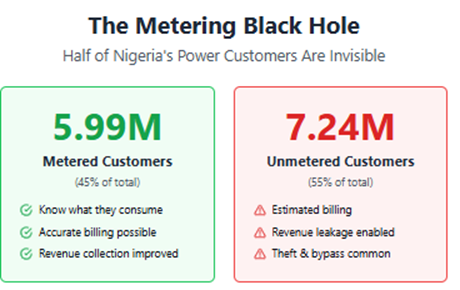
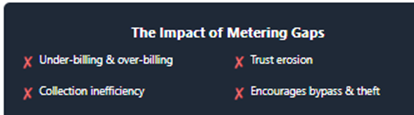
The metering gap is another fault line. As of mid-2024, more than half of registered customers were still on estimated billing. This creates an awkward mix of under-billing and over-billing that erodes trust and encourages theft. Without full metering and stronger enforcement, it will be difficult for DisCos to reach the collection levels needed to sustain the value chain, regardless of gas debt payments.
The silent generator economy
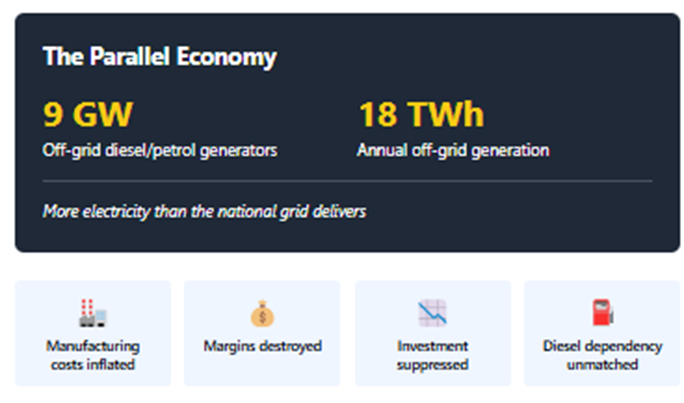
The most striking indictment of Nigeria’s grid is the rise of its parallel generator economy. Nigeria operates roughly 9 GW of backup diesel and petrol generation capacity—more than the grid itself delivers. Businesses and households pay a steep premium for this self-help solution. If the grid remains unreliable, firms will continue to invest in private generation rather than expand grid-connected operations.
What meaningful reform would require
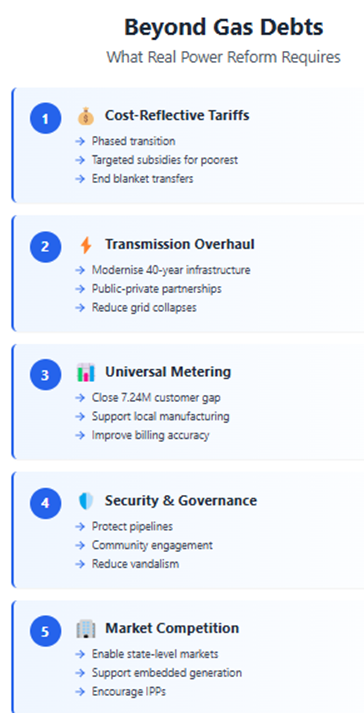
Real power reform would move beyond episodic bailouts. It would combine a phased transition to cost-reflective tariffs with targeted subsidies for the poorest households. It would prioritise serious investment in transmission and distribution infrastructure, accelerate metering programmes, and create regulatory stability to encourage independent power producers. Perhaps most importantly, it would confront the security and governance challenges surrounding pipelines and utility management. Without this, financial injections will act as short-lived stimulants.
Read also: States move cautiously on electricity autonomy amid funding, capacity gaps
A richly endowed country running on fumes
Nigeria holds some of the world’s largest gas reserves and considerable renewable potential. Yet it generates less than a tenth of South Africa’s electricity output. In the short term, settling gas debts should help stabilise gas flows and may lead to modest improvements. But unless Nigeria confronts the structural failures in pricing, transmission, metering, security and governance, the country will continue to oscillate between brief improvement and prolonged dysfunction. Paying off gas debts is a welcome step, but it is only a step. Without a comprehensive overhaul, the system will keep burning cash, and Nigerians will keep burning diesel.
Dr Oluyemi Adeosun, Chief Economist, BusinessDay.

Join BusinessDay whatsapp Channel, to stay up to date
Open In Whatsapp