


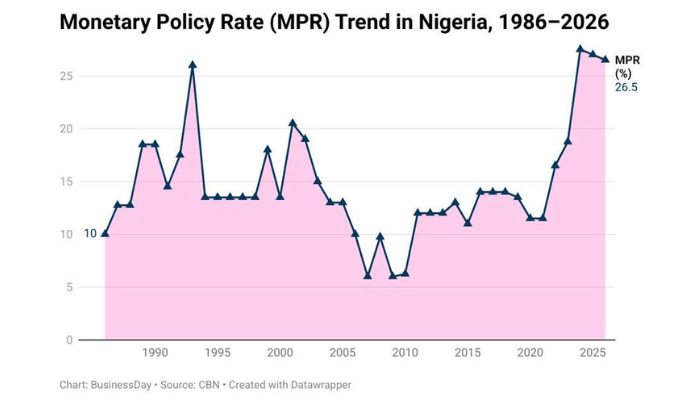
On May 20, 2026, the Central Bank of Nigeria left its benchmark interest rate unchanged at 26.5 percent, pausing one of the most aggressive tightening cycles in the country’s history. The decision followed a cumulative 1,600-basis-point increase in the monetary policy rate between 2022 and 2024, before modest rate cuts in late 2025 and early 2026.
The pause raises a familiar question: why does Nigeria keep fighting the same inflation battle? For more than four decades, monetary policy has been repeatedly redesigned to deliver price stability, exchange-rate stability and economic growth. The frameworks have changed. The governors have changed. Yet inflation has survived every regime.
“Rather than build a stronger agricultural base, expand non-oil exports and create fiscal buffers, policymakers relied on controls to manage symptoms while the economy remained vulnerable.”
World Bank data show that inflation averaged about 16 percent between 1960 and 2024, peaking at 72.8 percent in 1995 and rising above 30 percent again in 2024. Has monetary policy failed? Not quite. Nigeria’s challenge has rarely been a shortage of monetary tools. Rather, it has been the expectation that interest rates could solve problems rooted in fiscal deficits, weak productivity, exchange-rate distortions, insecurity and external shocks. That is the real story of Nigeria’s inflation battle.
Muda Yusuf, chief executive officer of the Centre for the Promotion of Private Enterprise (CPPE), argues that many of Nigeria’s inflationary pressures originate from structural and supply-side constraints rather than excess liquidity. According to him, factors such as insecurity, logistics bottlenecks, energy costs and exchange-rate volatility often exert greater influence on prices than monetary conditions alone.
Bismarck Rewane, chief executive officer of Financial Derivatives Company, has similarly argued that monetary tightening cannot fully resolve inflation driven by food supply disruptions, energy costs and exchange-rate pass-through effects. In such circumstances, higher interest rates may slow demand, but they cannot eliminate the underlying sources of inflation.
The era of direct controls
Before the Structural Adjustment Programme of 1986, Nigeria relied on administrative controls to manage monetary policy. The CBN regulated interest rates, imposed credit ceilings and directed lending to sectors such as agriculture and manufacturing. The approach appeared effective during the oil boom of the 1970s, when rising crude revenues supported growth and government spending. But the stability was largely built on oil. Credit allocation was driven by regulation rather than efficiency, while low interest rates discouraged savings.
When oil prices collapsed in the early 1980s, the weaknesses became obvious. Government revenues fell, foreign exchange earnings weakened and inflation surged to nearly 40 percent in 1984, according to CBN data. The verdict is straightforward. Direct controls could direct credit, but they could not create productivity, diversify the economy or shield Nigeria from oil shocks. The missed opportunity was the oil boom itself. Rather than build a stronger agricultural base, expand non-oil exports and create fiscal buffers, policymakers relied on controls to manage symptoms while the economy remained vulnerable.
SAP and the limits of market discipline
The Structural Adjustment Programme (SAP) of 1986 marked a major shift in Nigeria’s monetary policy. Administrative controls were scaled back, financial markets were liberalised and the CBN adopted monetary targeting, using money supply management rather than direct credit controls to influence inflation. The reforms aimed to improve efficiency, deepen financial markets and attract investment. Financial activity expanded, but inflation remained stubbornly high.
World Bank data show inflation exceeded 50 percent in 1993 and 1994 before reaching 72.8 percent in 1995, the highest level in Nigeria’s recorded history. The problem was not simply monetary policy design. Fiscal deficits, exchange-rate depreciation and government borrowing repeatedly undermined monetary targets. An IMF study found that much of Nigeria’s inflation between 1984 and 1999 was driven by exchange-rate pass-through effects, with monetary tightening only partially offsetting the pressure.
The verdict is clear. Nigeria liberalised monetary policy without imposing similar discipline on fiscal policy. Market-based tools were introduced, but persistent fiscal imbalances weakened their effectiveness. The lesson is that monetary reforms required fiscal reforms. Without discipline in public finance, monetary targeting was always likely to struggle.
The reform years: when policy worked
The period from the early 2000s to the mid-2010s was arguably the most successful phase of Nigeria’s monetary policy history. Higher oil prices, rising reserves, the 2005 Paris Club debt relief and improved macroeconomic management created a more stable environment.
The standout reform was banking consolidation. Under CBN Governor Chukwuma Soludo, the minimum capital requirement for banks was raised from N2 billion to N25 billion, reducing the number of banks from 89 to 25 by the end of 2005. The reform produced stronger and better-capitalised institutions and remains one of the few monetary-sector reforms that clearly achieved its objective. Inflation became more stable, falling into single digits in 2006 and 2007, while external reserves climbed to about $62 billion in 2008, according to CBN and IMF data.
But the gains rested heavily on strong oil revenues. Nigeria remained dependent on crude exports; fiscal spending expanded during boom years, and structural weaknesses in power, transport and productivity persisted. When oil prices weakened and the global financial crisis hit, many of the vulnerabilities resurfaced.
The verdict is straightforward. Banking consolidation worked because it had clear objectives, strong implementation and measurable outcomes. The broader economy remained vulnerable because diversification never followed. The opportunity was to use the oil boom years to strengthen fiscal buffers, raise productivity and reduce dependence on crude exports.
The exchange-rate dilemma
The period between 2015 and 2023 exposed the limits of exchange-rate management. Following the 2014 oil-price collapse, policymakers sought to defend the naira through foreign exchange restrictions, rationing and multiple exchange-rate windows.
In 2015, the CBN restricted access to official foreign exchange for dozens of imported items, a policy that remained in place until 2023. The goal was to conserve reserves and support the currency. Instead, distortions multiplied. Multiple exchange rates emerged, businesses struggled to access dollars and foreign investors faced growing repatriation concerns. The gap between official and parallel-market rates widened sharply, while capital importation fell from $23.99 billion in 2019 to $5.32 billion in 2023, according to NBS data.
The policy reduced visible pressure in the official market but did not eliminate it. It simply shifted the pressure elsewhere. The deeper problem was that Nigeria attempted to defend the naira without addressing the sources of foreign exchange scarcity. Oil production remained weak, non-oil exports struggled and investor confidence deteriorated.
The verdict is that Nigeria treated symptoms more aggressively than causes. Exchange-rate stability ultimately required stronger export earnings, deeper reserves and greater market confidence, not just administrative controls. An earlier and more transparent adjustment, supported by targeted social protection and credible reforms, would likely have produced fewer distortions.
The Cardoso test
The appointment of Olayemi Cardoso as CBN governor in September 2023 marked another major policy shift. He inherited high inflation, fragmented foreign exchange markets and declining investor confidence. The response was decisive. Interest rates were raised aggressively, foreign exchange restrictions were eased and efforts were made to improve market pricing and restore credibility.
Some results have emerged. Gross external reserves rose above $50 billion in 2026, capital importation reached $10.37 billion in the first quarter of the year, and S&P upgraded Nigeria’s sovereign credit rating, citing improving macroeconomic conditions. Inflation also moderated from its 2024 peak, although it remains elevated.
But the verdict is still pending. The reforms have improved confidence and strengthened external buffers, yet they have not resolved the structural drivers of inflation. Food supply disruptions, insecurity, weak logistics, energy costs and fiscal pressures continue to influence prices. Monetary policy can moderate demand and stabilise expectations, but it cannot solve those problems on its own.
The challenge reinforces a point repeatedly made by economists such as Muda Yusuf and Bismarck Rewane: inflation in Nigeria is often driven as much by structural constraints as by monetary conditions.
The central question is whether the current gains can be sustained. If inflation continues to ease while reserves strengthen and investor confidence improves, the reforms may mark a genuine turning point. If structural pressures re-emerge, Nigeria risks repeating a familiar cycle of temporary stability followed by renewed inflation and currency stress. Unlike previous monetary-policy experiments, the success of the current framework may ultimately depend on reforms beyond the central bank.
Four decades later, what did monetary policy achieve?
Four decades of monetary reform have produced mixed results. On inflation, the record is disappointing. Despite repeated changes in policy framework, inflation remained persistent, reaching 72.8 percent in 1995 and rising above 30 percent again in 2024.
While Nigeria averaged roughly 16 percent inflation between 1960 and 2024, several African peers, including Kenya and South Africa, generally maintained lower and more stable inflation rates despite being exposed to many of the same global shocks. The record on exchange-rate stability is similarly weak. Nigeria has moved through multiple devaluations, exchange-rate regimes and foreign exchange restrictions. Each promised stability. Few delivered it for long.
The strongest results came in financial-sector stability. Banking consolidation, recapitalisation and stronger supervision created a more resilient banking system than existed before the reforms of the mid-2000s. The record on credit to productive sectors remains incomplete. Successive interventions sought to channel financing to agriculture, manufacturing and small businesses, but poor infrastructure, insecurity and weak productivity often limited their impact.
The scorecard points to a simple conclusion. Monetary policy has been most effective where the CBN exercised direct control, particularly in strengthening the banking system. It has been less successful where outcomes depended on broader structural reforms, especially inflation, exchange-rate resilience and productivity growth.
What should have been done differently?
The recurring mistake was expecting monetary policy to compensate for weaknesses elsewhere in the economy. When inflation accelerated, interest rates were raised. When the naira weakened, the CBN intervened. When growth slowed, credit schemes were introduced. Many of these measures were necessary, but they were rarely sufficient.
The deeper drivers of inflation often lie outside the central bank’s control. Insecurity disrupted food production. Poor infrastructure raised business costs. Fiscal deficits fuelled liquidity pressures. Oil dependence weakened foreign exchange earnings. Exchange-rate instability imported inflation into domestic prices.
A more durable strategy would have combined monetary discipline with fiscal prudence, stronger food supply chains, export diversification, infrastructure investment and credible exchange-rate management. The lesson from four decades of monetary policy is not that interest rates do not matter. It is that they cannot carry the economy alone.

Join BusinessDay whatsapp Channel, to stay up to date
Open In Whatsapp


