For years, Nigeria’s homegrown oil companies were content to pick up what the international majors left behind, buying onshore fields and shallow-water blocks that Shell, TotalEnergies and Eni were glad to offload.
That strategy built them into a formidable force. Now, armed with capital, technical know-how, and having proved themselves at home, the most ambitious among them are looking beyond Nigeria’s borders, according to findings by BusinessDay.
“Even with significant resources, some are already looking beyond Nigeria for growth,” Simon Flowers, Wood Mackenzie chairman and chief analyst and Gavin Thompson, vice chairman, wrote in a note seen by BusinessDay.
“Current high oil prices offer a massive opportunity to increase domestic production with the help of indigenous players. Losing this investment to other markets should not be an option, ” analysts at Wood Mackenzie said.
Read also: Oil firms pay $646m gas flaring penalty, highest in five years
Nigerian producers now account for 27 percent of the country’s total oil output, nearly triple their 12 percent share from a decade ago, according to a May 2026 analysis by energy consultancy Wood Mackenzie.
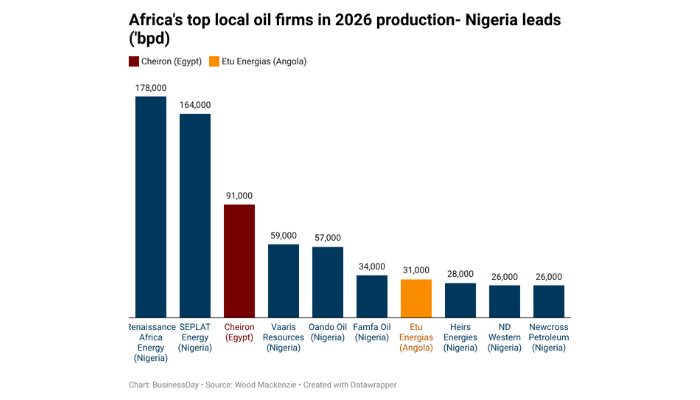
Eight of Africa’s ten largest indigenous oil producers are Nigerian companies, with Renaissance Africa Energy and Seplat Energy sitting at the top of the continent’s rankings.
Renaissance Africa Energy completed the largest indigenous acquisition in Nigeria’s upstream history in March 2025, taking over Shell’s shareholding in the Shell Petroleum Development Company joint venture to become operator of the country’s largest upstream operation, a position previously held by one of the world’s biggest oil companies for more than six decades.
Seplat, meanwhile, finalised a $1.28 billion purchase of Mobil Producing Nigeria Unlimited from ExxonMobil in late 2024, adding four offshore blocks, roughly 300 producing wells and a stake in the Qua Iboe export terminal. Oando absorbed Nigerian Agip blocks from Eni, completing a sweep of IOC exits that has reshaped Nigeria’s upstream map.
The financial rewards have followed. Seplat posted record results in 2025, and Aradel Holdings, one of the five companies that formed the Renaissance consortium, saw its profit margins jump from 49 percent to 67 percent between the second quarters of 2024 and 2025, an unusually high performance even by sector standards.
Yet Wood Mackenzie’s analysts are clear about the ceiling.
“Financing remains the major obstacle,” they wrote. “Nigerian independents are challenged with financing late-life projects in a high-risk environment without the luxury of large balance sheets.”
Operating costs for Nigerian independents average close to $15 per barrel of oil equivalent, the highest across Africa, and more than half of Nigeria’s oil output comes from fields that began producing before 2000. Wringing growth from ageing, depleted acreage in the Niger Delta requires capital that many of these companies can only access on punishing terms.
It is that financial constraint, as much as any strategic ambition, that is pushing some executives to scan the broader continent.
Read also: Local oil firms face funding hurdle as ambitions outstrip capital
For instance, Oando Plc is one of the most internationally ambitious Nigerian players. Oando is shifting its focus to opportunities beyond Nigerian borders in Angola, Tanzania, Mozambique, and the Caribbean.
First E&P is also eyeing gas exploration in Tanzania, among other opportunities, reflecting a wider push by Nigerian energy companies to grow outside the home market.
Since starting operations in 2004, Sahara has grown its upstream portfolio across West African basins and now participates with on- and/or offshore equity interests in Nigerian, Ghanaian, and Ivorian assets, some of which it also operates.
The Aiteo Group, owned by Nigerian tycoon Benedict Peters, is proposing a 200,000-barrel-a-day refinery in Mozambique, signalling downstream ambitions on the East African coast.
While primarily focused on Nigeria, Heirs Energies has stated plans to expand operations across Africa. The company has said it plans to double output by 2030 from 55,000 barrels a day, as well as expand operations across Africa.
Nigeria’s independents, Wood Mackenzie noted, now account for eight of Africa’s top ten indigenous producers, with a combined peer-group value of around $12 billion, roughly 75 percent of the African independents universe.
That financial weight gives the largest of them the credibility, if not always the ready cash, to pursue cross-border transactions that would have been unthinkable five years ago.
The domestic pipeline has not run dry. Nigeria’s ongoing 2025 licensing round, focused on discovered Niger Delta resources, offers further opportunities, though Wood Mackenzie’s analysts noted that local companies have raised concerns about data reliability and the marginal nature of available assets.
The round is expected to conclude in the fourth quarter. A wave of potential consolidation within the indigenous peer group, smaller players merging or being absorbed by the larger ones, could also absorb capital and management attention for years.
But for the producers who have already integrated the IOC assets and rebuilt production, the options calculus is shifting.
Read also: Nigeria’s oil firms survive on $7 per barrel as insecurity tames profit
Ghana, Ivory Coast, Senegal and Tanzania each hold acreage where the combination of exploration upside and a familiar operating language, Anglophone or Francophone West African regulatory environments that Nigerian executives understand, makes entry more feasible than a jump to, say, the North Sea or the Gulf of Mexico.
Wood Mackenzie’s analysts are not sounding alarm bells, but their caution is pointed. The government has done much, including local content laws, a new regulator, and competitive block licensing, to direct indigenous investment homeward.
But further action on facility uptime, project approvals and security is needed to keep the capital onshore.
“Without further improvements,” they wrote, “Nigeria risks curbing investment by its independents.”

Join BusinessDay whatsapp Channel, to stay up to date
Open In Whatsapp