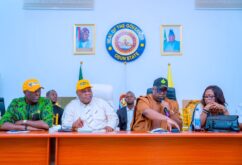
Like a football coach facing defeat at halftime, Governor Agbu Kefas of Taraba State now stands at a pivotal point in his tenure. Two years after assuming office with an ambitious vision to “Move Taraba Forward,” growing public dissatisfaction and elite-focused development choices are raising doubts about the effectiveness of his leadership model.
The administration, which rode into power with youthful vigour and promise of inclusivity, is now increasingly being criticised for administrative inertia, poor communication with the people, and governance strategies that prioritise elite optics over economic realities. From deserted roads in farming belts to underperforming ministries and political exclusion, the call for a cabinet reshuffle is becoming louder.
The recent commissioning of yet another government guesthouse; TY Danjuma House in Gembu has intensified debates over the governor’s spending priorities. The project, one of several elite residences earlier commissioned in Wukari, Takum, Jalingo, and Abuja, has reportedly consumed billions in state resources. Yet, basic infrastructure such as rural roads, schools, and healthcare centres remain in states of decay.
Farmers across Taraba’s agrarian belts are among the hardest hit. “We can’t transport our yams and maize to markets because the road from Karim to Jalingo is like a riverbed,” lamented Mallam Ibrahim Garba, a maize farmer in Jen.
Similar complaints were echoed in Lau, where Rhoda Nyame, a groundnut farmer, said she lost over N400,000 worth of produce in the last harvest season due to bad roads.
“The bridge near Kogin Baba collapsed three months ago, and no one has come to fix it,” said Buba Ali.
From Takum to Ibi and Bali to Wukari, farmers say the absence of motorable roads is discouraging agricultural investments and worsening post-harvest losses. Taraba’s economic potential, especially in agriculture and tourism, is being undermined by infrastructural neglect.
Within urban areas like Lassandi, Mayo Dassa, ATC, and the NTA-Jalingo axis, residents say the situation is not much better. “No new road has been constructed here in two years. When it rains, the roads are flooded, and we wade through mud to get to school or work,” said Peter Tsoken, a secondary school teacher in ATC. “Yet, we see pictures of guesthouses opening in Abuja and Gembu.”
Political fatigue, disillusionment, and party tensions
The free primary and secondary education programme introduced by Kefas was one of the major achievements he recorded in his first two years in office.
Under the programme, new infrastructure was provided while work is ongoing on the construction of new classrooms in 60 schools across the state. The classrooms are remodeled under the programme aimed at creating conducive learning environment.
Text books, uniforms and WAEC registration fee is to be provided to students by the government.
Another key area is security; before the coming of Kefas administration Taraba was faced with rates of communal, farmers/herders crisis and kidnappings.
Security source claimed the rates of such security issues was brought to minimal and that was achieved through engagement with key stakeholders including traditional rulers, religious leaders and security agencies by the governor.
“I think, he responded to security threat promptly and also assisted security agencies with logistics and other support which encouraged good performances of security agencies in responding to security issues across the state,” an indigene said.
Musa Salihu, resident of Jalingo, noted that the governor has not done well in the provision of township roads and rural roads even though he had pledged to do so.
He maintained that in Jalingo, state capital, there is absence of good road network and erosion has destroyed many parts of the metropolis as a result of lack of roads and drainages.
“Many towns and villages lack roads which make movement of goods and services very difficult. The Namnai bridge which collapsed in September last year is yet to be reconstructed even though the governor has promised to reconstruct the bridge.”
Governor Kefas was recognised for renovating existing government structures such as government house Jalingo the Taraba government lodges in Abuja, Wukari and Gembu which were all named after his mentor General T.Y. DanJuma.
The office to the secretary to Taraba State government was also renovated to good standard.
He also provided street solar light in Jalingo town which is also vital to security of movement of people in the night.
Kefas, has also expanded the runway at the Jalingo Airport to enable for landing of bigger aircrafts.
But the political cost of these governance choices is beginning to show. Party stalwarts, once enthusiastic defenders of the governor, now appear withdrawn.
“Those of us who used to post daily updates of the governor’s activities on Facebook and WhatsApp have run out of things to post,” said David Danjuma, a youth mobiliser in Zing LGA. “People now insult us instead of commending us. They ask what happened to the schools, the roads, and the jobs.”
Perhaps, more telling is the growing unease within the People’s Democratic Party (PDP). Last month, the State Chairman of the party, Abubakar Bawa, issued a stern warning to party members seen to be “romancing with the new opposition coalition,” a group of political actors reportedly planning to challenge both APC and PDP hegemony in the 2027 elections.
Party insiders say the warning was a response to silent defections, strategic meetings with the opposition, and grievances over exclusion from government. “Many of us who worked hard for this government have not even seen the governor since inauguration,” a PDP Ward Chairman from Gassol who preferred anonymity, said. “It’s as if a small clique has hijacked the administration.”
This discontent, if not addressed urgently, could pose a significant threat to the PDP’s dominance in the state especially in the face of a national opposition coalition eager to capitalise on popular disillusionment.
Experts also point to a governance structure where key ministries are headed by individuals with limited technical background. The use of Hydraform block technology for constructing schools imported from South Africa is one such example.
“It’s a brilliant innovation in theory,” said Engr. Musa Gankon, a civil engineer based in Jalingo. “But it should have been piloted alongside local technologies to create jobs. Appointing a journalist with no engineering background to coordinate the project suggests it’s more about patronage than development.”
Meanwhile, the free education policy which slashes tuition from primary to postgraduate level remains popular but controversial. Critics argue that it is being poorly implemented, with dilapidated classrooms, insufficient teachers, and zero attention to learning materials. The Government Comprehensive Secondary School in Jalingo, marked for demolition over two years ago, still stands in ruins.
“What’s the point of free education if the classrooms have no roofs and students sit on the floor?” asked Aisha Mohammed, a parent in Mayo Dassa. “Our children come home complaining every day.”
Governor Kefas still has the opportunity to change the narrative. With two years left in his mandate, a well-thought-out cabinet reshuffle anchored on competence, regional balance, and inclusive development could restore public trust and reenergise the state’s economy.
For a state with enormous agricultural wealth, scenic landscapes, and youthful talent, the cost of political tunnel vision is too high. Real leadership demands listening beyond the praise-singers and responding to the concerns of ordinary citizens from roadside yam sellers in Ibi to schoolteachers in ATC.
Without a deliberate course correction, the road to 2027 could prove rougher for the governor than the roads currently troubling the people of Taraba. Again, if Kefas gets it right, the next two years could transform his legacy. If not, the 2027 political battlefield may prove less forgiving.
Civil Service Reform
Though the governor has implemented minimum wage twice, and salaries are being paid as of when due, across the civil service, murmurs of frustration are also building.
Several mid-level government workers who spoke anonymously complained of poor coordination, irregular staff audits, and a lack of motivation to deliver quality service. “There is no clear reform roadmap. Ministries are working in silos, and many commissioners are either absent or uninspiring,” said a senior staff member in the Ministry of Works.
The anticipated digitisation of government processes, promised during the campaign, has yet to take off, leaving routine services stuck in analog inefficiencies.
In the business community, traders and micro-entrepreneurs in Jalingo and Wukari say the economic environment has not improved significantly under the current administration. Inflationary pressures, limited access to soft loans, and poor power supply continue to suffocate small businesses. “We were hopeful when the governor promised to support small-scale enterprises, but it’s been two years and no real programme has reached us,” said Ngozi Eze, who runs a tailoring shop in Magami.
Market women in Takum also complained about multiple levies and poor sanitation conditions that affect their daily trade.
The discontent has also reached religious and traditional leaders; some of whom have quietly expressed concern over the government’s growing disconnect from the grassroots. A respected traditional ruler in southern Taraba, speaking off the record, noted: “Our role is to help the government stay grounded, but we are not being engaged. We only hear about projects after they’ve been awarded or commissioned, and many don’t reflect the immediate needs of our communities.”
Youth groups and civil society organisations, once optimistic about Kefas’s agenda, have also started organising town hall meetings to appraise the administration’s performance.
In Jalingo last month, the Taraba Youth Coalition for Democratic Development issued a communique demanding transparency in project execution, equitable distribution of appointments, and publication of the government’s midterm expenditure report. “We are not fighting the government; we are demanding accountability and inclusion,” said the coalition’s spokesperson, Joseph Bako.
What many are now calling for is not just a cabinet reshuffle, but a full recalibration of the Governor’s political and economic strategy.
Analysts say Kefas must transition from campaign mode to governance reality moving beyond slogans and ceremonial ribbon-cuttings to data-driven policy implementation. This means building strong institutions, reforming procurement processes, and bringing in technocrats with the capacity to deliver measurable outcomes.
Ultimately, public trust is not won through lofty promises or social media posts, but through consistent, transparent, and people-focused leadership. For Governor Kefas, the next 24 months represent not just a countdown to re-election, but an opportunity to prove that youthful leadership can also mean strategic, inclusive, and economically sound governance.
However, Hospitals, especially the specialist hospital in Jalingo is begging for attention. The hospital built by former governor Jolly Nyame in 2002 has not under gone major renovations.
However, there is the need for the government to pay more attention to construction of access roads in Jalingo metropolis more especially in areas like Nana Aisha, Ambaliya, Kurkaye, Nasarawo, Mafindi, Sabongari, Saminaka areas among others.
Similarly, over 80 villages and towns in the 16 local government areas lack access roads and the government needs to focus more of its resources for construction of rural and urban road network.
The question is: will he listen to the discontent rumbling across Taraba’s plains, or remain cocooned in the comfort of praise-singers and gated celebrations?

Join BusinessDay whatsapp Channel, to stay up to date
Open In Whatsapp