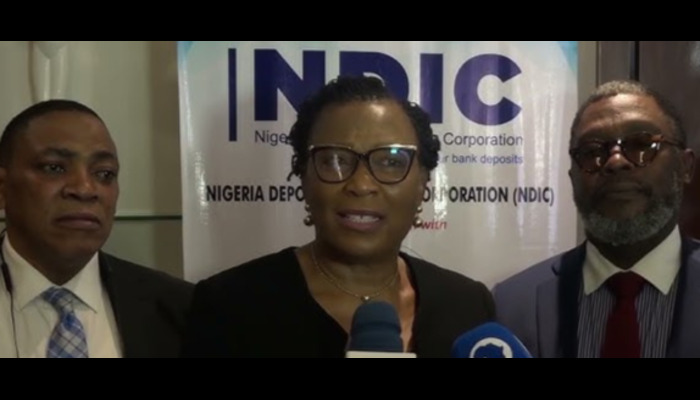
The Nigeria Deposit Insurance Corporation (NDIC) and the National Judicial Institute (NJI) have intensified efforts to strengthen judicial understanding of bank liquidation and depositor protection, bringing together judges and legal experts at a sensitisation seminar in Lagos.
The 2026 seminar, themed “Enhancing the Efficacy of Bank Liquidation and Depositor Protection”, attracted justices of the Federal High Court, Court of Appeal judges, members of the National Industrial Court and the Investment and Securities Tribunal, alongside financial sector stakeholders.
The engagement focused on improving the quality and consistency of judicial decisions in financial sector disputes, particularly matters relating to failed financial institutions, garnishee proceedings and depositor claims.
Speaking at the event, Justice Babatunde Adejumo, administrator of the National Judicial Institute, said the seminar formed part of ongoing efforts to strengthen judicial capacity in increasingly complex areas of the law.
“This engagement reflects a continuing effort to strengthen judicial capacity in areas of growing importance within our legal system,” Adejumo stated, noting that banking regulation and deposit insurance remained critical pillars of national economic stability.
Read also: NDIC begins wind-up of 89 failed microfinance, mortgage banks
He stressed that the judiciary had a vital role to play in sustaining confidence in the financial system through fair, transparent and credible adjudication.
Also speaking, Emily Osuji, executive director, Corporate Services at the Nigeria Deposit Insurance Corporation, underscored the importance of judicial integrity in maintaining trust in the banking sector.
According to her, the administration of justice in financial disputes must continue to uphold “fairness, equity, transparency and integrity” in order to safeguard public confidence in the nation’s financial system.
The seminar featured extensive discussions on expert orders in financial sector litigation, public interest claims, liquidation procedures and the implications of garnishee proceedings on financial stability.
Delivering his presentation, Ernest Ojukwu, Professor, SAN, explained that garnishee proceedings involved the use of debts owed to a judgment debtor by a third party to settle a judgment debt.
Read also:NDIC moves to conclude liquidation of 89 failed banks
He warned that banking insolvency cases extended beyond private disputes because they directly affected public confidence, payment systems, financial intermediation and broader economic stability.
Ojukwu therefore urged judicial officers to strike a careful balance between enforcing judgments and protecting depositors in failed financial institutions.
On the corporation’s mandate in resolving distressed banks, Kushimo Oladipo, director of Legal Services at the NDIC, said the NDIC remained committed to prioritising depositors during bank liquidation processes.
“In a bank failure, the NDIC does everything within its powers under the Act to ensure that priority is given to depositors of failed insured institutions,” Oladipo said.
The seminar formed part of broader efforts by the NDIC and the NJI to equip judicial officers with the specialised knowledge required to adjudicate deposit insurance-related matters effectively and support stability within Nigeria’s financial system.

Join BusinessDay whatsapp Channel, to stay up to date
Open In Whatsapp