President Bola Tinubu has appointed Femi Gbajabiamila, his Chief of Staff, to chair the Presidential Working Group on the National Policing Bill as the Federal Government moves to establish the legal framework for the implementation of state police across the country.
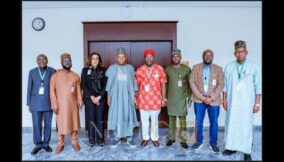
The committee, which includes Lateef Fagbemi, Attorney-General of the Federation and Minister of Justice, was inaugurated on Tuesday at the Presidential Villa in Abuja.
According to a statement issued by Bayo Onanuga, President’s Special Adviser on Information and Strategy, the working group was established following the passage of the Constitution Alteration (State Police) Bill, 2026, by the National Assembly.
Represented at the inauguration by Gbajabiamila, Tinubu said the committee’s task is to prepare an implementation-ready National Policing Bill that will provide the legal architecture required to operationalise state policing once the constitutional amendment process is completed.
He explained that while the Constitution Alteration Bill creates the legal basis for a dual policing structure, the National Policing Bill would spell out the operational details needed for effective implementation.
“The Constitution Amendment Bill establishes the framework for dual policing, but it does not operationalise it. That work is left to the National Policing Bill,” the President said.
Tinubu noted that the proposed legislation would address critical issues including minimum policing standards, certification of state readiness, coordination between federal and state policing authorities, accountability mechanisms, human rights safeguards and fiscal requirements.
He said the committee had been mandated to produce a technically sound draft bill that would be transmitted to the National Assembly immediately after the constitutional amendment process.
Read also: Reps in rowdy session over motion to summon Tinubu
“The Working Group has been constituted to produce a technically robust, implementation-ready draft National Policing Bill for transmission to the National Assembly.
“We must not wait until the constitutional process is concluded before beginning this important assignment,” he added.
Other members of the committee include Nuhu Ribadu, National Security Adviser, Adam Osigwe, President of the Nigerian Bar Association; Dapo Abiodun, Chairman of the Nigeria Governors’ Forum and Governor of Ogun State; Tunji Disu, Inspector-General of Police, and the chairman of the NGF Committee on State Police.
A secretariat will also be established to provide administrative support to the panel.
Speaking on behalf of the governors, Abiodun pledged the full support of state governments for the successful implementation of the reform.
He assured that governors would work with their respective state Houses of Assembly to ensure speedy consideration of the constitutional amendment once transmitted.
Describing the initiative as a response to long-standing public demands for decentralised policing, Abiodun said the proposed state police structure would build on the successes recorded by regional security outfits such as Amotekun.
He projected that if each state recruited about 6,000 personnel, nearly 200,000 additional officers would be added to complement the existing federal police force, significantly improving the country’s security architecture.
Fagbemi described the initiative as timely, given Nigeria’s prevailing security challenges.
“There is no denying the fact that we are in a critical moment security-wise, and all hands must be on deck,” he said.
He also urged governors to ensure the constitutional amendment receives prompt approval at the state level.
“I appeal to the governors to do their utmost to ensure the early passage of the constitutional amendment because this is a shared responsibility”, he said.
Osigwe reiterated the association’s longstanding position that Nigeria requires a decentralised policing system but stressed that safeguards must be built into the proposed law to prevent abuse of power.
“Nigeria can hardly be effectively policed by one national police. We fully support the constitutional amendment providing for state police
“We must ensure we do not create a monster. The right legal framework must guarantee accountability and prevent oppression”, he noted.
The inauguration was attended by attorneys-general and commissioners for justice from Plateau, Lagos and Ondo states, representatives of the Inspector-General of Police and the National Security Adviser, as well as other senior government officials.

Join BusinessDay whatsapp Channel, to stay up to date
Open In Whatsapp