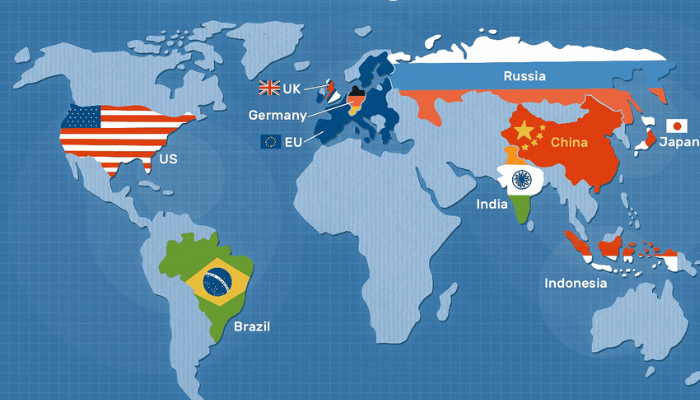
The world economy continues to be shaped by a small group of countries that account for a significant share of global output, trade, investment and consumption. According to the International Monetary Fund (IMF) estimates for 2025, the United States remains the world’s largest economy, followed by China and Germany.
For businesses, investors and policymakers, gross domestic product (GDP) remains one of the most widely used measures of economic activity. Countries with larger economies often offer larger consumer markets, stronger financial systems, and greater opportunities for investment and expansion.
Read also: The 10 most prosperous advanced economies in 2026
Here are the 10 largest economies in the world by nominal GDP heading into 2026.
1. United States – GDP: $29.2 Trillion
The United States remains the world’s largest economy with an estimated GDP of $29.2 trillion. Economic activity is driven largely by consumer spending, technology, finance, healthcare and professional services. The country also benefits from the global role of the US dollar, which remains the leading reserve currency.
The size of the American market continues to attract companies from around the world seeking access to consumers and business customers.
2. China – GDP: $18.7 Trillion
China holds the position of the world’s second-largest economy with a GDP of approximately $18.7 trillion. Manufacturing, exports and infrastructure investment remain key pillars of economic activity.
The country is also the world’s largest trading nation for goods. While policymakers continue efforts to boost domestic consumption, China remains a major force in global supply chains and international commerce.
3. Germany – GDP: $4.7 Trillion
Germany is the largest economy in Europe and ranks third globally. With an estimated GDP of $4.7 trillion, the country is known for industrial production, engineering and exports.
German manufacturers play an important role in sectors such as automobiles, machinery and chemicals. As the largest economy in the European Union, Germany continues to influence economic policy across the region.
4. Japan – GDP: $4.4 Trillion
Japan remains the fourth-largest economy in the world with a GDP of around $4.4 trillion. The country is a major producer of automobiles, electronics and robotics technologies.
Despite demographic pressures linked to an ageing population, Japan continues to be a major source of global investment and remains one of the world’s most important industrial economies.
5. India – GDP: $3.9 Trillion
India ranks fifth with a GDP of approximately $3.9 trillion. The country has recorded some of the fastest economic growth rates among major economies in recent years.
A large population, expanding digital infrastructure and growing consumer demand have contributed to India’s rise. Many analysts view India as one of the most important growth markets of the coming decade.
6. United Kingdom – GDP: $3.5 Trillion
The United Kingdom holds sixth place with an estimated GDP of $3.5 trillion. Financial services, professional services and creative industries contribute significantly to economic output.
London remains one of the world’s leading financial centres, helping the UK maintain its position in global finance and international business.
7. France – GDP: $3.2 Trillion
France is the seventh-largest economy globally, with a GDP of about $3.2 trillion. The economy is supported by sectors including aerospace, agriculture, finance, tourism and luxury goods.
Paris has also emerged as a growing centre for technology companies and start-ups, adding another layer to the country’s economic activity.
8. Italy – GDP: $2.4 Trillion
Italy ranks eighth with a GDP of approximately $2.4 trillion. The country is recognised for its manufacturing base, fashion industry, automotive production and food exports.
Industrial regions in northern Italy continue to support economic output through networks of specialised manufacturers and suppliers.
9. Brazil – GDP: $2.3 Trillion
Brazil is the largest economy in Latin America and the ninth-largest globally. With a GDP of around $2.3 trillion, the country plays a major role in global agriculture and commodity exports.
Brazil is among the world’s leading exporters of soybeans, coffee and beef. Its large domestic market also supports growth across several industries.
10. Canada – GDP: $2.2 Trillion
Canada completes the top 10 with a GDP of approximately $2.2 trillion. Natural resources, financial services, technology and agriculture remain important contributors to economic activity.
Close economic ties with the United States and continued immigration have helped support Canada’s long-term economic growth.

Join BusinessDay whatsapp Channel, to stay up to date
Open In Whatsapp