The Nigeria Shippers Council (NSC) said efforts to evacuate a backlog of export containers congesting the Apapa port are underway after a major shipping company assured the regulator it will send a ship next week.
In June, BusinessDay reported that Nigerian exporters were struggling to move cargo out of the country as disruptions to global shipping routes due to tensions in the Middle East squeezed vessel availability and trapped billions of naira in delayed shipments.
The report noted that thousands of containers, mainly carrying agricultural goods and industrial products, have sat for months at terminals in Apapa and Tin Can Island ports after shipping lines cut sailings and rerouted vessels. Some terminals even began rejecting export containers after being overwhelmed by the pile-up.
Come back to read: Nigeria’s exporters battle port gridlock as Middle East war disrupts shipping
Though representatives of the Nigerian Ports Authority initially denied the development upon BusinessDay’s enquiry and efforts to reach the Council proved futile, the NSC over the weekend confirmed that no fewer than 1,800 export containers are currently trapped at the APM Terminals (APMT) Apapa due to growing congestion at the terminal.
Juliana Saka, head of the Shippers Council’s complaints unit, said it had received complaints from shippers over the delayed shipment of export cargo, forcing an intervention that involved a meeting with Maersk Nigeria, a figurehead and the leadership of an unspecified shippers’ association.
Maersk, one of the major carriers cited by operators in BusinessDay’s report, had diverted some export operations to Ports and Cargo Handling Services at Tin Can Island using terminals as temporary holding points for export containers due to space constraints.
“Maersk promised that by next week they will see how they can get a vessel to lift the remaining containers,” the Council told operators.
She said Maersk attributed the delay to congestion in the Far East that has affected cargo destined for African countries and the Far East, as well as repeated vessel rescheduling.
Saka noted that while shipping lines had previously complained about a shortage of cargo in export containers from Nigeria, the situation has now changed, as export volumes rise.
In the first quarter of 2026, Nigeria handled 102,803 TEUs of export-laden containers, according to data from the Nigerian Ports Authority, equivalent to about 34,000 TEUs a month or roughly 500 to 600 containers a day.
Even a short disruption to vessel schedules and terminal operations can therefore translate into a significant build-up in the system.
“Before now, most shipping companies often complained that when they came to Nigeria, they go empty because there were not enough exports. Now we are having more exports but we don’t even have enough vessels to take them out, ” she confirmed.
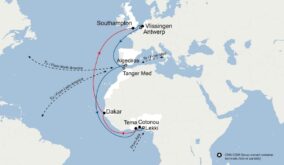
With few direct lines, ships calling at Nigeria’s ports must first call at chokepoints of the hostile activities in the Middle East where many ships are still either stationary, turned around or docked nearby, or unable to discharge their cargo, leading to longer waiting times.
Read also: Nigerian exporters bleed profits as shipping lines shun major Gulf ports
The Council said it warned shipping lines, including Maersk, that if any of the delayed cargo arrives at its destination in poor condition and is rejected because of the delay, the shipping line would be held liable for both the value of the cargo and the freight charges already paid by the exporters.
Meanwhile, the impasse has forced exporters to look to other functional, less-congested ports for relief. “What other exporters are doing now is they are using other ports, like Lekki Port. For people who are shipping through the south, they can use Onne. Those ones are not congested,” Omoyeni of the NEA told BusinessDay. “But the logistics are costlier. The haulage company will charge more,” he added.
Yet many exporters are already counting their losses. Even as global shipping stabilises, exporters are concerned that the backlog at terminals will take time to clear.
“We are keeping our fingers crossed and following up on the matter,” the Council said.
Meanwhile, Pius Akutah, the executive secretary of the Council, said it had prevented N86.06 billion unjustified demurrage payments and secured a saved shippers $1.348 million through its Alternative Dispute Resolution (ARD) and regulatory interventions between October 2023 and June 2026.
According to Akutah, the Council received 558 complaints and resolved 295 cases of container deposits, demurrage, detention charges, terminal charges, cargo claims, and export fraud.
He said the Council also concluded out-of-court settlements involving APM Terminals Nigeria Limited, CMA CGM and Maersk Nigeria Limited regarding charges paid by shippers above approved tariffs.

Join BusinessDay whatsapp Channel, to stay up to date
Open In Whatsapp