…Committee orders Customs to submit updated audited accounts within one week
…CAC admits ₦13.9bn unremitted revenue, NNPCL GCEO ordered to appear next week
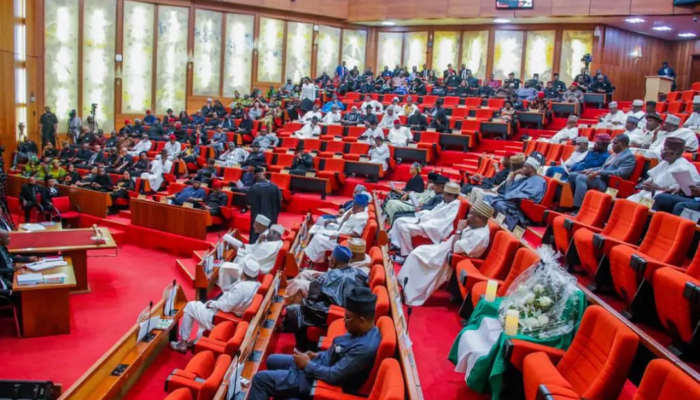
The Senate Committee on Finance on Monday threatened to invoke legislative sanctions against several Ministries, Departments and Agencies (MDAs) that failed to honour its invitation to an ongoing investigative hearing on the remittance of internally generated revenue and operating surplus into the Consolidated Revenue Fund (CRF), warning that persistent offenders could be reported to President Bola Tinubu for administrative action.
The warning came as the committee also commenced a detailed investigation into the Federal Government’s issuance of Import Duty Exemption Certificates (IDEC) worth about ₦34 trillion between March 2020 and December 2025, amid growing concerns over the impact of the waivers on government revenue.
The committee, chaired by Sani Musa, (APC, Niger East) said the investigation was aimed at ensuring accountability in the management of public resources and determining whether fiscal incentives granted by the Federal Government had achieved their intended economic objectives.
Appearing before the panel, Adewale Adeniyi, the Comptroller-General of the Nigeria Customs Service (NCS),, said government policies had significantly affected the Service’s revenue generation over the years.
According to him, Customs would have generated far more revenue but for fiscal policy measures, particularly import duty waivers introduced by the Federal Government.
He disclosed that the value of IDEC approvals had risen to about ₦34 trillion by 2025.
“IDEC approvals reached about ₦34 trillion in 2025. Sixty per cent of the waivers were for military hardware procurements because of Nigeria’s prevailing security challenges.
“Other government-backed waivers included imports of Compressed Natural Gas (CNG), electric and hybrid vehicles, healthcare equipment and medical supplies, industrial machinery and manufacturing inputs, as well as food import intervention programmes.”
Adeniyi maintained that fiscal incentives should not be assessed only by the revenue forgone but by their contribution to national security, industrial growth, healthcare delivery and economic development.
4.5He, however, recommended stronger monitoring mechanisms to ensure beneficiaries delivered expected outcomes such as lower prices, increased production and improved healthcare access.
On Customs’ revenue performance, Adeniyi said the Service generated ₦3.2 trillion in 2023 against a target of ₦3.67 trillion, attributing the shortfall to disruptions in global trade arising from the Russia-Ukraine war and instability in the Middle East.
He said revenue improved to ₦6.1 trillion in 2024, exceeding the ₦5.079 trillion target by over 20 per cent, while collections reached about ₦7.2 trillion in 2025 against a target of ₦6.584 trillion.
For 2026, he said Customs had generated about ₦4.5 trillion as of June 30 out of the ₦11.04 trillion target, expressing optimism that improved cargo volumes would boost collections in the second half of the year.
The Fiscal Responsibility Commission (FRC) told the committee that government-approved waivers on food imports, particularly rice and maize, had significantly reduced Customs revenue but confirmed that all revenue collected by the Service was remitted directly into the Treasury Single Account (TSA).
The commission, however, disclosed that Customs had not submitted audited financial statements beyond 2019 and currently had an estimated ₦8.9 billion operating surplus liability pending reconciliation.
The claim was disputed by Customs, but the committee directed the Comptroller-General to submit updated audited financial statements and comprehensive revenue records within one week.
The hearing also featured discussions on the Federal Government’s decision to reduce import duties on certain categories of vehicles.
Adams Oshiomhole argued that lower duties on fairly used vehicles could undermine Nigeria’s automobile assembly industry by encouraging increased dependence on imports.
Responding, Adeniyi said Customs merely implemented government policy and acknowledged that the measure would reduce revenue but was intended to make vehicles more affordable for Nigerians.
He also briefed lawmakers on the National Single Window project, saying it had entered its second phase with the integration of digital platforms across relevant government agencies.
According to him, sensitisation had been conducted for importers, exporters, airlines, shipping companies and port operators, while Customs’ ongoing modernisation programme, including electronic payment systems, digital declarations, geospatial intelligence and advanced surveillance technology, had strengthened revenue generation and border management.
He added that Nigeria’s export trade had grown by about 70 per cent over the past three years following the establishment of a dedicated export command in 2023.
The committee also scrutinised the Corporate Affairs Commission (CAC) after the FRC disclosed that the agency had an outstanding unremitted operating surplus of ₦13.9 billion between 2023 and 2025.
CAC Registrar-General Hussaini Ishaq Magaji acknowledged the outstanding liability but said the Commission had commenced gradual repayment.
Although senators commended the agency’s revenue performance, they directed the CAC, the FRC and the committee secretariat to reconcile their records and determine the exact outstanding balance before the next hearing.
Proceedings were later stalled following the absence of the Group Chief Executive Officer of the Nigerian National Petroleum Company Limited (NNPCL).
Tajudeen Karim , the NNPCL Financial Controller told the committee that the company’s Chief Financial Officer was receiving medical treatment.
The explanation did not satisfy lawmakers, who insisted that only the GCEO and other top management officials could adequately respond to issues relating to remittances, compliance with Executive Orders, revenue reconciliation and ongoing reforms.
The committee consequently directed the NNPCL GCEO and senior finance officials to appear in person at its next sitting.
At the close of the hearing, Musa expressed displeasure over the continued absence of several government agencies, including the Office of the Accountant-General of the Federation (OAGF), Industrial Training Fund (ITF), Nigerian Communications Commission (NCC), Nigerian Maritime Administration and Safety Agency (NIMASA), Federal Airports Authority of Nigeria (FAAN), Nigerian Railway Corporation (NRC), National Environmental Standards and Regulations Enforcement Agency (NESREA), Nigerian Civil Aviation Authority (NCAA), Small and Medium Enterprises Development Agency of Nigeria (SMEDAN), Nigerian Institute of Transport Technology (NITT), Institute for Agricultural Research (IAR), Nigeria Agricultural Quarantine Service (NAQS), Federal Medical Centre (FMC), Jabi, and the Veterinary Council of Nigeria (VCN).
He warned that the Senate would no longer tolerate disregard for legislative invitations.
Musa said, “Heads of agencies like NCAA, ITF, SMEDAN, FMC Jabi and others who failed to physically attend today’s session should unfailingly make themselves available at the next sitting or risk severe sanctions through the invocation of relevant sections of our rules.
“The National Assembly is carrying out its constitutional oversight responsibility, and every agency entrusted with public resources must account fully for revenues collected on behalf of the Federal Government.”
Musa added that agencies that persistently failed to honour Senate invitations could ultimately be reported to President Bola Tinubu for administrative action.

Join BusinessDay whatsapp Channel, to stay up to date
Open In Whatsapp