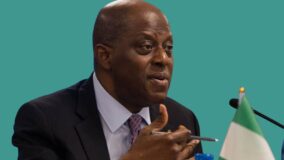
Patience Oniha, Director General of the Debt Management Office (DMO) said on Thursday that the federal government Sukuk issuance so far, has been a win-win for the investors, the federal government, and citizens who make use of the infrastructure built with the proceeds.
Oniha spoke in Abuja as she wooed investors to again, commit to the ongoing N150 billion federal government sukuk issuance which opened on October 3, 2023, and is expected to close on October 11, 2023.
Sukuk is a Sharia-compliant financial instrument and debuted in Nigeria in 2017.
The ongoing issuance which is the sixth in the series, is a 10-year Forward Al Ijarah, at a rental rate of 15.75%, and enjoys similar features as the previous Sukuk.
Speaking at the event, Oniha assured that the proceed, like the previous ones which were oversubscribed due to overwhelming investors’ interest, will also be well utilized in building infrastructure projects as already outlined by the implementing agencies. It will also help boost jobs and the economy she added.
Read also: DMO lists N2506bn Sukuk on Nigerian Exchange
Through the past five series, each in 2017, 2018, 2020, 2021, and 2022, the DMO has so far raised and deployed ₦742.557 billion to the rehabilitation and construction of 4,000 kilometers of road projects and bridges across the six geopolitical zones and the Federal Capital Territory.
Oniha said that in these past six years, sukuk has been a viable funding and investment option for the federal government’s infrastructure drive and investors respectively.
But beyond infrastructure building, it has driven some associated multiplier benefits, including jobs; offered ethical investors an opportunity to invest in government securities; achieved a higher level of financial inclusion; deepened the domestic financial markets; as well as set benchmarks for corporates and sub nationals.
Nigeria’s infrastructure deficit, amounting to 30% of its gross domestic product (GDP), falls short of the international benchmark of 70% set by the World Bank.
With a score of 48.33 out of 100 total points, the country has over 50% infrastructure deficit.
With Nigeria’s population growth rate of over 2.5% per year, and an expected population of 400 million people by 2050, there are fears that the current infrastructure in the country is likely to be overwhelmed.
The Chief debt manager lamented that despite the role Infrastructure plays in the socio-economic development, facilitation, and acceleration of economic development, Africa’s largest economy still struggles basically due to funding.
The 2019 Global Competitive Index Report ranked Nigeria 130th out of 141 economies surveyed for quality infrastructure facilities, even though the country has conducted several important infrastructure sector reforms.
Speaking further, Oniha recalled that as of 2017, the Federal Government’s investment in roads and bridges was primarily funded through the annual budgets which were grossly inadequate, to some extent external borrowings, and other initiatives of the Government.
Consequently, the Federal Government, through the DMO initiated the Sukuk Funding Programme for financing road infrastructure in 2017.

Join BusinessDay whatsapp Channel, to stay up to date
Open In Whatsapp