Before the bombs started falling over the Strait of Hormuz, Nigerians cooking with gas were already paying more than most of their continental neighbours.
Now, with the US-Iran war having choked the world’s most critical energy corridor, they are paying even more, and the relief in sight is thin.
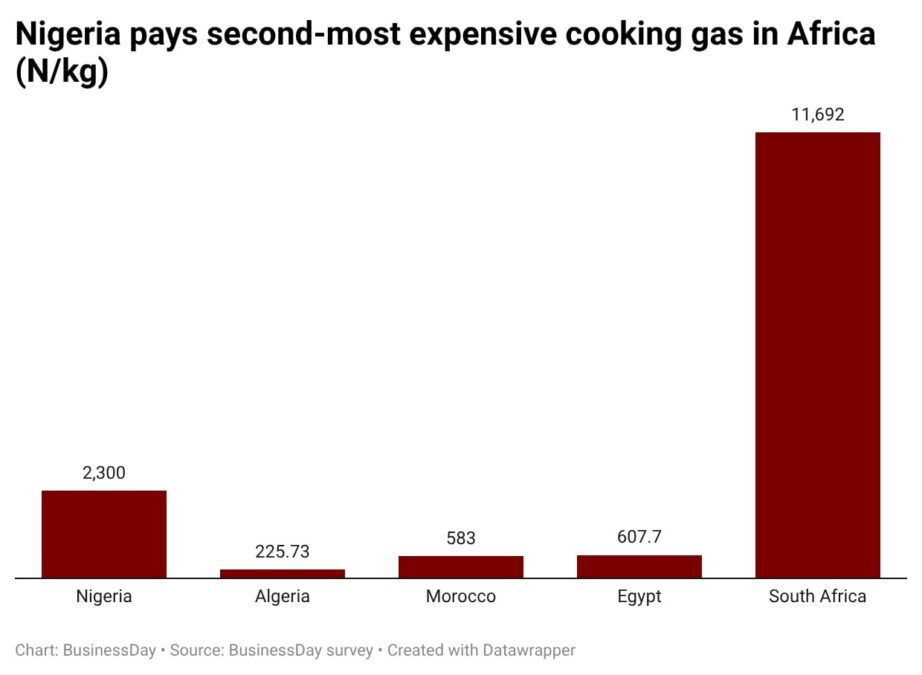
A kilogram of liquefied petroleum gas in Nigeria currently fetches around N2,300, up from N1,700 in February, a 35 per cent surge that has arrived on top of years of structural price pain. Across Africa’s five largest economies, only South Africa, a country whose LPG market is driven by a chronic electricity crisis and industrial demand, charges more.
That places Nigeria in an uncomfortable second position, as Africa’s most populous country pays more for cooking gas than Egypt, Morocco, and Algeria, yet without the consumption infrastructure or subsidy architecture those countries have deployed to cushion their populations.
In Egypt, where the government classifies LPG as a social good and prices it accordingly, consumers pay LE 22 per kilogram, equivalent to roughly N608. In Algeria, a major hydrocarbon exporter, state support has kept the per-kilogram price at 22 Algerian dinars, about N226, less than a tenth of what Nigerians currently pay.
Even Morocco, which imports the bulk of its LPG needs and is therefore exposed to the same international shocks now hammering Nigeria, manages to hold its per-kilogram price to around 4 Moroccan dirhams, or N583.
“I used to buy gas every three weeks,” said Chidinma Okafor, a mother of four who runs a small food business from her home in Lagos’s Mushin district. “Now I’m back to firewood. The gas money is the same as my children’s school feeding for the whole week. I can’t do both.”
South Africa, for its part, sits at the top of this cost table with an average of R40.85 per kilogram, equivalent to about N11,692, a premium driven not by scarcity but by a gas market repurposed as a substitute for an unreliable national electricity grid.
The contexts are entirely different. South Africa’s load-shedding crisis has turbocharged LPG demand among a growing middle class using gas as a backup energy source; prices reflect supply under pressure from unusual demand. Nigeria’s pain is more fundamental.
A paradox written in reserves
What makes Nigeria’s position particularly difficult to explain is that the country sits on approximately 2.71 trillion cubic feet of proven natural gas reserves, among the largest on the continent.
Nigeria is one of the most gas-rich nations in Africa. Yet those reserves have done comparatively little to moderate the cost of cooking in the kitchens of Lagos, Kano, or Port Harcourt.
“It is almost absurd,” said one Lagos-based energy economist who asked not to be named because of the sensitivity of discussions with government officials. “You have a country with gas coming out of the ground, and households are switching to charcoal. The infrastructure gap, the import dependence, the absence of a serious domestic distribution policy, this is a decades-long governance failure that the war has simply made impossible to ignore.”
The Nigerian Midstream and Downstream Petroleum Regulatory Authority recently confirmed that the country’s LPG supply contracted by 11 percent in May. The regulator has flagged an urgent need for a supply boost before conditions deteriorate into full scarcity.
For a country that has spent years trying to shift its domestic energy profile away from firewood and kerosene, the warning is a setback.
Many households, unable to absorb the current price levels, have already made the switch in reverse, back to charcoal, firewood, and kerosene stoves that produce the indoor air pollution policymakers had spent years trying to phase out.
Emeka Eze, who operates a gas refilling depot in Onitsha, says his customers have thinned out considerably since February.
“Before, I was refilling maybe 80 cylinders a day. Now it is 30, sometimes less. The ones who still come are the restaurants; they have no choice. The housewives? They’ve gone back to firewood, or they’re borrowing from neighbours and managing small quantities,” Eze said on X, formerly known as Twitter.
The Strait of Hormuz effect
The proximate cause of the latest spike is the closure of the Strait of Hormuz, the narrow waterway through which a substantial share of global energy trade flows. The US-Iran conflict, which has escalated through months of military exchanges, delivered a decisive blow to global LPG supply chains when the strait became impassable. Brent crude prices surged. Shipping routes were disrupted.
African import depots that depend on Middle Eastern gas found themselves unable to meet demand, and the shortfall was passed, as it almost always is, to consumers.
Nigeria’s exposure to this kind of external shock is, in part, a function of how its domestic gas infrastructure has been managed.
Despite vast reserves, the country imports a meaningful portion of its LPG supply, leaving it vulnerable to the same global price signals as import-dependent nations like Morocco, but without Morocco’s relatively efficient distribution network or its government’s long-established subsidy system.

Join BusinessDay whatsapp Channel, to stay up to date
Open In Whatsapp