… Says Abubakar restored faith in democracy after Abacha’s death
… His 11-month transition, set stage for civil rule
…He laid foundation for democracy in Nigeria – Mbeki
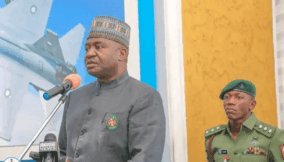
Former Nigerian leaders, Yakubu Gowon, Olusegun Obasanjo, Goodluck Jonathan and Godswill Akpabio, Senate President, all unanimously agreed on Saturday that Abdulsalami Abubakar’s decision not to extend his military rule, helped to heal the wound inflicted by the annulment of the June 12 1993 election and restore democracy in Nigeria
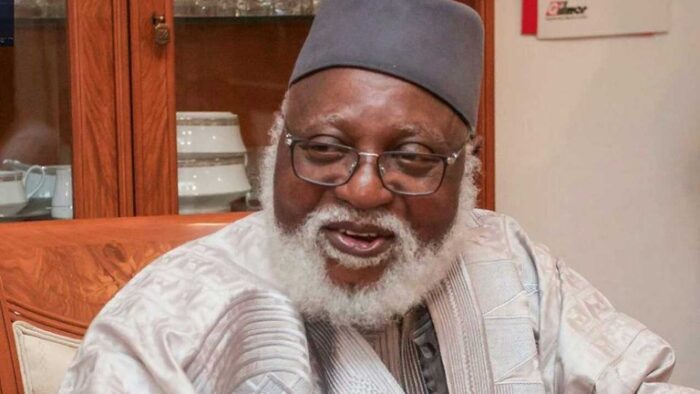
At a well attended unveiling of the three books, in honour of the former leader, ” Call to duty, Nigeria’s grand Patron and Mediating for Africa”, the leaders noted that Abubakar had provided leadership that restored hope and confidence in Nigeria at a critical period in the nation’s history following the death of General Sani Abacha in 1998.
Gowon who was the Chairman of the occasion, described Abdulsalami’s stewardship during the uncertain period after the death of Sani Abacha, reassured Nigerians that a path forward remained possible and ultimately paved the way for the country’s return to democratic rule.
They also described him as a man of ” unprecedented humility”, adding that the three books were written to honour Abdulsalami ahead of his 84th birthday.
Gowon recalled that Abdusalami Abubakar appeared at a time Nigeria was in need of calm, reassurance and clear direction
“You came to office at a very delicate moment for Nigeria, when the country needed calm, reassurance and a clear sense of direction. Nigerians were looking for a way forward and your stewardship at that time helped create the confidence that such a path was still possible,” Gowon said.
He noted that Abdulsalami understood the significance of the moment and responded with decisive leadership by organising elections and handing over power to a democratically elected government within 11 months.
“In choosing to organise elections and to hand over power within 11 months, you did something of lasting significance for our country. You helped restore confidence in the promise of democracy and demonstrated that leadership, especially in a time of uncertainty, must be anchored in responsibility and in the national interest,” he said.
According to Gowon, Abdulsalami’s ability to earn the trust of both military officers and political actors was instrumental in ensuring a smooth transition process and preventing instability during a period of national uncertainty.
“You were able to carry both the military establishment and political leaders through that transition because your approach inspires trust,” he said.
Former President Goodluck Jonathan described Abdusalami Abubakar’s life as a “testament in humility and a clear demonstration that institution are built and strengthened by men of uncommon courage, adding that “true leadership comes with sacrifice. ”
He recalled that when he lost election in 2015, some people called him not to accept defeat, but he rejected the urge to remain in power
“It takes somebody with strong disposition to peace and uncommon courage to accept the quit and General Abdulsalami has continued to advocate for peace. As we celebrate him today, we are reminded that nations are built by leaders with great character
Former President Olusegun Obasanjo, in his remarks he listed Abubakar as one of the four military leaders whose actions helped to shape the history of Nigeria
He noted that they made their contributions, adding that despite the fact that they were not perfect human beings, but without their contributions, we may not be here today”
He cited the roles played by Yakubu Gowon in civil war, Murtala Mohammed, in hastening the return to democracy in 1979, Adekunle Fajuyi, whose contribution he said is better reserved for the future and Abdulsalami Abubakar, who he also described as ” a great military leader, a patriot, a peace maker”
He recalled how Abubakar emerged from emerged and managed the nation’s political issues.
He regretted that despite Abubakar’s commitment to releasing MKO Abiola from detention, such could not happen
According to him” Kola was already in Abuja to pick up his father. i was shocked when you called me and said our man us dead. When I asked who is our man ?; You said Abiola.
“Not only did you initiate and restored the return of democracy, you sustained it.
“Can i forget how you used to come with a piece of paper to discuss with me what we needed to do to make Nigeria better”
*I must say that I learnt what I learnt asxa military head if state, there were three, Dr. Jibril Aminu, Kashim Ibrahim, Chief Adebo.
The former Head of State described the 11-month transition programme as a defining moment in Nigeria’s democratic journey, saying it renewed public faith that democratic governance could return after years of military rule.
He commended Abdulsalami’s contributions after leaving office, describing him as a respected advocate of peace, dialogue and conflict resolution across Nigeria and the African continent.
“That same sense of duty has continued to define your service beyond office. Over the years, you have remained a respected voice for dialogue, for peace, and for the patient work of building peace in Nigeria and across the continent,” he said.
For him, the Abdulsalami’s memoirs and other books are befitting recognition of both the former leader’s personal journey and his role in one of the most important periods of Nigeria’s history.
“It is especially fitting that your memoirs are being launched on this occasion. They will capture something of your journey, but also of a very important period in our country’s history, and they will help pass on the lessons of that time to a new generation,”
Former South African President Thabo Mbeki who was guest speaker, applauded the former Nigerian Head of State, for laying the foundation for Nigeria’s democratic stability through his historic transition programme that ended military rule in 1999.
Mbeki said Abdulsalami’s brief but consequential tenure as Head of State between 1998 and 1999 not only restored democratic governance in Nigeria but also established a framework that has sustained civilian rule and peaceful transfers of power for more than two decades.
The former South African leader spoke in a keynote address delivered at the public presentation of three books in honour of Abdulsalami Abubakar as part of activities marking the elder statesman’s 84th birthday.
Mbeki, who was unable to attend physically due to a family bereavement, described Abdulsalami as one of Africa’s foremost statesmen whose contributions to democratic governance, peacebuilding and constitutional rule continue to resonate across the continent.
According to him, Abdulsalami demonstrated uncommon patriotism and statesmanship by choosing national interest over personal power at a critical moment in Nigeria’s history following the death of General Sani Abacha in 1998.
“His tenure is significant not only for its brevity but also for the lasting impact it created in the history of democratic transition in Africa. He swiftly paved the way towards democratic governance in Nigeria and laid the foundation for subsequent peaceful transfers of power, for which not only Nigerians but the rest of us Africans are immensely proud,” Mbeki said.

Join BusinessDay whatsapp Channel, to stay up to date
Open In Whatsapp