…mercury exposure threatens Nigerian children’s health, stakeholders warn
The Federal Government has intensified efforts to formalise artisanal and small-scale gold miners across the country as part of measures aimed at reducing mercury pollution, protecting public health, and improving Nigeria’s access to the global gold market.
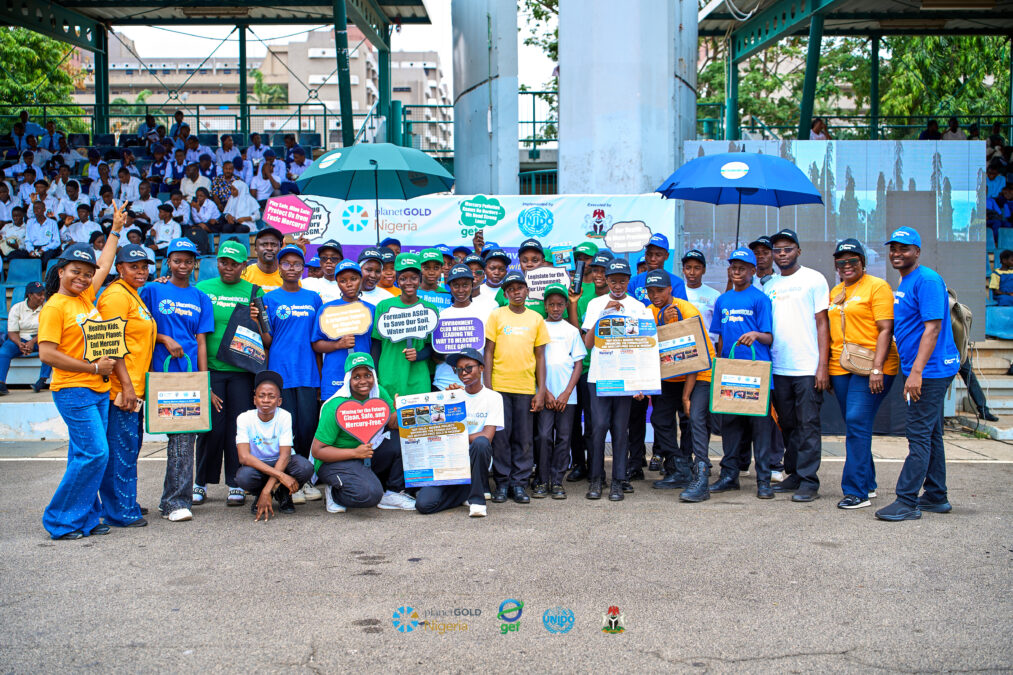
Stakeholders disclosed this on Monday in Abuja during a School Children Advocacy and Sensitisation Campaign organised to commemorate the 2026 Children’s Day celebration with the theme, “Future Now: Effects of Mercury, The Invisible Threat to Nigerian Children.”
Speaking at the event, Omotunde Adeola, Project Coordinator of planetGold Nigeria and Director of the Pollution Control and Environmental Health Department at the Federal Ministry of Environment, said the project was designed to reduce the use of mercury in artisanal gold mining and create awareness on its health and environmental hazards.
According to her, children were deliberately targeted in the advocacy campaign because they could influence their families and communities on the dangers associated with mercury exposure.
“The project is basically for us to reduce the mercury used in gold mining and to let people know the hazards associated with mercury in mining.
“We thought it necessary to collaborate with the FCTA so that we can promote the elimination of mercury among children. They understand that children are the future, and they can easily convince their parents about hazardous things that can affect them,” she said
Adeola warned that mercury exposure had been linked to increasing health complications, especially among children, including damage to cognitive development and vital organs.
She described mercury as a dangerous substance that persists in the environment and is difficult to eliminate once released.
“We want people to know that mercury is dangerous. Mercury persists in the environment, mercury is difficult to deal with, and that is what is being used in gold production to extract more gold from tailings,” she added.
She noted that although mercury remained widely used by artisanal miners, safer and cleaner alternatives were available, stressing that adopting mercury-free mining methods would make Nigerian gold more acceptable in the international market.
“Globally, the advocacy is that gold can be produced without mercury. There are alternatives that are cleaner and more viable. If we achieve this, our gold will be more acceptable globally,” she said.
Adeola further revealed that the Federal Ministry of Environment was collaborating with the Ministry of Solid Minerals Development and other stakeholders to formalise miners and improve their access to finance and modern technology.
Also speaking, Ahmed Bah Ibrahim, Project Technical Coordinator of planetGold Nigeria, said the initiative formed part of a global project being implemented in several countries, including Nigeria, to reduce mercury emissions from artisanal and small-scale gold mining activities.
He explained that the sensitisation campaign aligned with Component Four of the project, which focuses on knowledge sharing, awareness creation, and community sensitisation.
According to him, pilot implementation of the project would take place in Kaduna, Kebbi, Niger, and Zamfara states.
He stated that the artisanal and small-scale gold mining sector accounts for more than 60 per cent of global mercury pollution due to the widespread use of mercury during gold processing.
“The project is trying to minimise mercury emissions globally because the artisanal and small-scale gold mining sector contributes over 60 per cent of mercury pollution,” Ibrahim said.
He added that the initiative also supports Nigeria’s implementation of the Minamata Convention on Mercury, an international treaty aimed at protecting human health and the environment from mercury pollution.
Ibrahim explained that the project planned to introduce mercury-free technologies such as gravitational concentration and cyanidation methods to artisanal miners in order to improve gold recovery and reduce environmental contamination.
“Mercury is a neurotoxin. It affects the neurological development of children, and women are among the most vulnerable groups to mercury toxicity,” he warned.
He further explained that mercury could travel long distances in the atmosphere, bioaccumulate in the environment, and remain non-biodegradable for years.
“Mercury pollution generated in Abuja can travel as far as Ghana, Chad or even Uruguay,” he said.
On financing, Ibrahim disclosed that the project intended to establish a financial committee that would develop frameworks to enable artisanal miners to access the funding needed to transition to cleaner mining technologies.
In his remarks, Chike Ajaero of the Artisanal and Small-Scale Mining Department, Federal Ministry of Solid Minerals Development, said the ministry was working with the Federal Ministry of Environment to ensure the sector became mercury-free.
He noted that formalising miners remained critical to reducing mercury emissions and integrating artisanal mining into the mainstream economy.
“The sector has the highest release of mercury into the environment. Once we get the miners formalised, mercury release will reduce significantly,” Ajaero said.
He explained that the ministry was currently implementing a nationwide drive to organise informal miners into registered mining cooperatives to make them traceable and eligible for government interventions.
“After formalisation, we can engage them better because we have a lot of plans for artisanal miners,” he added.

Join BusinessDay whatsapp Channel, to stay up to date
Open In Whatsapp