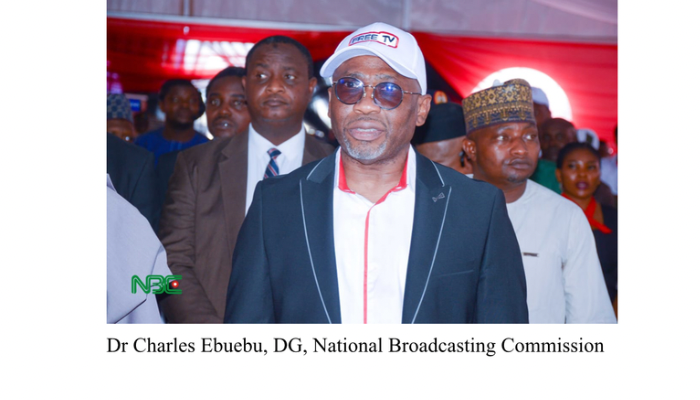
Ibadan — One month after Nigeria relaunched its long-awaited transition from analogue to digital broadcasting, the National Broadcasting Commission (NBC) reports steady progress. The renewed push, which began on 17 June 2026, is driven by a coordinated strategy focused on public awareness, stakeholder engagement, and technical capacity-building.
Recognising past setbacks, the NBC is acting urgently to close implementation gaps and prioritise community outreach and technical preparedness.
Stakeholder Engagements Gather Pace
The NBC has intensified engagement with key industry players, kicking off in Ibadan — historically significant as the cradle of television broadcasting in Africa, where the first station was established in 1959.
Mrs Clementine Usman-Wamba, Deputy Director of Public Affairs and Head of the Digital Switchover (DSO) Unit, took the DSO message to major radio stations including Yes 101.7 FM and Splash 105.5 FM, and participated in the 2026 Broadcasting Summit and the Zonal Induction of the Society of Nigerian Broadcasters.
Hands-On Training Empowers Installers
A key highlight was a specialised capacity-building workshop for satellite television installers, organised by the NBC in collaboration with NigComSat on 17 July 2026 at the NBC Zonal Office in Ibadan.
Mrs Usman-Wamba addressed participants, while Mr Sunkanmi Bello, Deputy Manager and Engineer at NigComSat, delivered technical sessions on the installation and maintenance of Television Receive-Only (TVRO) systems — critical equipment for accessing digital satellite signals.
The Transformative Promise of Digital Broadcasting
The NBC emphasises that the Digital Switchover promises improved spectrum efficiency, superior picture and sound quality, greater channel capacity, and enhanced service delivery. The migration aims to accelerate digital inclusion, stimulate economic growth, and expand opportunities for local content production.
“Digital Switchover is not just about technology; it is about creating an inclusive digital economy and ensuring that every Nigerian has access to quality broadcasting services,” the NBC stated.
Technical Training and Professional Standards
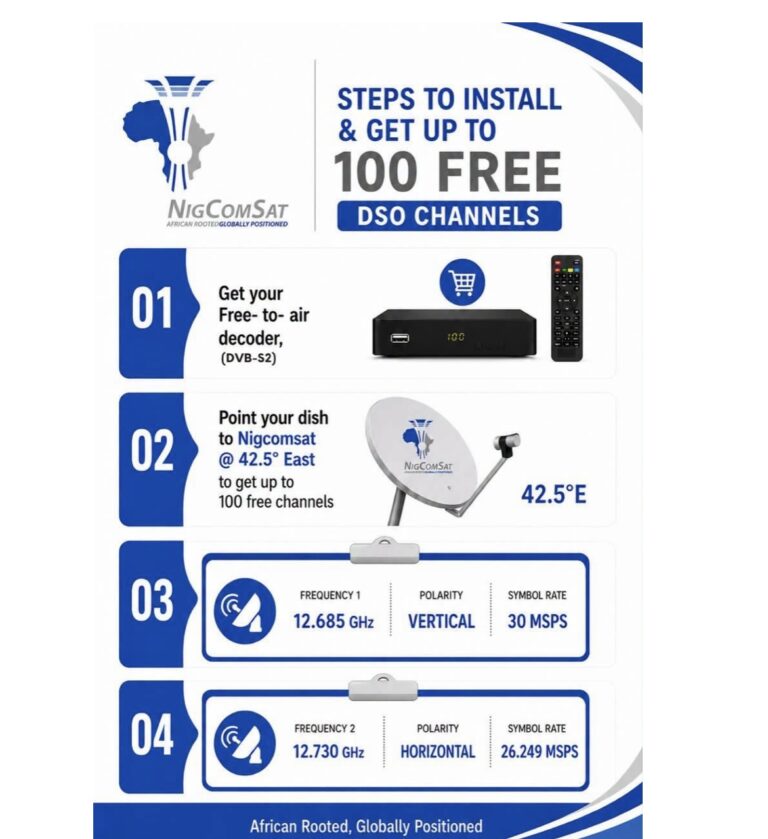
TVRO systems comprise a satellite dish, a Low-Noise Block downconverter (LNB), and a satellite receiver. These systems can receive both Free-to-Air and encrypted Pay TV services. Installers received detailed technical parameters for the NigComSat-1R satellite at 42.5° East, including frequency details:
| S/N | Name | Frequency (MHz) | Symbol Rate | Polarisation |
| 1 | DSO1 | 12685 | 30000 | Vertical |
| 2 | DSO2 | 12730 | 26249 | Horizontal |
Participants were equipped with knowledge of essential tools, including satellite signal meters, compasses, and inclinometers. The workshop emphasised proper installation techniques: ensuring an unobstructed line of sight to the satellite, secure mounting to withstand weather conditions, and adherence to cabling and grounding protocols.
Project Background
Nigeria’s DSO project spans more than a decade with repeated delays. Although a pilot phase launched in Plateau State in 2017, progress remained slow due to funding constraints, regulatory disagreements, and infrastructure gaps. As of April 2026, the NBC reported approximately N80 billion spent over 17 years, yet digital terrestrial signals reached only eight cities.
FreeTV Official Launch
To break the deadlock, the Federal Government officially launched FreeTV on 17 June 2026, marking the nationwide rollout of Nigeria’s digital television migration.
Key features include:
• Free viewing: Over 100 free channels with no monthly subscription fees
• Rich content: News, sports, movies, music, education, and indigenous language channels in Yoruba, Hausa, and Igbo
• Multiple access methods: Set-top boxes, smart TVs with satellite tuners, and the FreeTV mobile application
• Hybrid broadcasting model: Combining Digital Terrestrial Television (DTT), Direct-to-Home (DTH) satellite services, and internet streaming
Minister of Communications, Innovation and Digital Economy Dr Bosun Tijani described it as part of a broader national digital infrastructure strategy. Information Minister Mohammed Idris stated that a fully operational DSO ecosystem would “expand jobs, boost local content production, attract investment and strengthen Nigeria’s creative economy”.
Progress and Challenges One Month After Launch
Progress Made:
1. Nationwide hybrid coverage launch: The project adopted a hybrid model combining DTT, DTH satellite, and mobile applications
2. Stakeholder engagement**: A DSO Stakeholders Consultative Forum on June 16 convened 128 participants who endorsed the hybrid framework
3. Industry mobilisation: Plans initiated for regional production centres in Lagos, Abuja, Port Harcourt, Enugu, Kano, and Benin
Major Challenges
1. Legal and model legitimacy disputes: The Broadcasting Organisations of Nigeria (BON) argues that under the International Telecommunication Union’s GE06 Agreement and Nigeria’s 2012 DSO White Paper, digital migration is defined as transition to Digital Terrestrial Television, not satellite broadcasting.
2. Regulator conflict of interest: BON has raised concerns that the NBC, as industry regulator, is becoming a content aggregator on FreeTV — creating a conflict of interest. As one critic put it: “Is the referee now playing the match?”
3. Hidden costs: While the service has no subscription fees, households must purchase satellite dishes and decoders ranging from approximately N5,000 to N20,000, plus professional installation. Critics argue this imposes a heavy burden on low-income families compared with cheaper antennas used for DTT.
4. Historical trust deficit: The DSO’s long history of delays and financial concerns — N80 billion spent over 17 years with limited results — has left stakeholders sceptical.
5. Infrastructure gaps: FreeTV’s reach depends on patchy digital terrestrial infrastructure, with expansion prioritising state capitals before rural areas.
Future Outlook
Nigeria’s final transition from analogue to digital broadcasting remains scheduled for 31 December 2028. Key areas to watch include:
– Legal resolution: How the government responds to BON’s legal challenges
– Infrastructure rollout: Whether the hybrid model achieves meaningful coverage, particularly in rural areas
– Equipment affordability: Pricing and accessibility of set-top boxes critical to user growth
– Content strategy: Quality and variety of programming will determine viewer retention
The DSO and FreeTV project have successfully taken the critical step from planning to implementation in its first month. The NBC is resolutely tackling gaps through training, stakeholder engagements, and upcoming town halls. As Nigeria’s Digital Switchover advances, the Commission remains committed to a smooth, consumer-centric process that delivers the full benefits of digital broadcasting to all citizens.

Join BusinessDay whatsapp Channel, to stay up to date
Open In Whatsapp