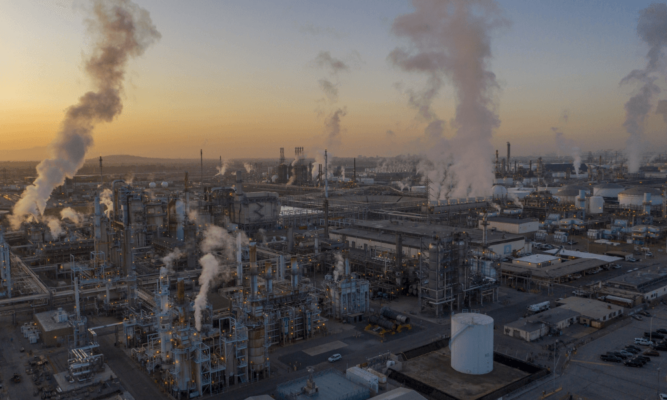
Despite ratifying the Paris Agreement in May 2017, experts say Nigeria presently shows little sign of meeting its unconditional target of a 20% reduction in greenhouse gas (GHG) emissions by 2030 and of achieving net-zero by 2060.
The country’s emissions grew at a compound annual growth rate of 1% from 1990 to 2021, according to reports, with emissions from gas flares, methane, and other sources expected to reach 350–400 MtCO₂e per year by 2030.
Nigeria ranks 25th globally and second in Africa in greenhouse gas (GHG) emissions.
Ikechukwu Ahaka, Lead Project Officer at the Media Awareness and Justice Initiative (MAJI), a non-governmental organisation, says the country needs to take decisive steps to cut GHG emissions by 35%.
He was speaking at a press briefing on Friday, 5 June 2026, held in Port Harcourt to commemorate World Environment Day 2026, with the theme “Inspired by Nature. For Climate. For Our Future.”
Ahaka said, “Nigeria is a signatory to the Paris Agreement. We committed to reduce greenhouse gas emissions by 35% by 2030 and to reach net zero by 2060. As a result, the country currently ranks second in West Africa, behind South Africa, whose greenhouse gas emissions are very high because it relies on coal for energy.
“For Nigeria, we don’t use coal at the level seen in South Africa. What mostly affects us is gas-flaring and methane pollution from multinational oil and manufacturing companies in the country.
“For three or four decades Nigeria has repeatedly pushed back the deadline to end gas flaring. Every year the government gives an excuse for why it cannot stop flaring. We think that’s enough. The Nigerian government must bring gas flaring to a definitive end,” he said.
Ahaka further noted, in a statement read alongside Comfort Ilesanmi, Project Officer, that the “constant environmental challenge from severe oil exploration, industrial activities and indiscriminate human‑induced pollution continues to degrade air quality and threaten community health across the Niger Delta region.
“On this World Environment Day 2026, the Media Awareness and Justice Initiative (MAJI) reaffirms its commitment to protecting nature and driving evidence‑based climate action through stakeholder capacity building, low‑cost real‑time environmental monitoring, and the compilation of relevant data for qualitative and quantitative policy advocacy, campaigns, and stakeholder engagement,” he said.
Ahaka said MAJI’s Strengthening Data for Climate Action in Nigeria (SD‑CAN) project, supported by the United Nations Democracy Fund, is delivering real‑time air quality data through the deployment of low‑cost monitoring devices across communities in Akwa Ibom, Bayelsa, and Rivers states.
He explained that the automated sensors capture live pollution data, which is analysed and published on the DATACAB environmental portal, providing access to reliable environmental information for communities, civil society organisations, journalists, government agencies, and other stakeholders.
He added that the initiative has also prioritised capacity building for community actors, government institutions, media professionals, researchers, people with disabilities, and civil society organisations, equipping them to use data-driven tools for environmental monitoring, protection, and governance.
Ahaka said, “Our project, Strengthening Data for Climate Action in Nigeria (SD‑CAN), implemented with support from the United Nations Democracy Fund (UNDEF), is providing relevant and important real‑time air quality data through the deployment of low‑cost air quality monitors in communities and localities in Akwa Ibom, Bayelsa, and Rivers states.”
“These automated sensors collect live pollution data, which are analysed and made available on the DATACAB environmental portal.
“This data‑driven platform helps community groups, NGOs, journalists, government agencies, and concerned citizens who are aware of the current air quality situation make better climate decisions and hold polluters accountable,” he added.
Ahaka noted that MAJI’s approach aligns with global climate action efforts by promoting open, transparent, and accessible environmental data, which enables communities to drive evidence‑based advocacy and support policies that safeguard public health and livelihoods across the Niger Delta.
He urged the Federal Government to enforce the ban on gas flaring, describing it as a major source of environmental pollution, climate change, and the erosion of livelihoods in host communities.
Ahaka called for stronger stakeholder engagement and wider public sensitisation in both rural and urban areas affected by climate change, while urging oil companies operating in the Niger Delta to end oil pollution and gas flaring.
He said, “We call on the Federal Government to end all forms of gas flaring, which have already been criminalised in Nigeria, as they contribute significantly to environmental pollution and have severe impacts on lives, livelihoods, and the climate.
“We urge environmental agencies and relevant stakeholders to adopt technological tools and inclusive strategies to strengthen environmental protection.
“We also call on the Federal Government to reinforce environmental regulatory agencies with the necessary policies, manpower, and technology to ensure effective enforcement of environmental laws.
“MAJI calls for multi‑stakeholder collaboration and inclusive awareness campaigns for rural and urban communities affected by climate change and urges oil companies operating in the Niger Delta to stop indiscriminate oil pollution and gas flaring activities,” he said.
Ends/

Join BusinessDay whatsapp Channel, to stay up to date
Open In Whatsapp