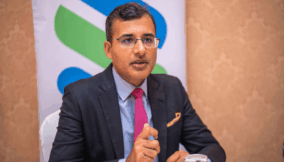
Adesola Adeduntan, chief executive officer (CEO), First Bank of Nigeria Limited spoke to BusinessDay Editor Anthony Osae-Brown and Iheanyi Nwachukwu in this exclusive interview. Excerpts
We have looked at your latest result. What are the major issues here and how well is the bank dealing with them?
One particular public document I will always like to reference is the analyst’s note that was prepared by Rencap following my announcement as the CEO of the bank. Rencap basically said this is going to be a turnaround story and they highlighted what they believe should be three key areas of focus –asset quality, cost management and cost optimisation, and capital management.
What we basically have been doing since we assumed office is what I refer to as enterprise transformation and when you do enterprise transformation, you are looking at your people, processes, policies, and the technology that underpin what you are doing.
Areas of focus
For us, over the last 16 months, we have zeroed in on the things that we want to focus on. One is that we focus on the area of business growth –what is it that we want to do that will grow this institution. Basically that ties into our gross earnings.
The next is the issue of cost management and optimisation. The other thing is our profit and loss account or the cost of risk. That is where our risk management and control capabilities come in.
Changing the way we do business
We are a full service bank. When I mean full service bank, we do corporate banking, commercial banking, public sector banking (government and government agencies), and retail banking –that is from a customer segment perspective. Prior to now, we have always rendered some of those services through our brick and mortar –that is our head office here and our branches.
First Bank has the largest branch network in the country with over 700 branches and also present in about 7 countries outside Nigeria. It is actually a financial supermarket. Our focus since the beginning of last year has been not just to grow the customer base but to grow the customer base in a profitable manner and that is why our focus has been on digital banking –that is migrating our customers away from our branches to other channels such as ATM, online banking, mobile banking, and the latest being the USSD.
Meeting the changing needs of our customers
Banking is moving away from the era of armchair banking to the experience that the customers go through when they come in contact with you through all your channels. First Bank has invested significantly in all its delivery channels. Today, First Bank has the largest ATM network in the entire market. About 25 percent of the ATM in this country belongs to First Bank.
When you look at our firstmobile, the enrolment and the number of first users is one of the highest.
The USSD (that is *894#) banking has also ramped up significantly. We have always had it but with very limited features before but we re-launched it in the last quarter of last year and from the growth trajectory that I see, it becomes clear about the growth potential.
Targeting customer growth to 30 million
Our objective is over the next three years, we want to grow our total number of customer accounts to 30 million. We are currently about 14million –give or take. It is quite ambitious but we believe that we have what it takes to deliver.
New corporate banking structure
We have also restructured what we use to call our institutional and corporate banking to form what we call a new corporate banking. What we did was that we head-hunted a top talent in an international bank, a Nigerian who had huge African and Nigerian experience. He has been with us now for about a year. He now heads our corporate banking business.
Rising efficiency
In absolute numbers, our total expenses fell. The total expense for 2016 in absolute term is lower than the total expense that was incurred in 2015. Put that on the back of the fact that we had inflation of about 18percent, there was massive devaluation and there was a general rise in the price of goods and services. So for us to have recorded that kind of drop it gives you the idea of the amount of work that has gone up in terms of optimisation.
The other statistics that is also very important in the result that we have just released is the cost-to-income ratio, which dropped. Getting cost to income ratio of an institution to drop from 63%, which was where we were for about the end of 2015 to come, done to even 50% is a huge amount of work and we are not relenting.
In fact I believe it is when we complete some of the structural changes including decentralization of transaction processing, the automation of our middle office using the oracle enterprise resource planning system and the enterprise oracle enterprise system, it will help optimise out cost management system further.
How are you dealing with the significant NPL position of the bank?
Again let me take some step back and remind you of what I have said. We made N249billion pre-provision profit. In making a provision of N226billion impairment charges from our normal business flow tells you we have the capacity to deal with our NPL without touching our capital. So to put it simply, we have drawn the line on our NPLs. We are fixing the portfolio that we inherited.
But going forward, we are creating new business lines that generate sufficient revenue that allows us to deal with what we inherited without eroding the capital. If you look at last year, we took about N150bn to N160bn in impairment charges and we did not touch our capital. So that is the strength of our business because we have the ability to generate strong earnings.
How fast would the strong earnings we are seeing translate into the bottom line?
If you look at our result in 2016, it is better than 2015, I can assure you that 2017 will be better than 2016, so what we are going to see is that as we deal with these issues you will see the impact in improvement in the bottom line. For us, we know what the issues are and we are dealing with them and we believe that all the measures we have deployed will ultimately lead to significant shareholders value.
Would you advise investors to consider your stock as one of their top picks?
I will say that First Bank is the stock to buy. We have succeeded in building a very strong leadership team, and when you look at the quality of the board, when you look at the quality of the franchise and when you look at where the share price of the listed entity is trading today, for me what I see is up-side, up-side, up-side.
Your e-banking growth is quite impressive. What are you doing to improve on it?
We are the only the bank that processed up to a 100 million electronic transactions in a month, and we have been recognized by Interswitch more than twice, and that is just for transactions that go through Interswitch which means we have more because there are transactions that are processed that do not go through interswitch.
Where do we see this going from here, what are your targets in this direction?
Let me go back to what I have said before, part of the strategic repositioning that is going on at first bank is we are transiting the institution from a credit led institution to a transactions led institution. And that is very significant, when you are a transaction led institution, that means your IT, your processes, your people, everything must be geared towards transactions velocity. I also did mention to you that our USSD *894# is the fastest growing USSD platform, the same thing with our firstmobile, so all this are geared towards growing our noninterest income.
But over and above that we have restructured our corporate banking and that is where we interface more with the cooperate and we provide them with our cash management solutions and trade finance solutions which are also geared towards improved customer satisfaction.
When you have a strong transaction banking capability and you have a strong digital banking capability, it will show up in your noninterest income, so when we say we are moving the institution from a credit led institution to a transaction led institution, what you will continue to see is that we will grow our noninterest income.
Can you briefly speak on your oil sector loans?
As you know, since 2012, the government has being talking about local content and encouraging Nigerians and Nigerian entrepreneurs to participate in the oil and gas sector, indeed you will recall that the international oil companies especially Shell and to some extent Chevron sold a chunk of their onshore assets to Nigerian players. First Bank being who we are, we see our self as a Nigerian bank and fully imbedded in the economy of the country, we financed a number of those institutions and with the sudden and drastic drop in the price of crude that happened in the course of 2015, we were adversely affected.
You are also right that oil price is recovering and we do think it will go back in the near term, in fact in the medium term to where it was, because the price of crude went as high as USD114, it reached its peak in 2014 before it started dropping and it went as low as USD27 to a barrel and it is currently hovering between USD50 and USD55.
We have restructured our oil and gas portfolios in line with current realities and we will begin to see improvements but because the stringent application of some accounting rules, you will still need to recognize the impairment for some of them pending when you have sufficient cash flow to deal with the matter.
Would you mind sharing with us at what price you restructured?
No because you know it varies based on the individual fields and the circumstances of each of credit facility. It differs but we are making progress in that area.
Can you take us through some practical things that have changed in your risk management practices that will ensure that what has happened in the past will not reoccur in the feature?
A number of things have changed, I have spoken about how the leadership of the risk origination on the corporate side of the organization has been changed and how we have recruited a new chief risk officer, we have redefined our risk appetite. The risk appetite of a finical institution or a bank defines the kind of risk you are willing to take and how you will manage it, it also defines the risk you are not willing to take.
So what we have done generally is to lower our risk appetite compared with what it used to be before, so certain credits that we did in the past, if they come in today, because they will no longer meet our risk acceptance criteria they will not pass.
We have also strengthened our credit monitoring capabilities so that we can look after the right governance level, be it at the management level or at the board level.
The most important thing is around people. We have also redefined the approval levels and the monitoring process. But equally very important you know I spoke about people, process and technology, we also deploying the enterprise risk management solutions to enable us strengthen that, there is always so much that we can do manually but when you have technology that assist you in credit monitoring it enhances the overall effectiveness.
Going back to the NPL, because it is the biggest issue on your books, have you done any analysis on what percentage of this classified loans can be recoverable in the next one or two year?
There are different models for managing NPLs when they are sizeable. The model at First Bank is that we will manage our challenged portfolio internally and that is what we are doing and we have recruited people with the right skill set and capabilities to enable us do that, and we believe that at the end of the day, we will be fine.
So you are not thinking of the Ecobank model in any way?
We have adopted our own model and like I said, there are different models. One model was what was adopted by CBN some years back when we had AMCON. Ecobank has also adopted their own model but before Ecobank we have implemented our own model where we opted to manage that portion of our balance sheet that is challenged internally.
Would you want to expatiate on that briefly?
It is essentially what they do but the most important thing is to have the people with the right skill set and the right capabilities to help you and that is what we have done. All I can tell you is that it is an area of focus for the leadership of the institution both at the management and board levels, and we are giving it our best short, so when an institution with our kind of reputation and rich pedigree says it is given something its best short, you can be sure we are giving it our best short.
We have to go a little bit into the economy itself, you deal with a lot of customers, are we seeing a recovery of the economy from last year’s very low point, from where you are sitting?
There is a general sense of positivity here. It is almost like a self-fulfilling prophecy. When people expect negative thing, it tends to happen. When people are positive about the outcome, it tends to happen. What we have seen is that there is a general sense of positive optimism.
It is actually on the back of corporate firms –most especially if as a nation, we survived when the crude oil dropped as low as $27/barrel, we can indeed survive now that the price of crude oil is hovering between $50 and $55 per barrel.
There has also been a significant growth in terms of oil production which dropped significantly at some point and now we are almost meeting our OPEC quota. From the price perspective, things have recovered and from the volume of production perspective things have recovered.
Improved dollar liquidity
There is also a bit more of dollar liquidity in the market. We have also seen that the CBN has injected a significant amount of dollar liquidity into the economy in the last four months. The governor has successfully created several windows through which dollars are made available to eligible buyers.
We have successfully achieved a convergence in the exchange rate. There is also optimism that when the budget is passed, the level of government spending will also help boost the general economic activities in the country. In general, I think we are seeing a positive outlook as far as the economy is concerned.
What is the target for loan growth in 2017?
First Bank has always been very open for business, when you talking of loan growth, there are two things that are of importance to how fast you can grow, one you talk of liquidity that the institution has available. Today we are very liquid indeed our liquidity over the last one year is around 50% which is way in excess of what is required by regulation, if you also look at the capital adequacy ratio of the bank in the published account of the bank you will also notice that we are close to 18%.
The indices are quite strong and that means we have enough headroom to lend. What will constrain lending is the availability of quality credit that will meet our new risk appetite, which are very clear in what we can do and what we will not do. So if any credit comes today that meets our risk appetite, we have the liquidity and the capital to support it.
But do you have any guidance on loan growth this year?
We do, we have generous headroom that allows us to grow and the constraint will not be on our side.
Eurobonds exposures! Are you in anyway looking at refinancing it or are you looking at a new issue, what do you want to do considering the outlook on the naira dollar exchange rate?
As a financial institution part of what we do is to continuously evaluate our funding needs and our funding position and to ensure that we make the best use of the opportunities that the market presents to us, so as far as tapping into the market in general is concerned, it is a continuous process of evaluating our needs and where the market is, to ensure that we don’t miss market opportunities. It is a continuous process of evaluation and re-evaluation.
So it is something you are looking at?
We looked at it last year, every year we look at it to see where our need is, where is the market, where is the sub-segment of the market, where can we meet our needs, and that could be anywhere.
Any capital raising plans?
Our capital adequacy ratio is good but it is also good to fortify your balance sheet so if during cause of the year, like I said, there are a couple of strategic variables that as a financial institution we will continuously evaluate, then you look at the market. Where we are, let us be clear on capital, we are roughly 18% so we are comfortable, however if there are opportunities for us to fortify our balance sheet, we will go ahead. But we are not under pressure.

Join BusinessDay whatsapp Channel, to stay up to date
Open In Whatsapp