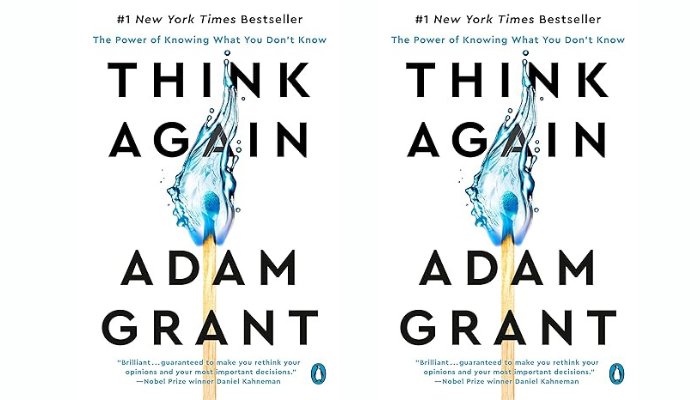
In a business environment defined by disruption, uncertainty and rapid technological change, the ability to rethink may be one of the most valuable leadership skills. While many organisations celebrate confidence and conviction, Adam Grant argues in Think Again: The Power of Knowing What You Don’t Know that success increasingly depends on the willingness to question assumptions, admit mistakes and change course when circumstances demand it.
Grant, an organisational psychologist and professor at the Wharton School of the University of Pennsylvania, presents Think Again as a defence of intellectual humility. The book challenges the belief that changing one’s mind signals weakness, arguing instead that the capacity to revise opinions is a sign of learning, adaptability and effective decision-making.
For business leaders, the argument is particularly relevant. Companies rarely fail because they lack intelligence or resources; many fail because they become trapped by outdated assumptions. Grant’s central message is that organisations and individuals must develop the discipline to constantly examine what they believe they know.
The book opens with the 1949 Mann Gulch wildfire tragedy in Montana, where 13 firefighters lost their lives after a rapidly changing fire environment exposed the dangers of rigid thinking. Grant uses the event to illustrate how established beliefs can prevent people from recognising new realities. The story sets the foundation for his broader argument: survival and success often depend on the ability to rethink.
Grant divides the book into three parts: individual rethinking, interpersonal rethinking and collective rethinking.
The first section explores how people develop and defend their beliefs. Grant identifies three common approaches to disagreement: the preacher, who defends beliefs as absolute truths; the prosecutor, who focuses on proving others wrong; and the politician, who seeks approval from others. He argues that a more productive approach is to think like a scientist testing assumptions, examining evidence and being prepared to change conclusions when new information emerges.
This idea carries significant implications for executives and entrepreneurs. In fast-changing markets, strategies that once delivered success can quickly become liabilities. Businesses that refuse to question their models risk losing relevance, while those willing to experiment and adapt are better positioned to compete.
One of Grant’s most important arguments is that people should separate their identity from their opinions. When individuals define themselves by values such as curiosity, learning and improvement rather than fixed positions, they become more comfortable accepting new information. This principle is especially relevant for leaders managing organisations where innovation depends on challenging existing practices.
The second part of the book focuses on interpersonal rethinking and the challenge of communicating across differences. Grant argues that effective persuasion is not about winning arguments but about listening, asking better questions and helping others reconsider their own assumptions.
This lesson is increasingly important in workplaces where diverse teams must collaborate despite differences in experience, background and perspective. Grant shows that productive disagreement does not have to become conflict; when approached with curiosity, it can become a source of creativity and better decision-making.
The final section examines collective rethinking and how organisations can build cultures that encourage learning and innovation. Grant highlights the importance of creating environments where employees can question established processes without fear of punishment. For companies navigating economic uncertainty, technological disruption and changing consumer behaviour, such cultures can become a competitive advantage.
However, while Grant’s argument is persuasive, the book has limitations. The biggest challenge is that it sometimes underestimates the practical barriers that prevent individuals and organisations from rethinking. In many companies, changing an opinion is not simply a matter of embracing curiosity; it can involve challenging powerful interests, admitting strategic failures or confronting organisational cultures that discourage dissent.
Grant’s emphasis on scientific thinking is also compelling but may be difficult to apply universally. Business leaders often make decisions without complete information, under intense time pressure and with significant financial consequences. Not every decision can be subjected to continuous testing and revision. In some situations, speed, experience and decisive action may matter more than prolonged reconsideration.
The book also relies heavily on examples of exceptional individuals and organisations that successfully embraced change. However, the realities of most businesses are more complicated. Companies with limited resources, rigid hierarchies or weak leadership structures may struggle to create the kind of psychologically safe environments Grant recommends.
Furthermore, readers familiar with behavioural psychology may find some of the ideas familiar, particularly those related to Carol Dweck’s growth mindset and concepts around learning and adaptability. While Grant adds value by focusing on the importance of unlearning, the book occasionally revisits themes that have already received significant attention in management literature.
Despite these limitations, Think Again succeeds because it transforms complex psychological research into practical lessons for everyday decision-making. Grant combines academic studies with real-world examples to show how individuals and organisations can improve the way they learn, communicate and lead.
The book’s relevance extends beyond corporate leadership. In an era of misinformation, political division and rapid change, the ability to reconsider assumptions is becoming increasingly important across society. For businesses, the lesson is clear: the organisations that thrive will not necessarily be those with all the answers, but those willing to continuously search for better ones.
Ultimately, Think Again is a valuable contribution to the conversation about leadership and decision-making. Its greatest strength is reminding readers that knowledge alone is not enough; the ability to question, adapt and learn is equally important. However, Grant’s ideas require more than individual willingness; they require organisational structures that genuinely reward openness and allow people to challenge established thinking.
For executives, entrepreneurs and professionals seeking to improve decision-making, Grant offers an important lesson: intellectual humility can be a competitive advantage, but only when organisations create the conditions for people to practise it.

Join BusinessDay whatsapp Channel, to stay up to date
Open In Whatsapp