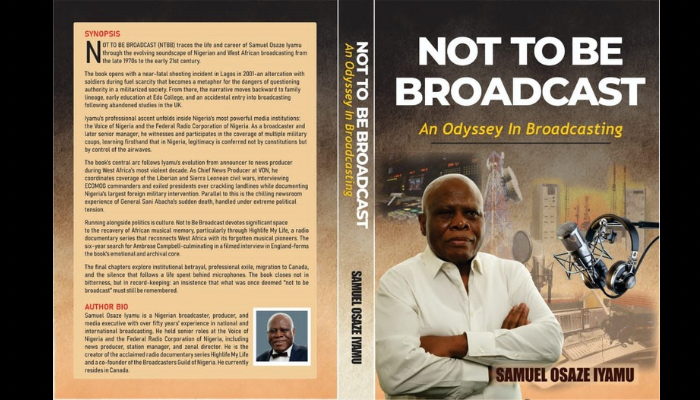
Samuel Osaze Iyamu (2026). Not To Be Broadcast: An Odyssey in Broadcasting. ISBN: 978-1-0675436-0-0; Hardcover ISBN: 978-1-0675436-1-7; Paperback ISBN: 978-1-0675436-2-4, eBook ISBN: 978-1-0675436-3-1
Raw honesty, cultural excavation, and lived institutional knowledge anchor this memoir, which refuses to let crucial stories fade. Not To Be Broadcast (NTTB) weaves together personal genealogy, a thirty-five-year career in Nigerian public broadcasting—primarily at Voice of Nigeria (VON) and the Federal Radio Corporation of Nigeria (FRCN)—institutional politics, national turbulence, and a passionate recovery of African musical heritage, especially Highlife and Afrobeat.
Essential reading for students of Nigerian media, West African popular music, and the politics of broadcasting, Iyamu’s work distils three decades of microphone time into a document that speaks plainly when silence would be safer.
Summary
The memoir opens with a gripping prologue: a 2001 encounter at a Lagos petrol station in which Iyamu questions preferential treatment in a fuel queue, and soldiers respond with gunfire. This incident becomes the book’s central metaphor—the price of speaking plainly in a society where voice and power are perpetually contested.
From there, the narrative moves back through Iyamu’s Edo and Ijesa lineage, his formative years at Edo College, and his accidental entry into broadcasting after abandoning his studies in England. His professional ascent unfolds across Nigeria’s most powerful media institutions.
The book is organised into seven parts. Part I covers his origins and early career, including the creation of *Radio Express*, a breakfast programme that revitalised Radio Nigeria Lagos, which had been moribund. Part II explores broadcasting amid political upheaval, documenting coups and the civil wars in Liberia and Sierra Leone, where, as Chief News Producer at VON, Iyamu coordinated ECOMOG coverage. Part III traces Nigerian music on air—from Highlife through Afrobeat to Afrobeats—featuring deep reflections on Fela Anikulapo-Kuti, Tony Allen, and Benson Idonije.
Part IV, the emotional and archival core, recounts Iyamu’s six-year quest to locate Highlife pioneer Ambrose Campbell, culminating in a filmed interview in Plymouth and subsequent disputes over custody of recovered memories. Parts V and VI detail institutional betrayals: the France ’98 broadcast rights scandal, the ambitious but failed Compliance and Content Monitoring (CCM) project, and the stalled Digital Switch Over (DSO).
Part VII follows his retirement, a seven-year litigation over power modules, and his migration to Canada, where he founded i-LifeRadio, a streaming station dedicated to African classics. The epilogue concludes: “The music does not need us to survive. But it needs us to pay attention.”
Strengths
1. Insider’s Witness to History
Iyamu’s firsthand perspective on Nigerian broadcasting during its most turbulent decades is invaluable. His account of coup coverage—the martial music, the seizure of Broadcasting House, the careful calibration of tone—shows how radio functioned as both target and instrument of power. The chapter on Abacha’s death captures newsroom tension with surgical precision: “Scripts were rewritten in minutes. Sources were verified obsessively. Language was weighed.” His coverage of ECOMOG operations in Liberia and Sierra Leone offers rare broadcast-side documentation, including interviews with commanders Victor Malu and Maxwell Khobe, and with Sierra Leonean president Ahmad Tejan Kabbah from exile.
2. Cultural Recovery as Broadcast Mission
The book’s most distinctive contribution is its treatment of music as a form of broadcast memory. The Ambrose Campbell pursuit unfolds with the suspense of a detective narrative and the gravity of archival rescue. Iyamu’s insistence on provenance embodies ethical custodianship. The *Highlife My Life* project, syndicated across eighteen FM stations via MTN advertising, illustrates broadcasting as cultural infrastructure rather than mere entertainment. His insistence that “Afrobeat did not replace highlife. It absorbed it, stretched it, argued with it, and then repackaged it for a world that was already listening” challenges origin narratives that privilege individual genius over collective process.
3. Institutional Ethnography
For readers interested in how Nigerian public institutions actually function, the book provides granular detail. The France ’98 rights scandal exposes how contracts become negotiable after signing. The CCM project—a technologically ambitious attempt to create automated broadcast monitoring—fails not because of a technical flaw but because “Nigeria was not ready to be seen.” The seven-year litigation over power modules reveals how systems protect themselves through procedural delay: “Inflation and legal costs devoured the victory. Financially, I lost. But I saw the system blink.” Iyamu’s analysis of the HND/B.Sc dichotomy as a weapon of institutional control offers a case study in bureaucratic warfare.
4. Prose, Structure, and Courage
The writing is often powerful. The prologue achieves Hemingway-like compression: “Gunshots cracked behind me. Ikorodu Road blurred into flight.” Iyamu writes with unfiltered directness about abuses of power, corruption, and personal battles—rare courage in a context where such accounts are scarce. The book fills a significant gap: while Nigerian political history is well documented, broadcasting’s role as both witness and participant has received far less attention. Iyamu’s work joins a small shelf of Nigerian broadcast memoirs and extends beyond memoir into institutional and cultural history.
Weaknesses
1. Structural and Editorial Issues
The text reveals organisational problems: inconsistent chapter numbering, page restarts, and repetition. The Ikorodu Road shooting appears in both the prologue and Part I. The 1990 Orkar coup is described multiple times with nearly identical language. A sharp editorial hand could reduce the length by 15–20% without loss of content.
2. Uneven Pacing and Selective Candour
Some chapters function as discrete essays that interrupt narrative flow; others descend into operational detail that may interest specialists but try general readers. The Ambrose Campbell section’s custody disputes feel defensive, disrupting the emotional arc. More significantly, Iyamu is candid about institutional betrayals but circumspect about personal relationships. His divorce passes in a single sentence. His own missteps—acquiring France ’98 rights without written guarantees, giving controlling interest in the CCM project to external investors—go under-examined. The reader infers lessons the author does not explicitly draw.
3. The Global Frame and Technical Density
Despite the subtitle’s claim to “global broadcasting,” the book is resolutely Nigeria-focused. The Canada chapters are brief, and engagement with international broadcasting literature is limited. Technical passages on transmitters, audio fingerprinting, and multiplex access assume familiarity; while a glossary is provided, clearer explanations would help non-specialist readers.
Contribution to Literature
Nigerian Broadcasting History
The book establishes itself as a primary source for understanding Nigerian broadcasting from the late 1970s through the early 2000s. Iyamu’s roles—announcer, producer, news editor, station manager, zonal director—give him a vantage across institutional levels. His documentation of coups, coverage decisions, and editorial pressures provides material for future historians that existing secondary sources lack. Unlike Olu Ladele’s antiseptic History of the Nigerian Broadcasting Corporation (1979), Iyamu does not avoid politics. Dr Christopher Kolade, as DG, commissioned the work to mark 20 years of the FRCN.
Iyamu was here earlier in Voice of Nigeria at Thirty: Quo Vadis (2020) by Ben Egbuna and Osaze Iyamu. Then there is Vincent Maduka (2022), Reel Life: My Years Managing Public Service Television.
African Media Studies
Within African media studies, the book offers a rare longitudinal account of a single broadcaster’s career across political regimes. Iyamu’s movement between VON and FRCN, and his engagement with both the public and private sectors, provide connective tissue missing from more narrowly focused studies. His frustration with institutional capture echoes arguments by scholars such as Helge Rønning and Keyan Tomaselli, but from within the system rather than from academic distance.
Music and Broadcasting
The book’s treatment of Highlife, Afrobeat, and Afrobeats as broadcast phenomena is its most original scholarly contribution. The *Highlife My Life* material, particularly the Ghana chapter documenting exchange between Nigerian and Ghanaian musicians, is a valuable primary source for scholars of West African popular music. Iyamu’s discussion of Tony Allen as rhythmic architect and Benson Idonije as custodian models a form of music writing that takes broadcast infrastructure seriously.
Memoir as Method
The book exemplifies a particular form of African memoir: the insider-outsider account that uses personal experience to illuminate institutional dysfunction. It joins works such as Wole Soyinka’s The Man Died and Chinua Achebe’s There Was a Country in using a first-person narrative to document state failure and personal survival. Iyamu’s refusal to be bitter distinguishes his account: “What happened to me was not personal. That is the most damning truth of all. It was routine.”
Conclusion
*Not To Be Broadcast* is an important, critical, and ultimately valuable work. Its strengths—insider witness, cultural recovery, and institutional ethnography—outweigh its structural unevenness and occasional defensiveness. For readers interested in Nigerian history, African broadcasting, and the relationship between music and memory, the book offers material unavailable elsewhere.
Iyamu’s central insight—that “broadcasting is never neutral. What it chooses to carry, how it frames it, and how often it repeats it determine what survives as memory and what dissolves into anecdote”—is both a professional credo and an argument for taking media seriously as a historical actor. The book itself, by documenting what was almost lost, performs the custodial work it describes.
The subtitle promises “an odyssey in broadcasting,” and the book delivers: a journey across decades, institutions, continents, and genres, driven by the conviction that voice, properly exercised, can hold power accountable and memory intact. That the journey leaves the author exhausted but unembittered—“I fought. I won. And still, I lost. But I left with something the institution could not confiscate: the certainty that resistance, even when costly, still matters”—gives the work its moral weight.
For the history of Nigerian broadcasting, the book is essential. For African media studies, it is a significant contribution. That it is also, at its best, a compelling read makes it accessible to audiences beyond specialists. The book’s final words—“If someone listens deeply, truly listens, the work continues”—are both an epitaph for Iyamu’s career and an invitation. Not To Be Broadcast deserves deep listening. The work it documents, and the work it is, will continue.

Join BusinessDay whatsapp Channel, to stay up to date
Open In Whatsapp