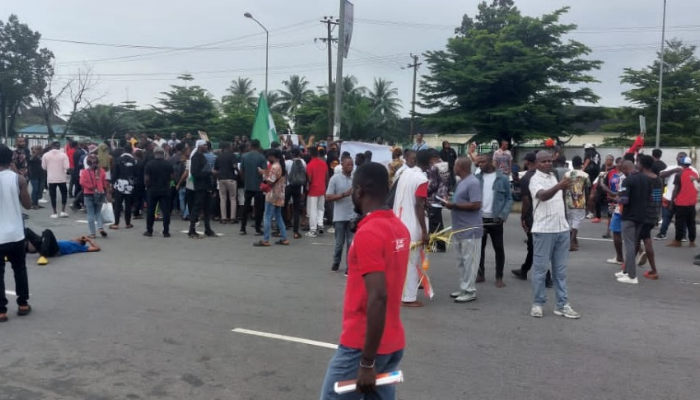
Youths, civil society actors and other stakeholders in Rivers State led by the ‘Take It Back Movement’ on Friday joined the nationwide protest against worsening insecurity across the country.
The protest march began early at the Federal Secretariat Complex along Aba Expressway, Port Harcourt and culminated at the Government House.
Enefaa Georgewill, National Organising Secretary of the group, said the protest was “called nationally, across the country, to protest against hardship, insecurity, banditry, poor governance and police brutality.”
Georgewill pointed to “the very recent Ogbomoso incident, where students were kidnapped, one of them beheaded and ransom demanded,” and to all forms of banditry going on around the country.
He then narrowed the situation to Rivers State, “where a young girl, Miss Favour, was kidnapped in her father’s house around the Elelenwo area (Obio/Akpor LGA), and two years after, the police have failed to produce the girl, even when we have traced the kidnappers into Enugu Prison.”
Read also: Democracy must be protected, renewed, EU tells Nigeria on Democracy Day
Georgewill said the protest also condemned what they described as the political strangulation of Rivers State, a situation that is almost grinding governance to a halt in the state.
The protesters accused Abuja-based Rivers politicians of hamstringing Siminalayi Fubara, Governor of Rivers State, from effectively governing, urging that he should be allowed to perform his constitutional role “for the one year he has left.”
Georgewill stressed that all sectors in the state, education and others, are feeling the slowdown in government activities.
He said, “On the specific of Rivers State, we are still saying that the continuous political strangulation of the state, where there is movement without progress, where the president is now the one controlling what happens in Rivers using his agent, the minister of the FCT, should stop.”
Meanwhile, in neighbouring Bayelsa State, there was heavy tension and disruption of vehicular movement at Igbogene Junction, the major gateway into Yenagoa, the state capital as protesters barricaded the road, leaving commuters, travelers and residents stranded.
The protest, which was part of a broader nationwide demonstration marking Nigeria’s Democracy Day, centred on growing public frustration over economic hardship, insecurity, unemployment, rising cost of living, inflation and worsening social conditions across the country.
Civil society groups and activists had earlier declared June 12 a day of mass action to draw government attention to the plight of ordinary Nigerians.
Eyewitnesses at Igbogene Junction reported that protesters occupied strategic sections of the road, causing a complete standstill of traffic.
Motorists travelling in and out of Yenagoa were forced to seek alternative routes, while many passengers were seen waiting helplessly as commercial transport operations ground to a halt.
The demonstrators demanded urgent government intervention in addressing the soaring food prices, transportation costs, electricity tariffs and the persistent security challenges confronting many communities across the country.
The protesters argued that despite Nigeria’s democratic journey, many citizens have continued to struggle under severe economic pressure.
BusinessDay gathered that security personnel were subsequently deployed to monitor the situation and prevent any breakdown of law and order although the protest remained largely peaceful.

Join BusinessDay whatsapp Channel, to stay up to date
Open In Whatsapp