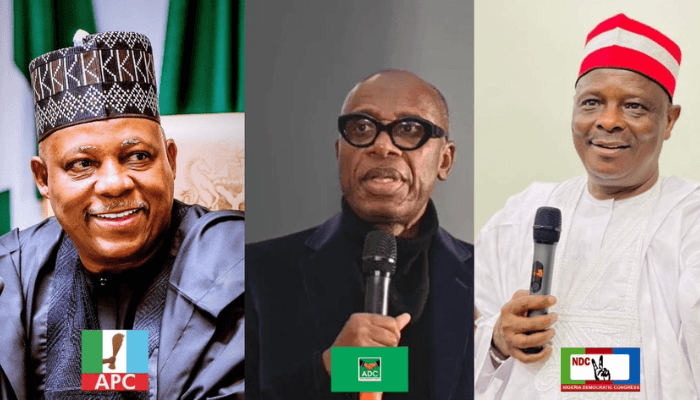
The emergence of Vice President Kashim Shettima as President Bola Ahmed Tinubu’s running mate has shifted attention to a critical but often underestimated aspect of Nigeria’s presidential elections; the influence of vice presidential candidates.
While presidential candidates remain the face of their campaigns, political analysts say the 2027 contest will equally be shaped by what the running mates bring in terms of regional influence, political structures, grassroots mobilisation and electoral strategy.
With Shettima flying the flag of the All Progressives Congress (APC) as running mate, Rabiu Musa Kwankwaso, former Kano State governor, partnering Peter Obi of the Nigeria Democratic Congress (NDC), and Rotimi Amaechi, former Rivers State governor, teaming up with Atiku Abubakar on the African Democratic Congress (ADC) platform, and the battle for votes has become a contest of political heavyweights.
Shettima: The APC’s northern bridge
For President Tinubu, retaining Shettima was a strategic decision aimed at preserving political stability and rewarding loyalty. Shettima, former Borno State governor remains one of the APC’s strongest political figures in the North-East, a region that has consistently delivered substantial votes for the ruling party.
Beyond the North-East, Shettima has cultivated relationships with political leaders across the North through years as governor, senator and now vice president.
His experience in government also gives the APC the advantage of presenting a ticket with a proven working relationship, unlike opposition alliances that are only beginning to build internal cohesion.
Analysts say Shettima’s calm disposition, accessibility and understanding of northern political dynamics make him a valuable asset as the APC seeks to retain support in a region where insecurity remains a dominant concern.
He is also expected to play a leading role in reassuring northern voters over issues affecting agriculture, security and infrastructure. Yet, his biggest assignment may not be political mobilisation but defending the Tinubu administration’s record.
The opposition is expected to campaign heavily on soaring inflation, the high cost of living, unemployment, insecurity, naira instability and widespread complaints of economic hardship since the removal of petrol subsidy and other reforms.
As vice president, Shettima will inevitably become one of the administration’s chief defenders, explaining government policies while convincing voters that the economic pains are temporary and that reforms are beginning to yield results.
Chekwas Okorie, elder statesman, former presidential candidate and founding national chairman of the All Progressives Grand Alliance (APGA), said Shettima’s greatest political test would be his ability to deliver the North-East for Tinubu, stressing that the region would determine the vice president’s contribution to the APC ticket.
According to him, Shettima’s influence has largely remained within the North-East despite serving as vice president for nearly four years.
“I have not seen him all the while as one whose political influence extends beyond the North-East. The electorate in the North-East will assess him based on what he has been able to attract to the region as vice president,” he said.
Okorie argued that Shettima’s task has become more difficult because Atiku Abubakar, former Vice President, who is candidate of the African Democratic Congress (ADC) also comes from the North-East.
“Because Atiku Abubakar is from the same geopolitical zone and remains one of the most prominent northern politicians, it will be a major challenge for Shettima to deliver substantial votes from the region,” he said.
“If Tinubu performs strongly in the North-East, then it can reasonably be said that Shettima’s influence came to bear. That region will determine his real contribution to the election,” Okorie added.
Read also: As 2027 campaigns near, hardship threatens to overshadow reform gains
Amaechi: Experience meets political headwinds
For the ADC and its presidential candidate Atiku Abubakar, Amaechi offers administrative experience, national political networks and campaign expertise.
The former Rivers governor has served as Speaker of the Rivers State House of Assembly, governor, chairman of the Nigeria Governors’ Forum and Minister of Transportation, making him one of Nigeria’s most experienced politicians.
Pundits say his reputation as an organiser and strategist could strengthen the ADC’s nationwide campaign and improve coordination across states.
However, Amaechi faces perhaps, the toughest regional battle among the three running mates. His political dominance in Rivers is said to have steadily waned following years of intense rivalry with Nyesom Wike, minister of the Federal Capital Territory (FCT).
Since leaving office, many of Amaechi’s loyalists have either lost elections or defected to rival political camps, while candidates backed by Wike have repeatedly won key contests in Rivers State.
Analysts argue that Wike has built a stronger grassroots political structure in Rivers and continues to wield considerable influence across much of the South-South through alliances with governors, lawmakers and local political actors, and he has openly declared his support for Tinubu’s re-election bid.
There are claims that Amaechi might find it difficult to deliver Rivers to the ADC in 2027.
Jackson Lekan Ojo, a political analyst, told BusinessDay that Rotimi Amaechi may have little to contribute to the ADC presidential ticket, arguing that his electoral value and ability to sway voters remain limited.
“I have doubt over his capacity to make a significant electoral impact or add substantial value to the ADC’s presidential ticket ahead of the election,” Ojo said.
Chekwas Okorie, convener and National chairman of the Igbo Agenda Dialogue (IAD), also expressed doubts about Amaechi’s ability to significantly influence the outcome of the election for the ADC ticket.
He said that Amaechi’s political standing in Rivers State has diminished amid changing political realities and competing power blocs.
“In Rivers State, you have the Amaechi-Wike factor and other emerging political interests. I honestly do not know what Amaechi’s contribution will be,” he said.
Okorie also pointed to Amaechi’s record as Director-General of Muhammadu Buhari’s presidential campaigns in 2015 and 2019, arguing that he failed to substantially improve Buhari’s electoral performance in Rivers State.
“He served as Buhari’s campaign Director-General twice, yet he did not make much impact in Rivers State to Buhari’s benefit. It is therefore, doubtful that he has acquired enough political capital while out of office to attract significant support now,” he said.
“So, his contribution to the election of Atiku Abubakar, in my view, will be minimal. I do not see him making a significant electoral impact in the final analysis,” Okorie said.
However, some observers are of the view that his challenge will be helping the ADC to expand into other South-South states and making inroads in parts of the South-East and North-Central.
Kwankwaso: Still formidable, but facing new realities
For Peter Obi and the NDC, Kwankwaso remains one of the most recognised political figures in northern Nigeria. His greatest strength lies in the Kwankwasiyya political movement, which for years built a loyal grassroots base in Kano and parts of the North-West.
His experience as former governor, senator and presidential candidate also gives the ticket credibility among northern voters. It is argued that Kano remains one of Nigeria’s biggest voting states, making Kwankwaso a significant electoral asset.
However, analysts believe his influence is no longer as dominant as it once was, following the defection of his political godson, Governor Abba Kabir Yusuf to the APC ahead of 2027.
There are also claims that internal divisions, defections and the emergence of competing political interests have weakened the once formidable Kwankwasiyya structure in parts of Kano and neighbouring states.
Observers say the NDC ticket could also face split votes in Kano, Jigawa and other North-West states where the APC, through Shettima and its established party machinery, is expected to mount a vigorous campaign.
However, Okorie, founder of APGA and the defunct United Progressives Party (UPP), told BusinessDay that Kwankwaso brings grassroots strength in the North West to the NDC and Obi’s advantage.
“Kwankwaso is deeply rooted at the grassroots because of his investments in education, skills acquisition and youth empowerment. The Kwankwasiyya movement has also spread beyond Kano into other parts of northern Nigeria,” he said.
Okorie also argued that Kwankwaso’s political appeal could receive an additional boost from calculations surrounding the 2031 presidential race, noting that with Obi committing to serving only one four-year term if elected president, Kwankwaso could increasingly be viewed by northern voters as a leading presidential contender in 2031.
“That gives Kwankwaso leverage to market himself beyond Kano as a possible president in 2031. The votes he helps secure in 2027 could become an important bargaining chip for his future political ambition,” he added.
As campaigns officially begin on August 19, analysts say the ability of these three running mates to mobilise their regions, counter political narratives and broaden their tickets’ national appeal may ultimately prove decisive in determining the outcome of the 2027 presidential election.

Join BusinessDay whatsapp Channel, to stay up to date
Open In Whatsapp