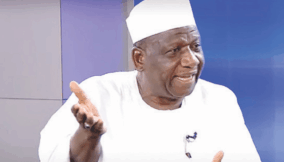
Adefolajuwon Amoo, retired Squadron Leader and chief executive officer (CEO) of Arbel Energy and Logistics, spoke with JOHN OSADOLOR AND CYNTHIA EGBOBOH on many pressing national issues including the US-Iran war and its implications on Nigeria economy. Excerpts:
What are your thoughts on the US–Iran–Israel conflict and its impact on the global economy, particularly the energy market?
International relations are ultimately driven by national interest. The United States, for instance, has consistently positioned itself as a global power—both as a “world police” and as a protector of its own strategic and energy interests.
From its perspective, Iran contributes to instability across regions, particularly in relation to Israel. Based on this assessment and its long-standing ability to project power, the U.S. has taken steps it believes will enforce outcomes aligned with its interests.
However, global dynamics have evolved. In the past, such power projection often guaranteed outcomes. Today, unexpected responses from Iran have complicated matters. What was expected to be a short engagement has stretched far longer, demonstrating the limits of traditional power assumptions. A key factor is geography—particularly the Strait of Hormuz. Iran has shown it can exert global pressure by influencing this critical oil route, disrupting markets worldwide. At this point, all parties—America, Israel, and Iran—are in a tense standoff, each waiting to see who will yield first.
How would you describe the impact of this conflict on Nigeria, just like other countries around the world?
Okay, to be honest, I say to people that if not for this war, I might have never forwarded my opinion. My opinion is that through what we normally call the unintended consequences, it has led to a situation where the economic fundamentals that were crucial for this administration faced a live test. The administration kept saying, oh, we’re putting in these macroeconomic principles in order to strengthen the economy. You know, the value of strength is apparent only in a day of adversity. If there is no adversity, your strength is just deteriorating. So, the crisis created the perfect circumstances to test the strength that was claimed by the administration as the basis for putting in the policies that they have been putting in, which has been very painful for citizens. So that’s the first, that’s for me the greatest impact on Nigeria. It tested the condition of the Nigerian economy. I would like for those of us that are old enough to remember, to recall 2015, when the price of oil crashed and it threw the world economy into a spiral. So, that is what we have been saved from. What happened at that time, Nigeria could not generate enough dollars to pay subsidy, import fuel, generate enough money to pay FAAC allocation. And what was the immediate consequence? Price of oil went up ten percent. Governments could not pay salaries, I remember very clearly, the government started paying 50% salaries. Too many state governments could not. So that is exactly what we have been saved from.
What happened in 2015? Let us look at now. Last week in Rwanda, the golden age country of Africa, the Rwanda government released an official statement taking fuel from the equivalent of 1,500 naira to 3,000 overnight. People woke up in the morning, people went to bed, fuel was N1,500, N1,600 but they woke up in the morning, fuel was N3,000. Can you imagine that in Nigeria? That we go to bed in the morning, fuel is N1,000, and wake up the following day, fuel is N2,000. You can imagine the crisis that Nigeria will enter.
So, that is not happening in Nigeria. It is happening in Ghana, it is happening in Kenya, it is happening in third world countries that have similar structures that we had before this administration introduced subsidy removal, floating of Naira, giving the crude in Naira as well. Those four things are what has prevented Nigeria from facing the shock that other countries are facing.
Interestingly, this crisis has served as a real-life stress test for Nigeria’s economic reforms. The government has long argued that its.
Do you think the government is doing enough to explain its policies to citizens?
Communication is a skill, and if people don’t understand policies, then more effective communication is needed.
For example, if Nigerians are told that fuel prices rose modestly compared to much higher increases in other countries, it provides context. But that message must be delivered in a way people can relate to.
What is concerning is the growing environment where people feel unable to express informed opinions publicly due to fear of backlash, especially on social media. That is a dangerous trend. A healthy society should encourage open and informed discussions.
The World Bank has suggested a return to petrol importation. What is your view?
Global institutions like the World Bank provide recommendations, but history shows mixed results regarding their effectiveness.
Countries that rely heavily on fuel importation are currently facing higher price increases. So, the question is: why adopt a model that appears less effective under current conditions?
Policy decisions should be based on evidence and local realities. For example, countries like India selectively adopted international recommendations but prioritized domestic production—and that strategy paid off in the long term.
How sustainable is reliance on a single refinery?
While relying on one refinery is not ideal, it is a starting point. Additional projects are already underway, including new refineries and modular plants. Over time, this will improve resilience and reduce dependency on a single source.
What reforms are needed to strengthen Nigeria’s energy sector?
Several steps are critical: Increasing crude oil production to meet both export and local refining needs; Encouraging indigenous ownership in extraction and refining; Leveraging new technologies to reopen previously unviable oil wells, and expanding refining capacity across the country.
These measures will improve resilience against global shocks.
How do you reconcile rising fuel prices with the presence of local refining?
The key is comparison. While prices have increased in Nigeria, they remain lower than in many other countries. That context is often missing from public discussions.
Local refining acts as a buffer—it doesn’t eliminate price increases but significantly reduces their impact.
How would you describe the current energy market in Nigeria with the introduction of local refining?
The impact is significant. Previously, Nigeria spent billions annually on fuel subsidies. Without reforms, that cost would have ballooned dramatically due to exchange rate changes.
Local refining has reduced this burden and freed up resources for infrastructure and development projects. It has also stimulated economic activity, particularly in industrial zones, and created a foundation for further investment.
What advice would you give to the government going forward?
The focus should be on continuity. Economic reforms often involve short-term pain but long-term gain.
It’s like repairing a faulty foundation—you must endure the temporary mess to fix the underlying problem. The key is to stay the course on sound macroeconomic principles while improving communication and public understanding.

Join BusinessDay whatsapp Channel, to stay up to date
Open In Whatsapp