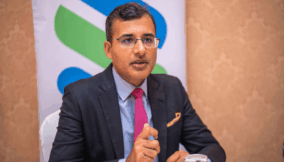
Ayodeji Sotinrin is the managing director and chief executive officer of the Bank of Agriculture. In this interview with Josephine Okojie-Okeiyi, he discussed the bank’s role in driving food security through the Renewed Hope Agenda and its recent recapitalisation.
The Renewed Hope Agenda prioritizes food security. How is BOA repositioning to deliver on that scale?
The Bank of Agriculture (BOA) has embarked on a financing programme called the Renewed Hope Smallholder Financing and Value Chain Fund, under which the President has directed that we finance two million smallholder farmers with improved varieties of seeds to enable them to produce a minimum of five tonnes per hectare in grain production.
Looking at the programme, the participating farmers will require at least ten million bags of fertiliser. So far, two million bags have been distributed, and half a million farmers have already been financed.
We are delivering this programme through farmer aggregation companies because we believe it will increase yields across the country, help address food insecurity, and ensure that farmers have enough equity to plant again next season because of the low-interest financing we have provided.
This facility is designed to become a revolving fund that will continue to grow, enabling us to finance at least ten million farmers between now and 2028.
Can you walk us through the recent BOA recapitalisation? What is the target size, sources of funds timeline, and what changes for farmers?
BOA’s recapitalisation has moved beyond the well-known N1.5 trillion that was provided for in the 2025 budget to something much more substantial. While the N1.5 trillion was expected from the government, we have so far received hundreds of billions of naira to fund several strategic intervention programmes.
One of these is the Renewed Hope Smallholder Financing and Value Chain Fund, which I have already spoken about. The second is the Guaranteed Minimum Price Programme, through which we are supporting farmers engaged in grain production in response to the import parity challenges experienced last year. Under the programme, we are providing farmers with a premium of over 30 percent.
We are ensuring that these interventions are implemented judiciously across the country for farmers, regardless of the type of grains they produce. The third is what will become the largest mechanisation programme in Africa.
We are on a journey to grow that portfolio to almost one billion dollars in mechanisation, supported by more than 2,000 tractors, over 10,000 implements, and additional equipment that we are procuring.
We are also establishing a manufacturing centre in Abuja on 23 hectares of land, alongside mechanisation service centres across each geopolitical zone.
Together, these initiatives will form one of the largest and most sustainable agricultural programmes on the continent. We believe they will create a new and sustainable mechanism for financing agricultural value chains across the country.
With more capital comes more risk. What new systems are being put in place to ensure loan recovery and reduce NPLs in agriculture?
We are completely digital with all our systems, from input collection to FAC verification, all the way to harvest. We can track and trace financing along the individual value chain, from the time a farmer receives inputs till the time they plant.
We assist them in accessing loans, and we also have extension service workers who support every farmer by teaching them the newest agronomic practices across the board.
Another thing we have done, aside from integrating these extension services into our digital platforms, is creating a system where we can monitor and manage where extension workers go in the field and even mine the data they send back from the field.
We also have a monitoring and evaluation consortium based on the work we have done, which involves putting together a technology working group for these M&E companies.
The goal is to create one singular system for BOA to track, trace, monitor, and evaluate everything that the farmers are doing, and not only the farmers, but also the aggregation companies.
These are all the plans we have put in place, and we believe this will continue to help us manage our operations better.
We lose an estimated 40% of produce to post-harvest losses. What financing instruments is BOA deploying for cold rooms, warehouses, trucks, and aggregation centers?
In terms of post-harvest losses, it starts with solving the problems within the farm and at the farm gate. That is why we are introducing our own logistics product, where we are pre-financing battery-powered cargo tricycles to move farm produce in larger volumes in a single trip.
For example, a typical motorcycle that farmers currently use can transport a maximum of between 50 and 100 kilograms at a time, and they pay about N5,000 to move produce out of the farm.
The battery-powered cargo tricycles we are introducing come with trailers and can move at least two tonnes in a single trip at a much lower cost. This will drastically reduce post-harvest losses while also increasing productivity across the sector.
Beyond loans, how is BOA linking smallholder farmers to off-takers, processors, and export markets to guarantee income?
We are organising the off-takers known as farmer aggregation companies, and we are deliberately supporting them to grow across the value chain. We want to help Tier 3 aggregators become Tier 2, and Tier 2 aggregators become Tier 1.
Our goal is to strengthen their capacity because they are the ones providing farmers with financing tools and, in some cases, direct financing. They also serve as the off-takers, purchasing produce directly from the farmers.
Once they aggregate the produce, they supply processors who convert it into finished products. Beyond that, we are bringing in institutions like NCX and AFEX to issue electronic warehouse receipts for commodities stored in the warehouses of these aggregators.
This ensures that the commodities are traded transparently, allowing us to know what is being sold, the volumes involved, and the value being generated.
Ultimately, this helps create a robust single market that improves transparency, efficiency, and access across the agricultural value chain.
With food prices spiking again, how does BOA’s financing model help to smooth supply and curb seasonal price spikes?
The fact that we are able to bulk negotiate inputs for primary production gives us a major advantage in running a very robust and sustainable programme.
Even though we provide loans to each aggregator, we also ensure that every aggregator that has traded with a particular supplier is brought together, allowing us to consolidate demand and negotiate a lower price before they get the inputs for whatever they want to use them for.
For us, these are the important things: ensuring that we have the best quality inputs and the best pricing for inputs going to the aggregators, and ensuring that those cost savings are passed on to the farmers as well.
How is BOA leveraging data, biometrics, and digital disbursement to ensure funds get to real farmers?
We are not paying lip service to this; we will tackle it head-on because we believe our intention is about solving the problems. We will get the right solution.
We make sure that the farmers we bring into the BOA ecosystem have access to quality inputs through these aggregation companies. We also support them with market linkages because that is important for the sector and for market development as well.
Because we work with farmer aggregation companies, we receive and vet the list of farmers before operations begin.
Whatever support we provide to farmers through these aggregation companies gets to them because we monitor and evaluate the process every step of the way, every single time.
Do you think access to clean energy is the missing piece in Nigeria’s push for food security and lower food inflation? If yes/no, why?
I won’t say that there are not so many things to be unpacked when it comes to the agriculture value chain that we desire, from getting the right inputs, to planting, to harvesting at the right time, and also ensuring that the produce is purchased at the right time and at the right location.
We believe that these are all the areas where we can support the sector and contribute to building a more efficient value chain.

Join BusinessDay whatsapp Channel, to stay up to date
Open In Whatsapp