From Uber driving and POS businesses to online tutoring and home-based catering, households are building new income streams to bridge the widening gap between wages and living costs.
The family that turned school fees into capital
“I turned my children’s school fees into business capital.” Few financial decisions are more difficult for Nigerian parents than moving their children from private schools to public schools. For Usman Bello and his wife, it became a business decision.
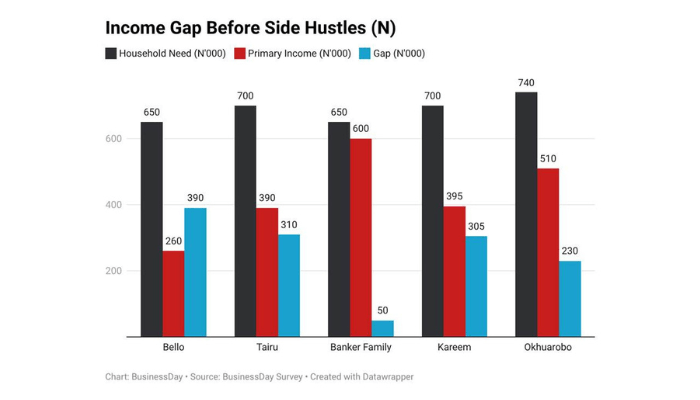
Usman, a 44-year-old federal civil servant in Abuja, earns N260,000 a month after deductions. Two years ago, his wife left her hotel job after childcare costs consumed most of her earnings. The family needed another source of income but lacked the capital to start one. The solution came from an uncomfortable sacrifice.
In 2024, they transferred their two children from private schools to public schools, saving approximately N160,000 per term. The money was used to purchase catering equipment and build inventory for a home-based food business. Today, Bello’s wife caters for office events, birthdays and naming ceremonies across the Lugbe and Gwagwa axis of Abuja.
She handles between two and three events monthly, generating net income of between N120,000 and N160,000 after expenses. “Moving the children was not easy,” Bello said. “But it gave us the capital to start. Now the catering business brings in more than the school fees ever cost.” The Bellos are part of a growing group of Nigerian households responding to a simple economic reality: one salary is no longer enough.
The shift reflects a widening gap between earnings and expenses. A modest family of four now requires between ₦650,000 and ₦750,000 monthly to cover basic living expenses, including rent and school fees, according to BusinessDay’s reporting across urban households. Yet many formal-sector workers earn substantially less than that amount, forcing households to seek additional income streams.
Across Lagos, Ibadan, Abuja and Ogun State, families are responding by turning professional skills, personal savings, vehicles, spare rooms and digital platforms into additional sources of income. The households coping best are not necessarily those earning the highest salaries. They are the ones finding ways to earn from more than one source.
The teacher who refused to depend on one salary
Every Friday afternoon, when classes end at a private secondary school in Lagos, Babatunde Tairu begins another workday. The 41-year-old physics and chemistry teacher earns N285,000 a month from his primary job. His wife earns N105,000 teaching at a private primary school. Together, their salaries amount to N390,000, well below the approximately N700,000 their household of four requires each month.
Rather than reduce spending further, Tairu expanded his working week. Four evenings a week, he teaches JAMB preparation classes, earning N7,500 per hour. On weekends, he drives for Uber using a 2005 Toyota Corolla acquired through a cooperative loan scheme. “I do not think of Uber as a second job,” he said. “I think of it as the salary I should have been paid.”
His wife’s private lessons for neighbourhood pupils provide another layer of support. Between the two of them, teaching has become not one job, but three.
The banker who built a pos network
In Ibadan, a 36-year-old customer service officer at a commercial bank and her husband, an auditor, earn a combined N600,000 monthly. On paper, that should be enough. In reality, it barely covers their household expenses.
Rather than search for additional formal employment, the couple built a small payments business. Today, they operate three point-of-sale terminals across different parts of the city, employing school leavers to manage daily transactions. The business generates a steady stream of income alongside their salaries.
Her husband also lectures at ICAN tutorial centres during professional examination periods. “The salary pays the bills,” he said. “The POS business gives us breathing space.” What began as a side business has become an important pillar of the family’s finances.
Turning education into enterprise
In Ikorodu, Yaya Kareem’s household has discovered that one of the most valuable assets in Nigeria’s economy is knowledge. Kareem earns N395,000 monthly coordinating deliveries for a logistics company. His wife, a graduate of education, left formal teaching after repeated salary delays. Rather than abandon the profession, she reinvented it.
Today, she runs WAEC and JAMB preparation classes through WhatsApp and Zoom, teaching students across the country. She charges N12,000 monthly for WAEC preparation classes and between N10,000 and N15,000 for JAMB coaching, depending on the programme.
With fifteen WAEC students and several JAMB candidates enrolled, her earnings frequently exceed what she earned as a classroom teacher. The digital format has removed many of the constraints associated with traditional tutoring. She no longer needs classroom space and can reach students regardless of location. “We are not getting rich,” Kareem said. “We are closing the gap.”
Building a household portfolio
Immanuel Okhuarobo’s family in Ogun State offers perhaps the clearest example of how households are diversifying income. The 39-year-old software engineer earns N510,000 monthly from his formal employment, placing him above the national median. Yet his household still requires approximately N740,000 each month once school fees and other expenses are included.
Rather than depend on a single income source, the family has built multiple streams of earnings. His wife operates a tailoring business from a converted room in their compound, serving clients sourced through referrals and social media. Meanwhile, two motorcycles owned by the family generate additional income through commercial operations.
Each income stream plays a different role. Salaries cover recurring obligations. Tailoring provides business income. The motorcycles generate additional cash flow. “We save during the good months so we can manage during the difficult months,” Okhuarobo said. The result is a household that is less dependent on any single source of income.
Nigeria’s new household economy
Five households. Five different strategies. One drives Uber after work. Another operates POS terminals. One family converted school-fee savings into business capital. Another turned teaching into a digital enterprise. One built a portfolio of income streams around a formal salary. What connects them is not hardship. It is an adaptation.
Muda Yusuf, chief executive officer of the Centre for the Promotion of Private Enterprise (CPPE), said the growing reliance on multiple income streams is a direct response to the widening gap between wages and the cost of living.
“Many households are confronting an affordability crisis,” Yusuf said. “The reality is that income growth has not kept pace with inflation and the rising cost of living. As a result, families are increasingly looking for additional sources of income to support household consumption and maintain living standards.”
According to him, what is emerging is not merely a side-hustle culture but a survival strategy driven by economic necessity. “The pressure on households has intensified significantly over the past few years. People are becoming more entrepreneurial, but much of that entrepreneurship is defensive rather than opportunistic. It is about preserving welfare and meeting basic obligations.”
Faruq Quadri, economist at SPEC-Matrix. Abuja-based research firm said the trend reflects the growing importance of what economists call household resilience.
“Households are adjusting faster than many formal institutions,” Quadri said. “What we are seeing is a reorganisation of economic activity at the family level. People are monetising skills, leveraging digital platforms, sharing resources and creating alternative income channels. These strategies may appear small individually, but collectively they are helping families absorb economic shocks.”
Quadri noted that while such adaptations demonstrate resilience, they also reveal deeper structural challenges within the labour market. “When households increasingly depend on multiple jobs to achieve financial stability, it suggests that wage growth and productivity have not kept pace with the realities of living costs. The resilience is impressive, but it should not distract from the underlying economic pressures driving it.”
Each family identified an asset it already possessed, a skill, a vehicle, professional knowledge, spare time or household savings and turned it into income. None would describe themselves as wealthy. Most remain vulnerable to unexpected shocks. Yet all have found ways to narrow the gap between what their salaries provide and what modern living costs demand.
Their stories point to a quiet transformation taking place across Nigeria. The household is becoming an enterprise of its own, built not around a single paycheck but around multiple streams of income. One family drives after work. Another runs POS terminals. One teaches online. Another caters for events. Together, they reflect how ordinary Nigerians are adapting to extraordinary economic pressures.
For decades, a stable job was the foundation of financial security. For a growing number of Nigerian families today, it is becoming something else: the starting point for the next source of income. The salary still matters. It is just no longer the entire plan.
Join BusinessDay whatsapp Channel, to stay up to date
Open In Whatsapp