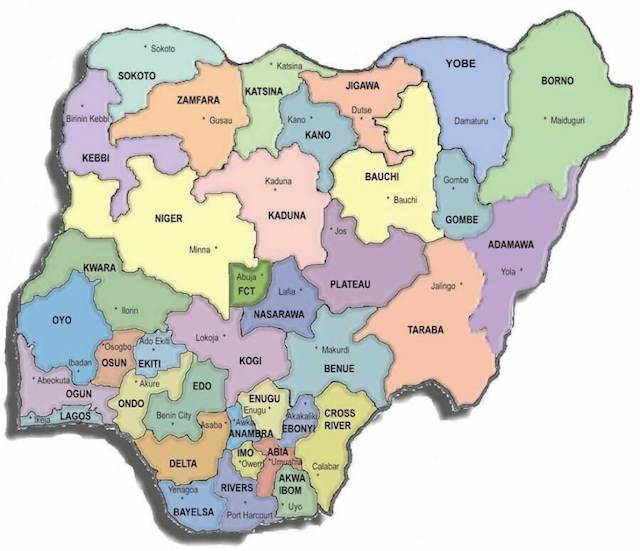
Revenue challenged Nigerian states plan to spend as much as N6.22 trillion in 2017, data gathered by BusinessDay Research Intelligence Unit (BRIU) based on the presented budgets of 33 of Nigeria’s 36 states show.
The 33 states’ expenditure plan of N6.22 trillion in 2017 is already 5% more than the N5.92 trillion which 36 states of the federation spent in 2016. This indicates that Nigeria’s states are bracing up to spend more this year. But there is a wide disparity in the spending power of states across the federation.
Lagos, which is the commercial capital of Nigeria, is increasing its budget by 23 percent year-on-year, as the state plans to spend N813billion in the 2017 financial year, as against N662.59 billion, which it spent in 2016.
Apart from Lagos, nine other states have shown themselves to be financial powerhouses. These states include; Rivers (N470billion), Akwa Ibom (N365billion), Cross Rivers (N301billion), Delta (N271billion), Bayelsa (N221 billion), Ogun (N221billion), Kaduna (N215billion), Kano (N210billion), and Oyo (N207billion).
The budget figures show that there is a wide disparity between the spending of states. For instance, Bayelsa, which has a population of less than 4.5million people, has a budget of N221billion as against Kano’s N210billion. Kano is projected as a state that has a population in excess of 18 million people.
Budget data collected and analysed by BusinessDay Research Unit for the past six years indicates that the traditional ten biggest spending states maintained their position.
In 2017, the combined budget of the ten big spenders is greater than what the other 26 states combined spend. The ten major spenders are planning to spend N 3.29trillion, as against the total budget of N3.01trillion of the less powerful 23 states plan to spend.
Lagos, which has the biggest state budget of all states in the country, will spend more than what the five states in the south-East plan to spend in 2017. Furthermore, the budget of Lagos exceeds the combined budget of the six states in the North Central by N31billion.
Apart from Lagos, most of the big spenders are drawn from the oil rich South-South. States in the region’s spending power has been boosted by the proceeds of the 13% derivation, which analyst predict may increase on the back of oil prices which have inched upwards marginally, as OPEC re-asserts itself in the international oil markets.
With the challenges faced by many states in 2016 following the collapse of crude oil prices, experts have advised that the country’s 36 states can accelerate the pace of the country’s transition from the current recession to economic prosperity in 2017 by creating settlements for industries, agriculture and other ventures, so that they can generate taxes, create jobs, and drive the country’s economic recovery.
Policy and economy analysts say this measure will vigorously change the structure of the respective economies of the states, from one that is overly dependent on money from the Federal Accounts Allocation Committee (FAAC) to one dependent on revenue from productive sectors.
Apart from Lagos, which garners 78.5 per cent of its finances from internally generated revenue (IGR), other states rely nearly exclusively on FAAC money, as allocations from this source comprise up to 70 per cent of their total revenue.
BusinessDay had reported that the 36 states shared N1.08 trillion among themselves from January 2016 to October, 2016, but grossed a deficit of N1.58 trillion within the period, which threw them into an insolvency situation, underscoring the clamour for revenue diversification.
“The states should develop the local areas and not focus only on the state capitals. The opportunities are in the local areas, but these areas are always neglected. In the UK and US, the manufacturing concerns are located in the local areas, where they are closer to their raw materials, but there are access roads in these areas,” said Femi Ademola, who is an executive director of corporate finance and advisory, BGL.
“The states should reduce the attraction in the urban centers so that pressure on the facilities will reduce. They can do this by creating the environment that will make things available in the rural communities. They should also make relevant laws that will minimise interference in the activities of businesses in the rural areas”.
In line with other analysts who urged the states to use their resources productively, Femi said that since the Federal Government has handed the governors the solid minerals in their states, they should exploit the minerals in creative ways.
“The states should look for private capital to explore the solid minerals, as most of them have the potential to generate funds far higher than what they get from FAAC allocations”.
Johnson Chukwu, managing director of Lagos-based investment banking firm, Cowry Assets Management, said in a telephone conversation with BusinessDay, that the states can actually drive Nigeria’s economic growth this year, by creating enabling environments and infrastructure for private businesses to thrive.
“One, you have appropriate road network, security and power supply, it makes it easy for businesses to spring up and grow, and job creation will naturally follow,” said Johnson.
Johnson urged the states to cut off non-essential expenses so that they will have reasonable level of finances to begin to develop their infrastructure.
“The Paris Club debt refund is a windfall that boosted the financial strengths of the states. The states should use that to drive infrastructural development, rather than embark on wasteful spending”.
Similarly, Eguarekhide Longe, CEO of AIICO Pension Managers Limited, had said in an interview with BusinessDay that the state governors should be visionary in their approach to managing the states’ wealth as that is the only way to create value that will enhance their economies and the economy of Nigeria, and transform the entire environment.
Eguarekhide said that the governors should talk to themselves to identify areas of economic partnerships.
“In the East of Nigeria, you know, all you need to do is to ensure there is movement and market will follow it. But the governors have very high egos and don’t talk to each other. They are busy quarrelling and looking for small money, building boreholes and things that don’t mean anything.”
He adduced that for the states to aid economic growth in Nigeria, they need to talk to themselves and identify projects they can execute together for mutual benefits and think about how to attract money and execute it as a collective effort, rather than crying about marginalisation and appointment.
In its Sustainable Development Goals Report 2016, the United Nations stated that for economic development to happen, states should emphasise the promotion of infrastructure development, industrialisation and innovation, through enhanced international and domestic financial, technological and technical support, research and innovation, and increased access to information and communication technology.
“The states need to look inwards and find their areas of competitive advantage. The Kebbi-Lagos partnership model can be adapted by a number of the states. The states should discover what they are most suited to do and develop a strategy around it,” said Taiwo Oyedele, who is a partner in charge of Tax Advisory Services at PricewaterhouseCoopers (PWC) Nigeria.
Oyedele also echoed the view of Johnson, regarding the need for the states to create a good business environment to spur economic recovery.
“For instance, the process of land ownership in the states should be simplified. It should be easy for business owners to perfect titles to land, so that they can attract money from financial institutions. The ease of doing business in these states should also be immensely improved.”
Economy watchers and policy analysts also say that the states should formulate and implement people empowerment initiatives like vocational training and mentorship, and develop innovation centers where young people can play around with ideas and eventually come up with products that will boost the economies of the states and the country.
INNOCENT UNAH & Obodo Ejiro

Join BusinessDay whatsapp Channel, to stay up to date
Open In Whatsapp