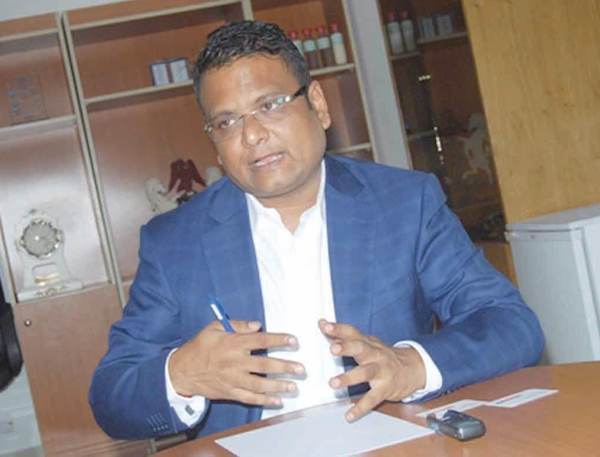
Manish Mundra is the Managing Director/Chief Executive Officer of Indorama Eleme Petrochemicals Limited as well as Indorama Fertilizer. He has been the helmsman of the Nigeria operations since October 2007. Mundra in this interview speaks about what Indorama have been doing at Eleme petro-chemical plant since they bought it from NNPC and the prospects of the Nigeria petrochemical industry.
Can you give us a little background on Indorama’s investment in Indorama-Nigeria operations so far and what the experience has been?
As you are aware, Indorama took over Eleme Petrochemicals during the privatisation exercise in 2006. Then, Eleme Petrochemicals was part of the NNPC. Indorama won the bid for the plant and our journey began. It took us about six months to gain access to the facility because of processes, but we were sitting outside planning. The moment we gained access, we moved into action and under three months, we had done massive Turn-Around-Maintenance (TAM). The biggest reason for non-performance of the place was lack of TAM. We started progressing; then our next challenge was about feedstock supply because the agreement was about to finish (2008). We worked on that and fixed that along with the NNPC and ensured feedstock supply (gas). Since then, we have been partnering with AGIP to see how we could enhance feedstock supply.
So, the first leg of our investment was bidding and winning the 75 percent shareholding; the second was TAM; the third leg was infusion of working capital; and the fourth leg was on expansion of the existing capacities and new products within two years. So, the whole investment got to between $550m and $600m within three years. That includes new product lines and investments. We also invested in PET plant, which took care of imported raw materials. We thought that being the global leader in the business, we needed to set up a PET plant and this took almost $100m. We now produce 86,000 metric tonnes of PET per annum.
By then, we had already planned to embark on a fertilizer plant, which would take $1.5bn. By this, we needed to also do a pipeline for gas supply and a jetty for export of what would be surplus. By the time we could secure gas and the jetty, it was 36 months. Today, our fertilizer plant is the largest urea train (fertilizer plant) in the world. We have capacity for 4,000 metric tonnes of fertilizer per day and 1.5 million metric tonnes per annum. Put together, we have investment of about $2.1Bn here and a cumulative of about $4.2 billion in the next few years.”
What have been the biggest challenges for you?
When we started, the challenges were varied because it was the restive era when militancy was at the highest. In 2007, insecurity was one of the highest challenges. There was a bad experience we had but with the support of the host communities, we were able to overcome that era. Since then, the environment has improved. We gave shares for the host communities and it led to economic growth in the area. That aspect of fear or insecurity has largely reduced.
Policy framework is one of the biggest challenges. We still feel that investments in Nigeria need big impetus and large investments such as fertilizer plant need high level of tax exemption. New investors from outside would need major enhancement in terms of policy framework. For instance, if you invest in the region of $1Bn to $1.5Bn, the tax exemption should be different. Policy should be put in place in line with global best practices.
There should also be sector-specific tax exemptions because Nigeria is a hydrocarbon zone, and there should be some incentives to those investing in the sectors. Taxes should also be graded in strategic locations to attract investments into certain areas that are unique. In an investment like fertilizer, the investor would not have to build pipelines and jetties if it were to be in other countries. This has increased the cost with about $400m. This is where policy makers need to look at non-oil business development policies. That will give impetus to investments in Nigeria and attract investors to come and invest in Nigeria. These are some of the challenges that the policy makers need to look at.
Another challenge is about getting experienced hands in the petrochemical industry. Even the curriculum in the tertiary institutions is not exciting to train young engineers that would man the petrochemicals sector. Getting qualified men or cadre level officers is a big challenge.
What incentives have Indorama got so far?
Incentive so far got is “pioneer-status” of two years extendable for another two years. That is all.
What do you see as the potential of the petrochemical industry in Nigeria, the market size, assuming the conditions were right?
To help you visualise what the potential is, in the last 15 years, investments in petrochemicals and gas monetisation in the Middle East (Iran, Iraq, UAE, Qatar, etc) has gone to about $90Bn. As a result, their dependence on crude oil exports has gone low. In that same period, Nigeria has seen just one investment (Indorama Eleme Petrochemicals). So, the dependence on oil still remains. The nature of Nigeria and these Middle East nations is the same. Nigeria is about the 7th crude oil producer in the world and 7th gas country just as those Middle East countries.
These other countries opened the gate for petrochemicals investments some years ago. Nigeria needs to open the same gate because it has huge oil and gas reserves especially the associate gas. If the policy frameworks are made to attract foreign investors, Nigeria can attract about $20 bn investments in about three years. The multiplier effect on the foreign exchange revenue of the country can only be imagined.
There is a huge potential for petrochemicals for Nigeria because it has huge hydrocarbon reserves. There is also the abundance of feedstock (hydrocarbons) in one location. Nigeria is strategically located in the Western Hemisphere. You have the horn of Africa on the left and close to Europe and the Americas. You are like $12 cheaper tonne in freight from the Middle East. Nigeria can easily become the petrochemicals hub of the world because we have amazing shoreline, great location, educated manpower and feedstock. What else do we need? We have huge potential.
I know you mentioned tax as incentive, are there other incentives needed?
I have mentioned earlier that investors need clear-cut policy decision. Somebody sitting outside in Asia, Europe or Americas, they don’t know what is the policy here in respect to land acquisition, security, gas pricing over a period of time, how investments would be treated long term, among others. The whole thing rests on policy and transparency to give people options to invest. They need the confidence that once you enter; the rules won’t change in three months or three years, because these are long-term investments. Of course, it requires creating an environment of peace.
Nigeria is now absolutely in a good position because democracy has come to stay; transition from one administration to another and another. The insurgency in the north is ebbing and militancy in the Niger Delta is reducing. The business environment is already there. What is needed is policy framework (clear-cut policy) to attract investors.
What is the market share of your fertilizer business, the demand, and how much of the market are you meeting despite these challenges?
The nameplate capacity is 1.5 million metric tonnes (MMT) of Urea per annum but because of the gas supply gaps, we reduced to between 1.1m to 1.2 mmt. We have got to about 65 per cent of our capacity. So far, our Urea fertilizer gets to all the nooks and crannies of Nigeria; and helps to boost food supply across the country.
Fertilizer in Nigeria and most of Africa is combination of Urea and NPK (N=nitrogen or Urea, P=Phosphate, K=Potash). Nigeria does not have phosphates but Nigeria needs it. It is very important that Nigeria has natural gas from where Urea and Ammonia can be made. Nigeria does not have phosphate and potash plants. You need to balance out. What we do is manufacture a lot of nitrogen (Urea) and export it to import phosphate and potash.
The philosophy is to manufacture plenty of what you have and export to bring in what you need to meet your domestic need. We are collaborating with the Federal Government’s Presidential Fertilizer Initiative to supply about 360,000 metric tonnes of Urea to blending plants across the country, which in turn produce NPK. This is a great partnership with the Federal Government of Nigeria. Recently, the Presidential Committee visited our plant here in Port Harcourt and were impressed with our cooperation with the presidential initiative.
So, the true domestic demand of our product is like 500,000 tom 600,000 metric tonnes. Because the supply of fertilizer was not heavy over the years, use of fertilizer went down significantly in Nigeria. We strongly feel that in about three years of steady supply of all grades of high quality fertilizers at transparent prices, the usage will grow and the demand will grow to over one million metric tonnes. This will increase food supply exponentially. This will surely help Nigeria stop food importation. We expect use of fertilizer per-hectare to increase so that we get to 2 to 3 million metric tonnes of fertilizer use in Nigeria.
So, do you have plans to expand your fertilizer plant, then?
Yes, we have plans for plant expansion. From the onset, we knew that Nigeria does not have good quality phosphate and potash. What we did was to have a very big vision and so we acquired a company called ICS in Senegal, which is Sub-Sahara Africa’s largest phosphate plant. So, in Senegal, we produce sulphuric acid and phosphates and bring them into Nigeria. This way, Nigeria can produce NPK from both plants through integration of the plants in Nigeria and Senegal. This is a big business opportunity for Nigeria. We are committed in helping Nigeria to exit recession through industrialisation.
We know your fertilizer plant was financed by foreign loans (IFC) and now many companies are having problems paying back, how are you managing this?
Local banks contributed almost $140m while the rest came from outside – International Finance Corporation (IFC) and others. We have an aspect of our business, which involves exporting some of our products to earn foreign exchange. This balances out things. In about two to four years, we would have enough ability to repay the loans. If we factor these things in, Nigeria is still better off than the regime of imported fertilizers. In plants of this size, you don’t look at a few years but long term of about eight years and above.
What is the outlook in feedstock supplies in few years to come; do you have plans to build your own gas plant?
We have our gas supply partners in ENI-AGIP and NNPC. They are doing investments and we are working very closely with them. We offer our support whenever there is any requirement of support from our side. We envisage getting about 90 per cent feedstock supply. We are very hopeful to be stable in feed stock supply through Agip/NNPC. We have invested in a new gas pipeline to Ob-Ob (Agip gas facility) here in Rivers State, which is 83 kilometres from here.
How much has the government realised from this investment since privatisation?
The Federal government and the Rivers State government are pleased with what they are getting from here in terms of dividend. We can get you the numbers later.
Are you looking at listing on the Nigerian Stock Exchange (NSE)?
Yes.
Do you have any timeline?
It should happen in the next two to three years. To tell you the truth, the market has not been very good. If it had been bullish, we would have done it earlier.
Do you have an idea of the percentage of your equity you will want to sell if you decide to list?
If you see our numbers, in Indorama Eleme Petrochemicals, Indorama has 65 per cent. Nigerians own 35 per cent. The listing will depend on the structure and timing. We want the largest share by the public to be in our company. We intend to list because we have plans to grow. We see Nigeria as a place we will play long term. We see huge potential and we have set-our target. We need funds and see the Stock Exchange as a place to secure funds to invest more and more.

Join BusinessDay whatsapp Channel, to stay up to date
Open In Whatsapp