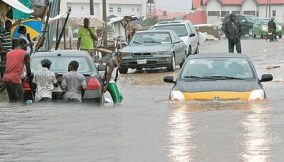
…potholes deepen as commuters spend hours in traffic jams
JOSHUA BASSEY
Commuting time to and from work, for many of the 20 million inhabitants of Lagos State has increased significantly, following the degradation of many roads by heavy seasonal rains.
The Governor Akinwunmi Ambode administration had on inception in 2015 embarked on the construction and rehabilitation of 115 roads, accross tate, bringing relief to inhabitants. But this relief is eroding with the deterioration of roads.
Lagos, with a population estimated at over 20 million, lies below sea level, making road construction a lot more challenging. In less than one year, some of the roads rehabilitated are showing signs of distress, as deep potholes dot their stretch with terrible impact on traffic flow. This is forcing commuters to spend unanticipated long hours in riotous traffic gridlock.
The development is seen betraying the technical capacity of some of the local contractors engaged by the state government to rehabilitate some of the roads and confirms fears earlier expressed in some quarters, that the contractors, some of whom were handling road construction for the first time, would end up doing shoddy jobs.
Tunji Bello, secretary to the state government, had said the government decided to use the indigenous contractors to encourage them develop competence, expertise and compete with their foreign counterparts in road construction.
One of the inner roads in Apapa, North Avenue, is collapsing and returning to its former state before the intervention of the state government. The road serves as one of the alternative routes for motorists, as the reconstruction of the Ijora-Wharf road, by AG Dangote gets underway.
Rehabilitated and commissioned on September 21, 2016, the North Avenue was awarded to Ramslot Investment Limited. It is one of the 115 road projects embarked upon by the state government in 2016. Less than one year after it was commissioned, it is now posing a serious challenge to motorists.
The Cele- Ejigbo/Ikotun road is also showing signs it may not withstand the rest of the rainy season, unless there is urgent intervention. The state government undertook the rehabilitation of the road, using the LSPWC early last year. Potholes have developed through the stretch of the road. But particularly troubling, is the axis around the NNPC bus stop, along with collapsed drainage which leaves it heavily flooded whenever it rains. As a result, daily commuting on the road has become a nightmare for commuters who now spend an average of one hour between the NNPC roundabout and the Ejigbo junction, a distance of less than one kilometre.
However, an official of the LSPWC told BusinessDay that the agency had to slow down because of the rains and would resume rehabilitation of the Cele-Ejigbo/Ikotun road as soon as the rains subside. “We will mobilise to the road once the rains give a break,” said the official.
The state government in the last two years, has embarked on major infrastructural project. Among such projects are the flyovers on the Abule Egba and Ajah axes, with the sole aim of tackling the challenge of traffic jams along the Lagos-Abeokuta and Lekki-Epe expressways.
In addition to the construction of laybys at the traffic infested Ojodu-Berger area on Lagos-Ibadan Expressway, networks of roads have opened in such areas as Epe, Ikorodu and Badagry, aimed at opening the rural areas and discouraging urban drift.
JOSHUA BASSEY

Join BusinessDay whatsapp Channel, to stay up to date
Open In Whatsapp