

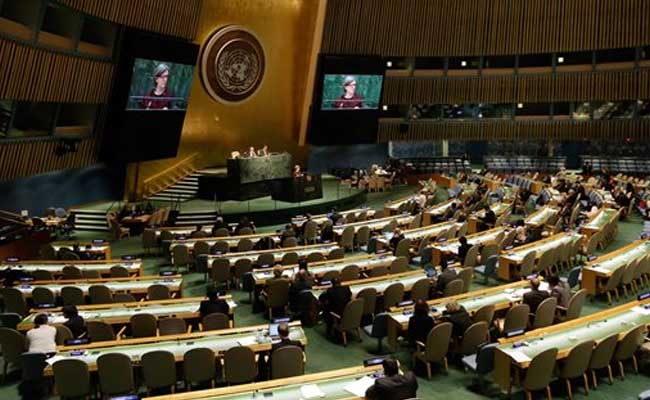
17 Sustainable Development Goals (SDGs) that will lead to the transformation of the world, especially in the fight against global poverty, will be adopted by 193 Member States of the United Nations, at this year’s General Assembly.
Nigeria may not be fully represented at the landmark Sustainable Development Summit which is expected to officially embrace the new agenda entitled “Transforming Our World: The 2030 Agenda for Sustainable Development,” as Nigeria’s President currently has no Adviser on the Development Goals.
The former Special Adviser to the President on the Millennium Development Goals (MDGs) Precious Gbenol had last year presented a speech on Nigeria’s progress so far. This is however President Muhammadu Buhari’s first session at the United Nations.
The MDGs 8 in a whole ends in December and transits to 17 goals and 169 targets that will run for another 15 years (2030).
Many countries, particularly in Sub-Sahara Africa have seen important progress across all goals, though uneven. In Nigeria, this has been no different as gender equality has made a leap with some significant reduction in child mortality. The fight against HIV/AIDS, Malaria and other diseases seems to have gained some milage,but Nigeria is still poorly rated globally in the hunger index.
With a global hunger index of 14.7 in 2014, Nigeria still has not made a significant improvement on the most important of the MDGs, which is to reduce extreme poverty and hunger. The target is set for 9.7 percent by the end of 2015.
The new SDGs represent an unprecedented agreement around sustainable development priorities among 193 Member States. With the shared global goals and targets, countries will tailor them and implement policies at the country level.
The news 17 SDGs and 169 targets of the new agenda will be monitored and reviewed using a set of global indicators framework which will be developed by the Inter Agency and Expert Group on SDG Indicators, will be agreed on by the UN Statistical Commission by March 2016. Counties will also develop their own national indicators to assist in monitoring progress made on the goals and targets.
The follow-up and review process will be undertaken on an annual basis by the High-Level Political Forum on Sustainable Development through a SDG Progress Report to be prepared by the Secretary-General.
The sustainable development agenda builds on the successful outcome of the Conference on Financing for Development that was held in Addis Ababa, Ethiopia, in July this year. It is expected that it will also positively influence the negotiations towards a new, meaningful and universal agreement on climate change in Paris this December.
“It is a roadmap to ending global poverty, building a life of dignity for all and leaving no one behind. It is also a clarion call to work in partnership and intensify efforts to share prosperity, empower people’s livelihoods, ensure peace and heal our planet for the benefit of this and future generations,” UN Scribe Ban. Ki-Moon said in a statement yesterday.
The new agenda is people-centred, universal, transformative and integrated. It calls for action by all countries for all people over the next 15 years in five areas of critical importance: people, planet, prosperity, peace and partnership. The agenda recognises that ending poverty must go hand-in-hand with a plan that builds economic growth and addresses a range of social needs, while tackling climate change.
At the summit which officially kicks of today (Friday) opening remarks will be delivered by Yoweri Museveni, President of Uganda, Lars Løkke Rasmussen, Prime Minister of Denmark, United Nations Secretary-General Ban Ki-moon, and civil society representative Salil Shetty, Amnesty International Secretary-General. The Sustainable Development Agenda will then officially be adopted by world leaders.
There will be six interactive dialogues at the summit around the following themes: ending poverty and hunger; tackling inequalities, empowering women and girls and leaving no one behind; fostering sustainable economic growth, transformation and promoting sustainable consumption and production; delivering on a revitalised global partnership; building effective, accountable and inclusive institutions to achieve sustainable development; and protecting our planet and combatting climate change.
A private sector forum, will also hosted by Secretary-General Ban Ki-moon with a focus on the role of the private sector in implementing the Sustainable Development Goals. A civil society high-level event will focus on building political will for the implementation of the Summit’s outcome and conclude with a Solutions Summit.
Elizabeth Archibong

Join BusinessDay whatsapp Channel, to stay up to date
Open In Whatsapp


