

Crisis of a huge proportion appears to be looming following the recent announcement by the association of Nigerian governors that its members would no longer abide by the long-standing agreement of payment of N18,000 minimum wage per month.
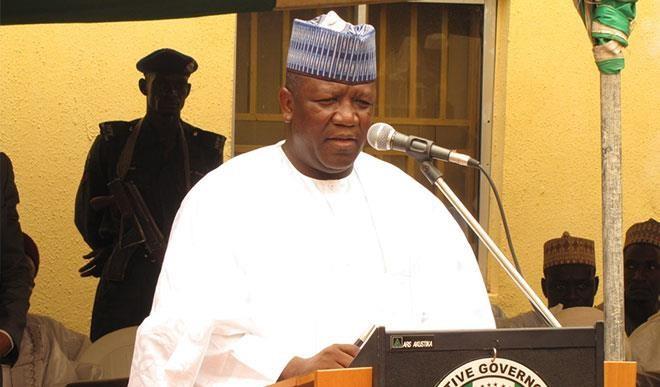
This decision was conveyed to Nigerians penultimate week throughAbdulaziz Yari, Zamfara State governor and chairman, Nigerian Governors Forum (NGF), during a meeting.
As if rubbing salt into the injury, Yari had again last Thursday insisted that Nigerian workers must either settle for pay cut or face the option of downsizing. This seemingly bare-faced threat has since elicited reactions from the public, many of whom described the decision as “a joke taken too far”.
Governors’ excuse
The NGF chairman had explained that the decision was as a result of the sharp drop in oil price, which had also resulted in huge reduction in federal allocations to states.
According to Yari, some states are now getting as small as N55million as monthly allocation, and that there was no way they would continue to borrow to service overheads.
He said: “We never said we are going to stop the payment of N18,000 minimum wage, but we are looking at the situation in the country and in the global economy. What we said was that when the National Assembly enacted the law of paying N18,000 minimum wage, then oil price was about $118 per barrel and today oil price is $41 per barrel.
“So, if it continues like that, definitely, we will find it difficult to continue. We have to sit down with the labour and see how we can review, either continue or downsize or what we are going to do.’’
“On the receipt from the federation account, some states received N400million, N500million. Some others received N55m; two digits. And there are other issues, not even the salary, pension is over a billion. So, how can we continue borrowing and servicing the service aspect of our expenditure or overhead? How can we do that?
“We are telling the public that we are planning to sit down with the President and his team and the state governors as a team and the experts to come out with the way forward and how we are going to handle the poor state of the economy in the country.
“But what we have on ground now will not be realistic if it continues the way it is without having other sources from the economy and still relying on oil that was sold for $118 dollar per barrel and now down to $41, and think that we can continue behaving or misbehaving the way we are doing, if there is anything like that.”
But NLC says no to pay cut, retrenchment
Reacting to the proposal, Ayuba Wabba, president of the Nigeria Labour Congress (NLC), said that the organised labour would neither accept a downward review of the minimum wage nor any move to sack workers.
Wabba said the labour movement was prepared to engage the governors in the bid to defend the Minimum Wage Act against the threat of violation.
He added that the labour movement was planning to ensure an upward review of the minimum wage.
“We are ready for them; we will resist any attempt to downsize. We are also going to resist any attempt to slash the minimum wage. In fact, we are going to make these demands because it has been proven that what keeps the economy going is the fact that workers are able to be paid and that they can buy.
“That is how production will continue and that we insist that the issue of minimum wage is a no-go area. We are talking about reviewing it upward; certainly, we are ready for them. We will shut down the economy if they try that.
“Certainly, we are ready for them; it is not something that we are contemplating. The issue of the minimum wage is something that is dear to us and we are ready to go to any length to defend it.”
Angry Nigerians spit fire
Martin Onovo, a petroleum engineer and presidential candidate of the National Conscience Party (NCP) in 2015 general election, said the claim by the governors that the 2011 minimum wage of N18,000.00 is not sustainable, is both “illogical and very vexatious.”
Onovo said that the move was “a continuation of the vicious war against the pauperised Nigerian populace by a class of greedy and parasitic political office holders that have seized power illegitimately using, corruption, violence, bribery, rigging and abuse of office as weapons for manipulating the democratic process.”
He also said that it was only reckless and corrupt state governors that have difficulties with payment of wages.
“Effective state governors have been paying as and when due. Recently, (after the 2015 general ‘elections’), the APGA Anambra State government announced a general increase in wages in its public service,” he said.
He expressed the view that if Anambra State Government has continued to increase the wages of its workers, there’s no justification for any state to say it did not have the capacity to pay.
“Anambra State is in the ‘bottom-third’ of states in allocation from the ‘Federation Accounts’. With the devaluation of the Naira, the inadequate minimum wage has painfully lost about twenty percent (20 percent) of its value in our import dependent economy. Therefore, an immediate increase of 20 percent is justified to restore the original 2011 value of the inadequate 2011 minimum wage,” he explained.
He also reasoned that “Since even the 2011 minimum wage is clearly inadequate when compared to the minimum cost of living, it has become necessary to increase it to the level of a living wage, sufficient to sustain one employee for a month. This can reduce the pressure for corruption and boost both morale and the productivity of public servants. State governments can easily afford a significant increase as confirmed by the APGA Anambra State government.”
Onovo advised state governors to “Control the outrageous benefits of their political officials; control corruption firmly; eliminate wastes in governance and improve inefficiencies in governance.”
In his reaction, Tunde Akingbade, a public affairs analyst, said: “It is so disappointing that the people charged with the responsibility of improving the lives of the masses are the same ones inflicting the most pain. It is pathetic. These governors that are agitating for a downward review of the minimum wage because of the financial woes we’ve found ourselves, have they, for once thought about cutting their own salaries and allowances?
“It is a total no no, for me! No sane person will support this wicked arrangement. I feel the FG should wade into this, else the protests will spiral out of control and further affect the economy.”
Another respondent, Ishola Martins, said: “It is sad because even the said minimum wage is hardly enough and they want to reduce it. It is really not fair. People are already suffering. It would be bad to increase their suffering by reducing the minimum wage. School fees and other bills are on the increase so, why should the minimum wage be reduced?”
For Esther Oluwafemi, a concerned citizen, the governors’ claim was really uncalled for.
“Some governors are wasteful, really. They lavish money on frivolous spending and they want the masses to suffer for it. What can N18,000 buy? Most people collecting that amount are family men and women with children, yet, some people are saying they should reduce the money. Can’t such governors take from their own personal earnings to make up for the shortage? After all, they are there to serve. The Federal Government should not give them any loan. They should generate the money and pay by themselves. The Federal Government needs to checkmate frivolous spending by states.”
A civil servant, who spoke on condition of anonymity, said it was unfortunate that the ruling class always heaps the negative side of the economy on the poor citizens, whereas when the economy is booming, they corner everything for themselves and their cronies.
“We have heard stories of a barrel of oil selling as high as 128 dollars, then the governors never invited the masses to ‘come and chop’ with them. They were wasteful and neglected to save for the rainy day; now because we are experiencing a downturn, not even up to a year, they are crying blue murder. What a brood of plunderers! How are they different from the ‘Prodigal Son’ who only remembered his hopelessness after he had squandered his father’s wealth? I am also shocked that they lack the simple principle of saving in time of plenty for the famine period. Imagine that even some of them who have been sitting on the wealth of their states for over four years are now saying that N18,000 is too much for them to pay. It is sheer wickedness,” the civil servant said.
According to Dan Owegie, a chieftain of the APC in Edo State, “oil revenue did not crash over night and it is a common knowledge that oil resource from elementary economics knowledge is open to volatility. Minimum wage of N18,000 paid to Nigerian workers was not agreed to when oil price was $126 per barrel. In fact, the national minimum wage came into existence after almost two years of agitation and eventual negotiation by the tripartite of government (represented by the federal and state governments), the Nigeria Employers Consultative Association (NECA), representing other employers (in the private sector) and organised Labour. This was in 2011 and at that time, the price of Nigerian crude averaged $100 and not $126 as claimed by the governors.”
Owegie further said: “Nigerians who are opposed to the creation of more states have always argued that existing states were not viable as most of them were depending on oil revenue for their survival and most opposing voices to the clamour for new states were actually canvassing for the abolition of states and return to regional governments and resource control as it were in pre-independence Nigeria and early years of post-independence. But little minds, who always do not see beyond the now or their nostrils, were always shouting them down and having their way in the National Assembly. But today, we are face to face with the reality of what people have been talking about.”
“Take away oil revenue, apart from Lagos and Edo which are serious on their Internally Generated Revenue (IGR), all others may close shop or be declared bankrupt soon, in the event oil price slumps to intolerable level.”
Oshiomhole pitches tent with masses
In a move described by many as being consistent with his struggle as a labour leader, Adams Oshiomhole, Edo State governor, insisted that state governors had no choice but to pay the 18, 000 minimum wage which was signed into law by former President Goodluck Jonathan.
He noted that with current economic realities, the N18, 000 minimum wage, which is less than 100 dollars, is nothing to write home about.
“I joined the NLC to protest to the National Assembly when they were going to amend the constitution to make the minimum wage a concurrent issue.
“I said workers have a stake in this democracy. They are the ones who could afford to match the street and they matched the street for democracy. Democracy doesn’t have to run at the comfort or convenience of governors, ministers, and presidents. I believe that the issue in the economy hasn’t got to do with minimum wage. I have always also reminded my colleagues that the minimum wage was not imposed, it was negotiated and state governments agreed to it, the president signed it not under duress, there was no strike to compel the then president to sign it; he signed it voluntarily.
“I believe when you look at the minimum wage as it is today at N18,000, it is less than 100 dollars. I think it is now about eighty dollars. Now, divide eighty dollars by 31 days, you will be getting about two point something dollars. Now we cannot argue that workers in Nigeria’s formal sector should not earn more than two dollars a day, I cannot subscribe to that because the art of governance is the welfare of the people,” he said.
“One would have thought that the governors will think out of the box to explore the possibility of increasing Internally Generated Revenue (IGR) through exploration of resources, albeit abundant ones in their vicinity to improve their state resources. Furthermore, time to rethink the exploration of mineral resources being entrenched in the Exclusive List is now. Methinks it is better made concurrent. Here, review of 1999 constitution along the line of 1963 Constitution is not out of place.
“In conclusion, Congress wishes to state that it is vehemently against the move and would stop at nothing to ensure it does not see the light of the day. The organs of the Congress are going to meet very shortly to prepare for the war declared by the Governors Forum against labour and the toiling masses of the country.”
Wike toes the honourable path
On his part, Nyesom Wike, Rivers State governor, said the state government would not be a party to the reduction of the minimum wage for workers, pledging that regular payment of workers’ salaries has multiple effects and was critical to social stability.
He said: “Rivers State will not be a party to the reduction of the minimum wage. Rivers State will not reduce the minimum wage. The state government will continue to pay the salaries of workers because we believe that the worker deserves his wage”.
Wike noted that his administration was committed to workers’ welfare, hence it cleared outstanding three months salaries owed workers upon assumption of duty on May 29, 2015.
He advised his colleague governors that rather than reduce the minimum wage, government at all levels should work towards addressing the numerous development challenges facing the nation.
Last line
On the way forward, rather than compound the woes of the Nigerian civil servants, governors must cut down on their frivolous lifestyle and the cost of governance. Critics say that what is unsustainable is the hundreds of billions of Naira public office holders continue to fritter away in the name of governance.
Zebulon Agomuo

Join BusinessDay whatsapp Channel, to stay up to date
Open In Whatsapp


