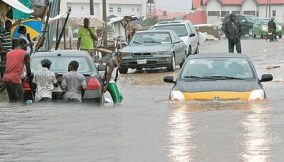
A strong moral restraint is required to down-play effusiveness or emotive outpouring that could appropriately capture nature’s fury as demonstrated in the heavy downpour and devastating flooding in Lagos penultimateSaturday which demystified a self-acclaimed megacity and its expensive, highbrow neighbourhoods.
That’s perhaps what often happens when man becomes too meddlesome and carefree with a superior power to which he owes love and tender care.
Looking at the unusual turbulence and the fury of the elements (heavenly bodies) of a particular season in the English society of his time, William Shakespeare, the cerebral and celebrated English playwright, observed, “It’s either there is civil strife in heaven or the earth too saucy with the gods incenses insurrection,” thus linking all that happened to the anger of a being above or beneath.
What happened in Lagos, Nigeria’s commercial nerve centre, on Saturday, July 8, was really a clear expression of anger by a furious nature whose balance has been mindlessly distorted by humans whose efforts in the last decade or more have not stopped at just distorting the natural balance of the eco-system, but also extended to caging nature permanently.
But it was not only Lagos that was affected. In Suleja, Niger State, more than 100 houses were said to have been flooded while about 10 persons were feared dead following the heavy downpour that began in the early hours of Sunday.
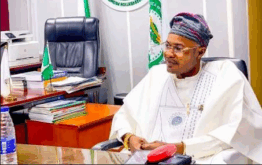
Last Wednesday, the News Agency of Nigeria (NAN) reported that while commiserating with victims of the latest flood disaster in Lagos and Niger States, Suleiman Adamu, Minister of Water Resources, warned that about 30 states and over 100 local government areas, which had been categorised as high flood risk areas, could expect flooding this year.
“Annually, there is an average of 1,000 cubic metres precipitation with over 760 cubic metres evaporation, resulting in a balance of approximately 240 cubic metres as runoff. When this added to the over 88 cubic metres trans-boundary water (that is Niger and Benue river systems), we get a total surface water of about 328 cubic metres,” NAN quoted Adamu to have said.
“Far less than 50 cubic metres of this runoff is impounded in reservoirs, leaving a surplus of over 250 cubic metres which should be controlled, harvested and managed before ending up in the Atlantic Ocean.”
The minister, however, gave assurance that the flow of this water would be constantly monitored by the Nigeria Hydrological Services Agency (NIHSA), while flood alerts would continue to be issued across the country. He also advised that people should adhere to the advice in the recent Annual Flood Outlook issued by the NIHSA and other flood alerts by related agencies.
“The ministry and its relevant agencies will continue to sensitise the public and warn them against abuse of the environment as well as the importance of tree planting in efforts to reduce erosion and flooding,’’ he said, while also calling on the state and local governments to also embark on similar sensitisation campaigns on flooding, particularly at the grassroots level.
Peculiar case of Lagos
Lagos is unarguably a special and unique environment. The key to understanding this Africa’s most populous city is in the water. From the sea, Lagos rose from being a humble port city to an economic and political powerhouse and sprawling home to around 22 million people. An unconfirmed report says the city derived its name from water, explaining that the word ‘Lagos’ is a Portuguese word for ‘lakes’.
Lagos consists of a mainland and a series of islands, which make it especially susceptible to rising sea levels. Its proximity to the Atlantic Ocean, combined with risks from climate change, poses the largest environmental threat to the megalopolis.
Adeleke Adedipe, chief operating officer, LEKOIL Nigeria Limited, agrees that Lagos Island is below sea level and, therefore, most of the places around Lekki and parts of Victoria Island are reclaimed land, and when lands are reclaimed from water, the water will try to find its level.
“First of all, you have to create a path for the water to find its level so that it can dissipate properly. But this hasn’t been done over the years in Lagos. So, when the rain comes, it must find a place to go,” Adedipe says.
But there are more to the causes of frequent flooding in the city than these factors. A lot of things have gone wrong through the action and inaction of the city state government and the residents.
Uncontrolled human activity
The Lagos State government has blamed the incident on illegal dumping into water channel by the residents and has assured that it has activated its emergency response system to respond efficiently where necessary.
Adedipe says the drainage system, particularly in Lekki, is too shallow and may not have been properly connected to the lagoon. When there is no proper connection of the drainage and the lagoon, he says, flood is inevitable when it rains.
“Even the shallow drainage that has been created, people, because of their dirtiness and stupidity, dump refuse in there, blocking the water from flowing,” he says.
Some environmentalists and urban development experts, however, think there is still more to it.
Rapid urbanisation without commensurate infrastructure
Lagos has a large and growing population of about 22 million people with fast-paced urbanisation, but nothing concrete is being done to match facilities and basic infrastructure with this growth.
“When urbanisation is taking place and less attention is being paid to how we build and dispose garbage, what we get is what we see on yearly basis,” says Bode Adediji, an estate surveyor and valuer.
“As a professional, I have been familiar with the hues and cries concerning flooding in Nigeria in the past 50 years, but despite these frequent challenges, we have not been able to tackle the root causes from an intellectual and professional standpoint. People only remember this problem when tragedy occurs. There has never been a time Mother Nature has not alerted us of the imminence of this danger, yet everybody goes about as if nothing matters. We have the meteorological agency of government which predicts the coming of this incident, yet government itself does not take its agency seriously,” he adds.
This was perhaps why highbrow locations including Victoria Island, Lekki, Ikoyi and Victoria Garden City, which are home to the rich, were submerged with the residents unable to move out of their homes. Some major roads in the metropolis including Ahmadu Bello Way, Adeola Odeku, parts of the Apapa-Oshodi Expressway, Ikorodu Road, among others were not spared.
Tampering with nature
Besides the unwholesome activities of some residents who block the very few available drains with indiscriminate waste and garbage disposal, Lagos is over-building with intensive and extensive land reclamation from the seas and lagoons that surround the city.
“A lot of land reclamation is taking place along the coast and that is increasing the water level. When it rains, it adds to the water level and what we see is the flooding that is making all of us uncomfortable,” says Adeniji Adele, vice president of the Nigerian chapter of International Real Estate Federation (FIABCI), who fears that the city is yet to see the worst if nothing is done as a preventive measure.
The land reclamation from the Atlantic Ocean for the development of Eko Atlantic City comes off easily as a major source of concern.
“The Atlantic City is a reclaimed land and the water driven from there must go somewhere; and if you are not prepared for it, you will be in trouble sooner than later. Unfortunately, many people who built houses in these areas built on the path of the water and a new path hasn’t been created for the water. When water comes to a place and it cannot move, it will build up; and therefore, there will be flood, which is the second element,” Adedipe of LEKOIL says.
But Adediji thinks differently, saying he doesn’t have anything against Eko Atlantic City nor does he support the kind of agitation people are raising against its development.
“For me, I like to look at anything that comes up from an intellectual and professional perspective. What is happening there is an engineering model but I believe that people can reclaim land for development without precipitating flooding,” he says.
Eko Atlantic is the name of a grandiose project to create a new economic capital for Africa. The development includes everything from sky-scrapers to luxury apartments, a new financial district, a private power-grid, and a shopping boulevard in the image of New York’s Fifth Avenue. It’s the brainchild of the Chagoury brothers, two Nigerian-born billionaires of Lebanese descent who own South Energyx Nigeria Limited, a real estate development company created to build Eko Atlantic.
“Eko Atlantic is meant to be an antidote to some of Lagos’ deep-seated problems. The city is meant to bring 250,000 new jobs and address a housing shortage brought on by a surging population. This, and the fact that it’s privately-funded, have given the city support of the state and federal governments,” notes Mimi Onuoha who writes for the Quartz Africa Weekly Brief.
Before 2008 when construction started on the city which sits beside Victoria Island, Lagos residents in this area and the adjoining Ahmadu Bello Way were victims of seasonal flooding and frequent ocean surge. The development of Eko Atlantic was therefore seen as an antidote to this.
But nature has a different opinion. It proved this opinion with the flooding incident of Saturday, July 8 when Ahmadu Bello Way become a mini-sea with some funny characters seen paddling their canoe on the flood that swallowed the road and environs.
Onuoha recalls that in 2012, a storm surge in the exact location of Eko Atlantic’s construction killed 16 people. In the aftermath of the tragedy (which some blamed on disturbances caused by Eko Atlantic’s building), the developers of the project highlighted the fabrication of ‘The Great Wall of Lagos’, a sea wall that wraps around the city and protects it from the effects of the surrounding Atlantic.
“But, according to some climate scientists, the same wall that will protect Eko Atlantic could worsen the situation for neighbouring areas not protected by it, which include much of Lagos,” Onuoha notes, quoting Alan Blumberg, a climate scientist renowned for his research on the effects of climate change on water structures, who highlighted the challenges of a sea wall on its neighbourhoods.
“What happens when you build a wall is that the approaching storm surge will come up to the wall and moves to the left or right of the wall, searching for a weakness or a low spot. If there are two islands close to each other, it may go to the island next door instead,” Blumberg informed.
This aptly explains what happened to Victoria Island and environs on July 8.
David Frame, managing director, South Energyx Limited, had, however, explained at a forum on the evaluation of the city’s environmental impact assessment (EIA) in Lagos a few years ago that the sea wall is designed and tested to handle the worst storms in hundreds/thousand years.
“The Great Wall of Lagos will ensure that everyone living and working within the 10 square kilometres (6.2 miles) of reclaimed land for Eko Atlantic and the population of Victoria Island are protected from the sea,” Frame had said.
In his account of the Nigerian civil war, Fredrick Forsyth notes that “events mock at human foresight and nothing is certain but the unforeseen”. But whether Lagos flood which has become a yearly event is unforeseen or not remains a matter of debate.
Impact on property market
Though Adele describes the occurrence as a natural disaster and part of the consequences of global warming, he does not lose sight of human error in all of this. He differs from those who say that what has happened and may continue to happen will not impact on Lagos property market.
“This is going to pile pressure on the mainland because people living on the island who will not be able to cope with the flooding and high rent will be compelled to move to the mainland,” he says.
Adediji agrees, adding that houses and urban living have now become a matter of caveat emptor, meaning buyers beware.
“This is going to have dramatic impact on land value. I cannot see people wanting to buy property in areas that are notorious for perennial flooding. Those who have property on uplands are not likely to keep the price of their property low. So, there will be a paradigm shift in the market,” he says.
Way out of the wood
Tayo Odunsi, CEO, Northcourt Real Estate, who blames the whole incident on faulty planning and disobedience to urban planning regulations, says it is time for the government and builders to return to the drawing board.
He believes what happened was really a big disaster that usually leaves towns with serious impact on their real estate value. “Anybody who says real estate value will not be affected is not facing reality because it will be affected, though not significantly.
“Lagos being a coastal region should ordinarily have bigger drainages and dams such that when the water level rises, they will begin to pump water into the lagoon and ocean. That is the kind of thing they have in Amsterdam, Russia and Vienna where they have manual pumps. Lagos should have these facilities,” he advises.
Another approach to solving this problem, he adds, is urban regeneration and remodelling of the flood-prone areas. He recalls that in 2001, the Lekki master plan was drawn. That document was comprehensive enough and contains all that is needed for urban living including transportation, drainage and waste disposal systems.
“We need to revisit that document and begin to see how to implement its recommendations,” he says.
Adamu, Minister of Water Resources, while speaking on Wednesday, also advised that those living in urban cities should always refrain from constructing structures on drainages, advising state and local governments to strictly enforce environmental laws and town planning guidelines so as to check uncontrolled physical development in their domains.
“Flash floods in the urban cities or semi-urban areas can be reduced with effective and adequate drainage systems. People must not use this facility as their refuse bins which will block and render the facility useless, with the probability of flooding heightening whenever it rains,” he said.
“Furthermore, people in the riverine areas should not erect residential structures on flood plains as these areas are an extension of the river space,’’ he said.
Adedipe of LEKOIL suggests that many of the houses in Lekki that are blocking the normal flood paths should be pulled down, no matter who owns them, adding that the argument of defaulters that the land was properly bought from government cannot stand since the master-plan of the affected areas shows it is illegal to build on drainage system.
“So, anybody, who goes to get the ‘yeye’ (nonsense) permit from one stupid government official, contrary to the master-plan of the city, such houses should be pulled down. It is as simple as that,” he says.
“But the problem we have in Nigeria is that when Ambode starts destroying the houses causing the problem now, we will bring politics to it. You will start hearing people saying he is destroying houses that belong to PDP members. Until we start obeying the laws of the town planning, we will continue to have flooding problem,” he tells BDSUNDAY.
Buttressing the need for the Lagos State government to properly plan its metropolis, particularly areas where lands were reclaimed from the sea, he posits that the state, in its quest to overcome the clear and present danger, should adopt the Netherlands model.
“I lived in Netherlands. The entire country of Netherlands is under the sea. But they have a proper drainage system that you never see flooding. Because they know that they reclaimed the land from the sea, they created a path for the water body to return to where it was driven from,” he says.
“But we have not done that in Nigeria. So, Netherlands should absolutely be our model in developing a plan to check flooding in areas where lands were reclaimed from the water,” he adds.
CHUKA UROKO & NATHANIEL AKHIGBE
(Additional reporting by CHUKS OLUIGBO)

Join BusinessDay whatsapp Channel, to stay up to date
Open In Whatsapp