Stock investors who took long-term positions this year on the shares of Skye Bank Plc and Forte Oil Plc have seen their equity portfolio decline significantly, while those that invested in the shares of Dangote Flour Mills Plc and Mobil Oil Plc have seen marked increase in their investments.
BusinessDay analysis of the 107 most traded stocks on the stock exchange, from January to December 9 shows that 60 stocks suffered significant drops in share price, only 23 stocks recorded an appreciation while the prices of 23 stocks remained unchanged.
Skye Bank led the top losing stocks on the exchange with its share price declining 68.4 percent since the beginning of the year. Forte Oil Plc followed closely with a loss of 67.8 per cent since the beginning of the year, underperforming the NSE benchmark All Share Index (ASI) which has also dropped by -9.86 percent this year.
The shares of Skye Bank Plc nose-dived after the Central Bank of Nigeria (CBN) took over its Board and management, after the lender failed to meet the regulator’s minimum key liquidity and capital adequacy ratios. Under a new management, the bank has since stabilised.
Johnson Chukwu, Chief Executive Officer, Cowry Asset Management Limited, told BusinessDay that investors started selling the shares of Skye Bank following forced change in management, “investors became afraid of the future of their investments in the bank and so had to dump its shares”. On Forte Oil Plc stocks, Chukwu believes that “the stock rose beyond its intrinsic value,” adding that its record price decline resulted from the expected adjustment to its real value.
Listed companies on the stock exchange have seen their market value decline by about N1trillion this year. The stock market value at the beginning of the year was N9.85trillion but has dropped by N967billion to N8.883 trillion by Friday December 9.
BusinessDay analysis shows that some companies have been most impacted by the negative sentiments in the market. Skye Bank Plc opened this year with a share price of N1.58 but closed Friday at 50 kobo per share. The bank’s share price had risen to a 52-week high of N1.66 per
Forte Oil Plc stocks have also been beaten with its unit price dropping to N106.23 from year open of N330. Forte Oil share price reached a 52-week high of N342 before declining.
UAC Property Development Company Plc is another stock with a record dip of 66.7 percent since the beginning of the year. The company’s share price, which opened this year at N6.09, closed last week at N2.03.
Also, Diamond Bank Plc share price has lost 63percent year to date. The bank’s share price opened this year at N2.30 but closed Friday at 85kobo after reaching a 52-week high of N2.47.
Caverton Offshore Support Group Plc is another stock that has seen its value decline from a 52-week high of N2.35 94 kobo, a decline of 61.9 percent. Cement Company of Northern Nigeria Plc (CCNN) has lost 56.8 percent of its value this year from N9.35 at the beginning of this year to N4.04 last Friday.
CCNN share price reached a 52-week high of N10.10. Other big losers are investors in Glaxo Smithkline Consumer Nigeria Plc, which has lost 59.1percent of its share price from N34.20 to N14.
Lafarge Africa Plc has lost 59.9 percent of its share price this year. Lafarge opened this year at N96.80 but has declined to N38.82, after a 52-week high of N95.45.
Vitafoam Nigeria Plc has also lost 59.5 percent of its share price. After a remarkable year open level of N5.41 and 52-week high of N5.42, Vitafoam share price closed Friday at N2.19. Unity Bank Plc was not spared in the value erosion, as its share price has lost 52.7 percent of year-open value of N1.12 and a 52-week high of N1.26. Ashaka Cement Plc has lost 56 percent of its share price this year, from N25 to N11. Ashaka had recorded a 52-week high of N26.50.
But it was not all bad news on the exchange, as investors also reaped some significant gains on some stocks, which include Dangote Flour Mills Plc that outperformed the market with 236.3 percent gain; followed by Mobil Oil Plc which has gained 90.6 percent this year.
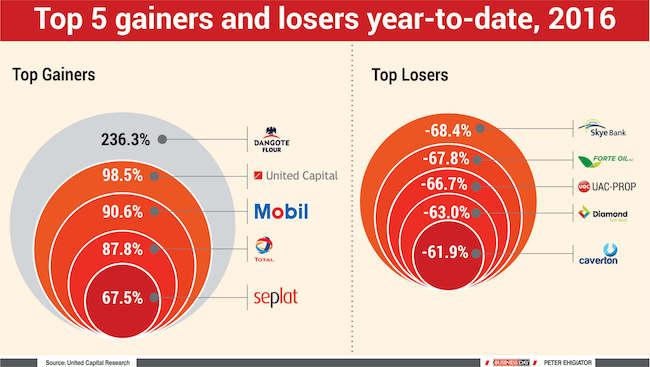
Dangote Flour Mills closed Friday at N3.80 from year open level of N1.13. It recorded 52-week high of N6.12. Mobil Oil Plc closed Friday at N305, from N160 at the beginning of this year.
“The recent re-acquisition of Dangote Flour from Tiger Brand by Dangote Industries Limited, to reposition it for better performance and leading to a name change, may have impacted on its share price”, said Sewa Wusu, Head, Research and Investment Advisor at Lagos-based investment bank, SCM Capital Limited.
Wusu noted that before the advent of the deal earlier this year, “the company had operated under a loss position for about two years, which had initially threatened hopes of a recovery. The need to inject vigour and reclaim its market share by management, may have induced renewed investors interest in the company.
“This is in spite of the current weak macroeconomic situation. As at third-quarter (Q3), Dangote Flour has moved from loss position to profitability. The recent announcement by the Federal Government to ban the importation of wheat, beginning from 2018 may have also be a positive catalyst to reposition Dangote Flour”, Wusu further told BusinessDay.
The stock price of Mobil Oil recorded a 52-week high of N340. The company’s share price has received a boost in recent weeks, following the announcement that NIPCO has acquired 60% stakes in it.
Seplat Petroleum Development Company Plc has also gained 67.5percent this year, despite the downturn in crude oil prices in the international markets and militant attacks in the Niger Delta.
The oil company stock rose to N340 last Friday from year open level of N203. It has recorded a 52-week high of N390. Total Nigeria Plc stock has increased by 87.8percent, while that of United Capital Plc has gained 98.5percent this year. Total Nigeria closed Friday at N276.05 from year-open level of N147.01 while its share price reached a 52-week high of N345. United Capital Plc opened this year at N1.31 but had risen to N2.6 last Friday. Its share price recorded a 52-week high of N2.84.
Even though the year is yet to come to an end, analysts at FSDH Merchant Bank in their recent outlook, said the market might not witness improvement in activities towards the end of the year.
Analysts believe that the unclear economic direction and shortages of foreign exchange (FX) continue to weigh down risk appetite in the equity market
Similarly, Johnson Chukwu CEO of Cowry Asset Management believes, “Investor sentiment in the market will still be largely mild. The market will remain largely weak because it will mirror the performance of the economy. I don’t expect any sharp economic growth. At best, we will climb out of recession.”
“We recommend that investors should maintain a medium-to-long term position in the equity market. We reiterate that long-term investors should take long positions in stocks that have strong fundamentals. The clarity of the economic policy direction of the FGN holds the key to the short-to-medium term needed upward push for the equity market,” the analysts stated.
Trading activities on the exchange declined by about N53.6billion in the last two months, latest trading figures for October showed.
As at August, the total transactions on the local bourse stood at N117.71 billion; in September it was N94.77billion; while in October it declined to N64.03billion, showing a significant decline between August and October 2016.
In the first ten months of 2016, total transaction on the stock exchange was N991.11billion, just slightly above half of the N1.667trillion transactions recorded in the in the comparable period of 2015.
In the ten months to October 2016, foreign inflows into the Nigerian Stock Exchange stood at N222.5billion, almost the same as the outflow of N221.88billion, indicating that foreign investors have taken a very short-term view of the Nigerian stock market.
“We observed that both foreign and domestic activities are decreasing. However, the domestic activity is decreasing faster”, said the Nigerian Stock Exchange, which on a monthly basis pulls trading figures from major custodians and market operators on their foreign portfolio investment (FPI) flows.
Analysts believe the performance of the stock market in 2017 will be mixed. “It can be bearish if the economy remains in recession or bullish if government acts fast. To a large extent, the bullish factor will depend on how quickly the government implements all its economic repositioning policy measures to lift the economy out of recession,” said Sewa Wusu.
“The main issues still centre around foreign exchange availability. The dollar shortages have significantly affected the performance of the stock market. However, the current market mood presents buyers’ market opportunities for risk tolerant investors.
“I expect such investors to begin to accumulate some of the blend of good fundamental stocks ahead, due to attractive entry points. This is in anticipation of a market upturn by 2017. Technically, the market momentum is in the oversold condition, which is a buyers’ market , as I said earlier. My take is that you buy the dips, based on selective risk appetite and expect a positive market upturn by 2017. This prognosis is supported by government spending plans and viable macroeconomic policies to revamp the economy,” said analysts at SCM Capital Limited.
Iheanyi Nwachukwu

Join BusinessDay whatsapp Channel, to stay up to date
Open In Whatsapp