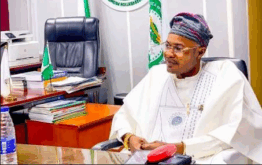
The high turnover of ministers at the Federal Ministry of Education is a major reason Nigeria’s education sector has remained troubled and turbulent, BusinessDay investigations show.
At the last count, Nigeria has had not less than 60 education ministers since 1958, while Ghana, its contemporary, has had only 29, further investigations reveal.
Industry watchers who spoke to BusinessDay say this development breeds policy inconsistency, a poor sense of direction, and lack of continuity in the education system, resulting in near stagnation of the sector.
“It is not good for stability and consistency,” said Ibidapo Obe, former vice chancellor, University of Lagos, and currently vice chancellor of the new Federal University Ndufu-Alike, Ikwo, Ebonyi State.
Obe insists that the position of the country’s education minister is like that of the attorney-general, adding, “It should be handled by professionals. It should not be based on political appointment.”
Of Nigeria’s 60 ministers of education, Aja Nwachukwu, who served from 1958 to 1965, is considered the longest-serving minister, followed by A. Y. Eke, who served 1970-1975, and Jubril Aminu, 1985-1989.

Since Nigeria’s return to democratic rule in 1999 up till date, a period of 15 years, Nigeria has had 17 ministers – or 18 if one adds the last supervisory minister, Nyesom Wike.
The huge cost of this uncommon instability in leadership, poor direction and haphazard policy execution is evident in several policy reversals that accompany the flux of ministers, the absence of a painstaking approach towards leading the education sector to a desirable status, and the glaring decay at all levels of the country’s education system.
Today, over 70,000 Nigerians are studying in Ghana, widely believed to have a more stable policy framework and better sense of direction in its education sector. Estimates as at 2012 made by Exam Ethics International, a non-governmental organisation, put the total expenditure of these Nigerian students in Ghana at over N160 billion. It is also estimated that over N1.5 trillion is expended by Nigerian students studying across the globe.
“The statistics for the number of education ministers since independence is quite bad. The high turnover of ministers of education can’t possibly be good, especially from the policy point of view,” said Chinedu Duru, managing consultant, Hamilton Lloyd and Associates, a human capital development firm.
“It is important for government to understand that the minister of education is not something they can change at their whim and caprice; they should realise that education is something that requires long-term planning and continuity,” he said.
Nigeria seems to be close to the tipping point of its greatness, but the question remains whether the country would play in a fast-developing global knowledge economy with a badly governed education system?
IKENNA OBI & KELECHI EWUZIE

Join BusinessDay whatsapp Channel, to stay up to date
Open In Whatsapp