


Inside the town of Chibok, few days after the horrific kidnapping of over 200 young schoolgirls, a desperate survivor of the countless Boko Haram raid in the area, Ali Yaga, spoke to BDSUNDAY. “ No water, no fuel. We have no water, we have no fuel to pump the water from the ground. Because of the embargo on vehicles bringing petrol to this area.”
The scarcity of virtually everything in Chibok and surrounding towns and villages emphasizes the area’s fate. There is barely a breath of wind.
Ali Yaha’s lamentation also reflects the full extent of Chibok’s misery. Countless number of surrounding towns and villages destroyed, shops and businesses crushed beneath tons of burnt out rubbles. Even the graves of the dead are not spared the brutality of the Boko Haram’s rampage.
“Water is very scarce! If anybody gives you a litre of water, that person must love you so much and you will be ready to protect the person with your life,” says Ibrahim Samuel, a resident of Chibok, to underscore the hardship that has befallen the once boisterous town.
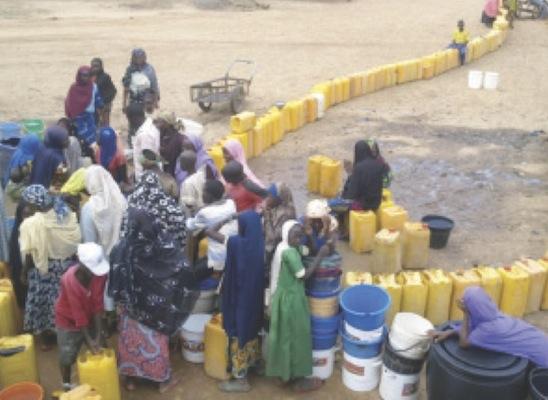
“Even when the water is available, it’s too salty for one to drink without having health problem. We have generators but how can we use it without fuel? Fuel is almost an exhibit in Chibok now,” he adds.
He says a litre of petrol is sold for N400 and in some cases for about N500. “They deprive us of our right. We cannot travel out.”
Yaga, who operates one of the very few borehole water pumping machines said the current challenge is as a result of the embargo placed on the sales of petrol in black market following the abduction of the Chibok girls.
He told BDSUNDAY that local government officials were formally responsible for bringing fuel to the area, but all that has stopped since the beginning of the rampage.
“They said they don’t have to bring anymore because the security has stopped all the vehicles bringing fuel here. How can you stop black market in a place without filling station? Right now, when they see anyone selling black market petrol, they will destroy everything there. The result is this long queue for water in Chibok.”
No one is certain who is responsible for ordering the embargo on fuel and thus economic activities in the area given the thin line between who is a genuine security official and the Boko Haram terrorists-a panorama familiar to anyone who has witnessed months of destructions in Borno State and the entire Northern Nigeria.
Our correspondent watched families who sought information on were to get water as well as other items of food such as pepper, salt , bread and, others as they sought to salvage what they could of their former lives. It was a powerful emotional moment for this reporter.
“Even if you find bread here, can you afford it? A small loaf can cook a pot of good soup in those day,” a senior citizen told BDSUNDAY.
But, Chibok is one place where the people seem not to just give up. It has now become so symbolic. People just seem to find a way to forget the danger they faced only yesterday and work to fight back.
That spirit was evident in the resistance of Chibok self-motivated vigilante group who face very daunting challenges in their confrontation with the Boko Haram terrorist sect.
The leadership of the Self-Motivated Vigilante Group told BD SUNDAY in Chibok that mobility has been a major challenge facing the group in its efforts to contribute to curbing the incessant attack.
The spokesperson of the group who also doubled as the Deputy Leader, John Musa, said going by the curfew in the area it would be unwise for the group to use okada (motorcycles) because okada are not allowed to move about starting from 6: pm.
“The villagers will also run for cover because they will think we are Boko Haram. If we have Hilux vans and guns we will be able to defend our town. We also don’t have a camp where we can assemble for action. Whenever the insurgents are around is not the time we should be calling our members for mobilization. If we have our own camp we will take off at once whenever the insurgents are in town. Most of the time before we trek there the terrorists would have achieved their aim and left. These are the challenges facing us and we will give our best if government, individual or organization can assist us in this regard”, he said.
He said recently, they were camped in Maiduguri by the state government for 18 days and given security training with the sole objective of sending them to Sambisa forest to confront the insurgents without hurting the girls; but the state government reneged in its initial plan and sent them back to Chibok with little incentive.
“We are very ready to fight the insurgents but we are not supported by anybody. We have apprehended several members of Boko Haram including the ones we paraded before you. We have killed 15 insurgents in Damboa Local government. There is no support from both state and federal government we are still working like this.
Imagine if they decide to throw their weight behind us. We are up to 613 registered members now, with many showing interest to join us. With adequate support we can contribute immensely to this fight against the insurgents”, he said.
He said further that, it was possible for the group to rescue the girls out of Sambisa forest where it is widely believed the insurgents held them without any casualty but that government has so far refused to grant them permission to do so.
“The people that form this Vigilante group are brave hunters. Somebody who can go and kill wild animal would not be afraid of human beings if he is equipped too”, he said.
“Nigeria has failed us and the rest of the world is watching and pretending nothing evil is happening here,” one village told BDSUNDAY as he strutted off in search of water.
Nathaniel Akhigbe

Join BusinessDay whatsapp Channel, to stay up to date
Open In Whatsapp


