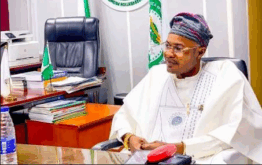
Africa’s richest man, Aliko Dangote, alongside Atedo Peterside, has been designated to spearhead the review of investment policies and incentives for Nigeria, which is struggling to attract more investments and strengthen its industrial sector.
BusinessDay learnt that Dangote will spearhead reviews of policies relating to investments, incentives and anti-smuggling, while Peterside, another notable businessman, will lead moves to improve access and cost financing to businesses in the country.
Their new assignment comes two months after Acting President Yemi Osinbajo signed three executive orders to guide government efforts on improving the country’s poorly rated ease of doing business, and is seen as a strong signal that the Buhari-led administration is now convinced on seeking private sector input in policy making.
Nigeria’s Industrial Policy Competitiveness Council, chaired by Osinbajo, with membership comprising mostly of foremost businessmen, members of the Organised Private Sector and some government officials, had penultimate week, identified five priority areas and set up committees to work on them. The committees include policy and regulation, financing, trade and market access, skills and capacity building committees and the committee on critical infrastructure.
A document seen by BusinessDay in Abuja, containing the terms of reference of the committees, showed that the committee headed by Dangote is majorly to identify and implement initiatives that will minimise smuggling and incentivise investment in the country. Nigeria has continued to move in efforts to encourage investments, and in many cases offering incentives and tax rebates. Furthermore, billions of naira are said to be lost yearly, due to smuggling across Nigeria’s borders.
An official who was at the Council’s meeting last week, told BusinessDay that the committees were advised by the Acting President to “pick one or two areas of focus and go after them aggressively,” instead of struggling to meet a long list of expectations.
The committee on Policy and Regulations, headed by Dangote, is expected to review existing and impending changes to investment policies and incentives schemes, to determine their adequacy and alignment to the
industrialisation goals.
They are also expected make recommendations on investment policies and incentives required to spur additional investments and achieve the country’s industrialisation goals. They are to engage relevant stakeholders, such as the Nigerian Customs Service, Federal Ministry of Finance, Nigerian Investment Procurement Council and Nigerian Export Processing Council, for input.
The committee will also develop and implement a prioritisation framework that will select proposed initiatives and build clear implementation/ execution plans for the selected initiatives. They are to develop a financing plan and strategies, as well as legal enablers to enable the private sector implementation of identified projects
On the other hand, the committee on Financing, headed by Peterside, also has a task of determining the key challenges impacting access and cost of finance to Nigerian businesses, as well as evaluating the effectiveness of existing financing mechanisms provided by the CBN, Commercial Banks and Development Finance Institutions.
They are also to come up with recommendations and propose initiatives to improve the effectiveness of existing financing schemes to large, medium and small enterprises and equally engage relevant stakeholders, including CBN, commercial banks, development Finance Institutions, Federal and State Government to obtain their input into the expected recommendations and initiatives.
Other sub committees constituted by the Council include Trade and Market Access to identify and implement initiatives to improve access to Nigeria’s priority market, streamline and improve border access between Nigeria and its priority markets along the ECOWAS Sub-region.
Skills and capacity building committee will identify and implement strategies to bridge the gap between the skills demanded by industry and supply by Nigerian education institutions. They are to develop the model for vocational education and training required to equip Nigerians with the knowledge, know-how, skills and or competencies required in industry in particular and more broadly for Nigerian businesses.
The committee on Critical Infrastructure has three subcommittees on Broadband, Roads and Power with an objective to identify fast paced methods to improve on their current situations.
The Broadband committee is also to review the broadband strategy developed by the Nigerian Communications Commission (NCC) and make recommendations (e.g infrastructure master plan). The Roads committee is to identify major roads which require repairs or replacement, including the specification of the rehabilitation or maintenance needs and capacity constraints that are inhibiting efficient transportation. It is also to ensure alignment with the infrastructure Masterplan, while the subcommittee on Power has a major objective to identify and implement project/initiatives to accelerate and boost power supply.
The committee on power is also tasked with the responsibility of determining the current and forecast load demand in industrial clusters and evaluate the willingness to pay in each cluster, amongst others. They are also to review the power sector value chain and make recommendations on measures required to accelerate power supply to industries and address its key challenges.
Elizabeth Archibong

Join BusinessDay whatsapp Channel, to stay up to date
Open In Whatsapp