


Nigeria’s embattled President Muhammadu Buhari presented a 2017 budget proposal of N7.2 trillion to the National Assembly yesterday, as he attempts to reset policies that have failed to lift Africa’s largest economy out of recession.
The proposal aptly titled ‘Budget of Recovery and Growth,’ seeks to increase agriculture output and productivity, promote domestic manufacturing and ‘Made in Nigeria’ goods, through intervention funds, eliminate costly Joint Venture cash calls for the Nigerian National Petroleum Corporation (NNPC) and increase funding for infrastructure, especially roads, rail and power.
The budget will also borrow heavily to plug a N2.36 trillion deficit for 2017, which is estimated at about 2.18 percent of GDP.
“The Plan, which builds on our 2016 budget, provides a clear road map of policy actions and steps designed to bring the economy out of recession and to a path of steady growth and prosperity,” Buhari said in an address to lawmakers in Abuja the capital.
“We continue to face the most challenging economic situation in the history of our nation. Nearly every home and nearly every business in Nigeria is affected one way or the other.”
The 2017 budget is based on a benchmark crude oil price of $42.5 per barrel; an oil production estimate of 2.2 million barrels per day; and an average exchange rate of N305 to the US dollar.
Based on these assumptions, aggregate revenue available to fund the federal budget is N4.94 trillion, which is about 28 percent higher than 2016 full year projections, with oil revenues projected to contribute N1.985 trillion of this amount.
Non-oil revenues, largely comprising Companies Income Tax, Value Added Tax, Customs and Excise duties, and Federation Account levies, are estimated to contribute N1.373 trillion. Independent Revenues are projected at N807.57 billion, while N565.1 billion is projected as receipts from various recoveries. Other revenue sources, including mining, amount to N210.9billion.
The N7.298 trillion budget proposal is 20.4 percent higher in nominal terms over 2016 estimates with 30.7 percent of this expected to be for capital expenses.
“I don’t see anything different from 2016 in this budget presentation. It seems to me like business as usual, where you say a lot of things you want to do but you don’t tell us how. They have lofty ideas and plan to spend less than $25 billion for a country of 180 million. We know it won’t work that way,” said Taiwo Oyedele, partner and head of tax and regulatory services, at Price Water house Coopers (PWC).
“We need trade, monetary and fiscal policies to attract investor confidence and once you get that confidence back, and there is consistency, you will find that the private sector will drive the economy out of recession.”
Nigeria is in its first recession in 25 years, after a rise in inflation to an 11-year high of 18.3 percent and the International Monetary Fund (IMF) forecasts a 1.8 percent contraction in economic output this year.
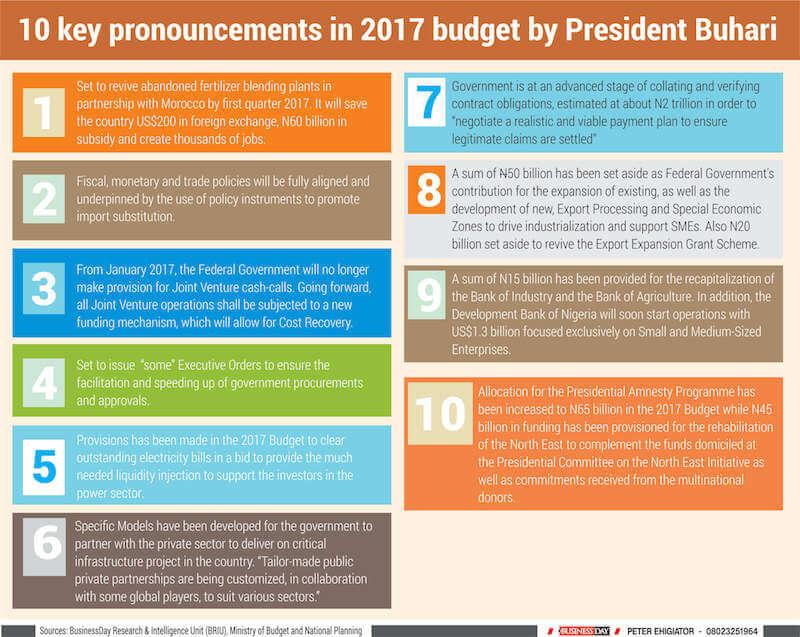
Policies the President has pursued, such as maintaining an unpopular dollar peg for more than a year after his inauguration in 2015, failing to move on reforms of the NNPC and making utterances that created an uncertain business environment, have exacerbated the economic crises critics say.
Despite a 40 percent devaluation of the naira in June, a shortage of dollars persists, and they fetch a premium of up to 40 percent on the black market. In Nigeria’s import-driven economy, this has pushed up the cost of everything, from rice to raw materials for manufacturers.
“Using an exchange rate of N305 to US$ at the interbank market, there is a contraction of about 25 percent in the 2017 budget, compared to the 2016 budget. To get out of a recession, you need to spend more in naira and dollar terms,” said Bismarck Rewane, CEO of economics consulting firm, Financial Derivatives Company.
The proposed aggregate expenditure of N7.298 trillion will comprise: Statutory transfers of N419.02 billion; debt service of N1.66 trillion; Sinking fund of N177.46 billion to retire certain maturing bonds; non-debt recurrent expenditure of N2.98trillion; and capital expenditure of N2.24 trillion (including Capital in Statutory Transfers).
A key capital budget provision, according to the proposal, would be the allocation of N213.14 billion as counterpart funding for the Lagos-Kano, Calabar-Lagos, Ajaokuta-Itakpe-Warri railway, and Kaduna-Abuja railway projects.
The 2017 budget proposals talks of partnering with private capital, through public private partnerships, to boost investments in infrastructure but provides very little details.
“There is a lot of aspirational rhetoric (in the budget) and it is just rhetoric. What is slightly disturbing for me is the philosophy underpinning it. There is a lot of statism. This sounds very much like in the eighties – import substitution, local production. It sounds very nice but the reality is that they hurt African economies across board and they have to get away from that and get more liberal.
“We must liberalise the foreign exchange market if we are going to be serious. The revenue profile will change automatically if the exchange rate for example was 450 or 500. There is a lot of discordant policies,” said Chika Mordi, CEO of the National Competitiveness Council of Nigeria (NCCN).
On using executive orders to improve business climate – Sammy Chidoka, Director Planet Capital Limited said :
“That is the problem with the present government. They keep repeating the same mistakes. It is a repetition of the whole error of 2016. There is a limit to what you can do by executive fiat. Economies work better when the institutions are strong and the rule of law prevails. I would rather prefer that the president and his team work on supporting and strengthening the institutions, rather than seeking to improve the investment climate through executive orders.”
PATRICK ATUANYA; LOLADE AKINMURELE & INNOCENT UNAH

Join BusinessDay whatsapp Channel, to stay up to date
Open In Whatsapp


