

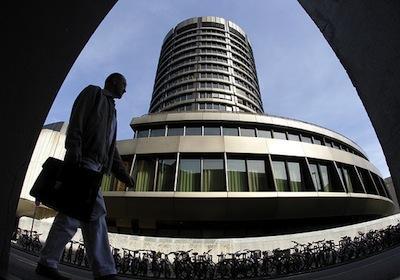
Ahead of the implementation date for Basel III, the associated liquidity pressure which banks are expected to face signposts the need to revive Nigeria’s Commercial Papers (CPs) market.
Basel III (or the Third Basel Accord) is a global, voluntary regulatory standard on bank capital adequacy, stress testing and market liquidity risk. It was agreed upon by members of the Basel Committee on Banking Supervision in 2010-2011 and was scheduled to be introduced from 2013 until 2015. However, changes from April 1, 2013 extended implementation until March 31, 2018.
Less than four years away from the Basel III implementation date, most banks with high liquidity ratio still face the challenge of meeting the financial requirements of their big corporate clients.
MTN, Dangote, Nigerian Breweries are among bank clients who at different times are either awash with or require liquidity for which CPs can serve to remove pressure on banks’ balance sheets.
Today, in the absence of a virile Commercial Papers market, banks are forced to keep all short-term credits on their books. However, some banks who wouldn’t want to be caught in the mess of Basel III-driven liquidity pressure have looked offshore by issuing Eurobond, while others are contemplating similar steps or even within.
A Commercial Paper is a money-market security issued (sold) by large corporations to get money to meet short-term debt obligations and is backed only by an issuing bank or corporation’s promise to pay the face amount on the maturity date specified on the note. It is an unsecured promissory note with a fixed maturity of no more than 270 days.
Worried by the near-term rub-off effect of liquidity pressure when Basel III implementation finally comes on board, FMDQ OTC plc believes there is need to revive Nigeria’s CP market.
Over the past four years, the CP market in Nigeria has become impaired. The size of the market shrunk drastically from monthly outstanding volumes of about N1 trillion in December 2008 to N9.8 billion in the fourth-quarter (Q4) of 2013, when ideally the market should increase in size to reflect growth in the economy.
On July 23, 2009, the Central Bank of Nigeria (CBN) suspended the sell-down of CPs as off-balance sheet items, which was aimed at forestalling several abuses in the use of the product. These abuses ranged from repackaging of troubled assets into CPs; frequent rollovers beyond the allowable tenor; and using CP sales to raise liabilities in an attempt to conceal the size of deposit liabilities or inter-bank borrowings.
“We are working with CBN and issuers to see how we can come up with a better CP market. This new market will create liquidity for issuers and less pressure on banks. Banks need long-term funds to start Basel III,” says Bola Onadele, managing director/chief executive officer, FMDQ OTC plc.
“The CP market existed before FMDQ kicked off. What we are doing is to ensure the market is upgraded to standard by bringing the technology that ensures transparent deals in CP market. The regulation used to exist but there was no technology to track the deals,” he adds.
Onadele believes there are advantages in vibrant CP markets for both the issuer and investor, adding that banks balance sheets need to be liquefied in positioning for Basel III capital and liquidity provisions.
He further tells BusinessDay that a vibrant CP market offers the issuer lower funding cost, observing that CPs do not create any lien on asset of the company, an indication that it is suitable for liquidity and cash flow management.
He also says a vibrant CP market offers an investor better returns in comparison to short-term risk-free assets, and it is tradable, and also creates alternative asset classes for PFAs and fund managers.
Dipo Odeyemi, divisional head, operations and technology, FMDQ OTC plc, notes that the integrity of financial benchmarks is critical to the development of financial markets, especially pricing of financial instruments, adding that in response to widespread concerns, FMDQ OTC plc embarked on NIBOR reform programme to ensure it complies with the IOSCO principles – focusing on restoring confidence, credibility and integrity in the benchmark.
Explaining FMDQ technology strategy, Odeyemi says it is to improve efficiency of the markets, adding that the recent in its offer was the NIBOR reform and E-Bond trading system.
The E-bond trading system provides an integrated solution for both trading and surveillance, which gives the sponsoring entity (FMDQ) supervisory view of the OTC markets. Less than five weeks after the introduction of ‘E-Bond’, the platform attracted about N2 trillion worth of deals.
Iheanyi Nwachukwu

Join BusinessDay whatsapp Channel, to stay up to date
Open In Whatsapp


