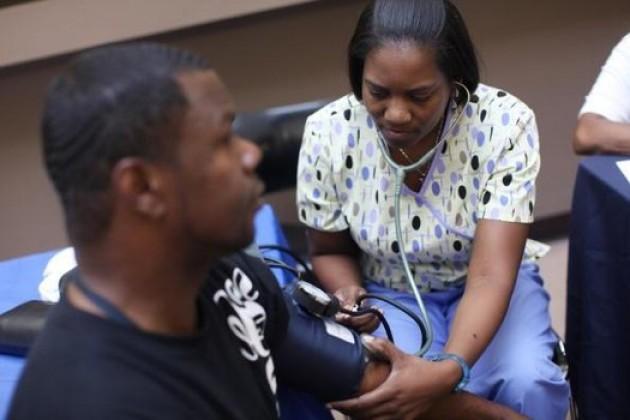
About 28.9 percent of Nigerian population have raised blood pressure (BP), while 82 percent are not aware of this disease con- dition.
By 2030, up to 39.1 million people, aged at least 20 years and above, may live with hypertension if nothing is done to reverse the trend.
This was the submission of experts at the launch of APROVASC®, a fixed-dose combination treatment for the management of hypertension, by Sanofi, a compa- ny reinforcing its sustained commitment to healthcare through the provision of affordable medicines that are tailored to the needs of patients, in Lagos.
People with uncontrolled hypertension are exposed to many complications like stroke, heart attack, kidney failure, and problems with vision, which can be controlled by adopting healthy diets, lifestyle changes and, in many cases, treatment with medications, according to the experts.
According to WHO, cur- rently, about 1.5 billion people are hypertensive.
Even in this 21st Century, hypertension remains a most powerful risk factor for both cardiovascular morbidity and mortality, and there is a projected 60 percent increase 10 years from now, according to experts’ report.
Furthermore, the change prevalence is currently being noticed in Nigeria.
Amam Mbakwem, associate professor of medicine/consultant physician and cardiologist, College of Medicine, University of Lagos, said “more patients are uncontrolled; there is the challenge of adherence to prescriptions (and non adherence is expensive), the challenge of adequate physicians and the chal- lenge with the health sys- tem in Nigeria as a whole.
More than 75 percent of the patients by five years of diagnosis will require more than one drug.
Single pill combination reduces pill burden and will improve adherence.
“The goal of treatment of hypertension is to achieve the maximum reduction in the long-term total risk of cardiovascular morbidity and mortality. To achieve this goal, treatment of all the reversible risk factors which include smoking, dyslipid- emia, obesity and diabetes are crucial. Also important is the appropriate manage- ment of associated clinical conditions as well as treat- ment of the raised BP.”
Nigeria is one of many developing countries where the health services focuse on treating infectious dis- eases, such as malaria and tuberculosis, but in recent years, non-communicable conditions have become an increasing problem.
One of the most prevalent non- communicable conditions worldwide is hypertension.
For Adewale Akinsola, a professor, head, Renal Unit, Department of Medicine OAUTH Ife, “hypertension is an important and major global public health problem with high prevalence across the world. By 2025, about 75 percent of the world hyper- tensive population will be in developing countries. Hyper- tension is simple to diagnose yet it is not often diagnosed and when diagnosed, it is sub-optimally managed. In Nigeria, it is a leading risk factor for stroke, heart failure and kidney failure.”
“It is important to ex- amine the patient with hypertension to know the underlining factor caus- ing the rise in blood pres- sure. What is responsible for the increase impulse rate? The patient must be properly evaluated to de- termine the cause of the rise in blood pressure. It is possible for the blood pres- sure to be normal whereas, there are other risk factors within that the patient is oblivious of. It is the evalu- ation in the hospital/clinic that will show other hid- den ailments,” Ademola Aderibigbe, a nephrologist explained.
KEMI AJUMOBI

Join BusinessDay whatsapp Channel, to stay up to date
Open In Whatsapp