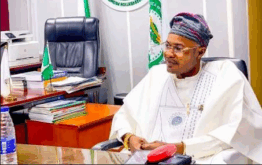
Kemi Adeosun, Nigeria’s finance minister says there is no truth to online media reports claiming she had cancelled Power Purchase Agreements (PPAs) signed by the Federal Government with solar project developers in the power sector because she lacks the power and the implications for the country will be enormous.
In July 2016, the Nigerian Bulk Electricity Trader (NBET) signed a Front-Runner Solar Power Purchase Agreements (PPAs) worth US$1.75 billion with 14 companies to build 1.125 Megawatts (MW) capacity of renewable power in the country at the cost of $2.5billion. Tariff was set at $17cents/kWh (N23/kWh; FX rate $1 = N200) but since then the projects have stalled largely over disagreement about tariff (which inflation, exchange rate has rendered obsolete), funding constraints and guarantees against project failure.
According to the terms of the deal, developers were obligated to handle upfront costs of sizing, procuring and installing the solar PV system but their forecasts ran into murky waters above initial projections. They began to demand a World Bank-backed Put/Call Option Agreement (PCOA), which guarantees them against project termination or failure but didn’t want to shift ground on tariff of $11cents/kWh the government wants.
Last year, the Federal Ministry of Power, Works and Housing signed a PCOA with two of the developers, Afrinegia Nigeria Limited and CT Cosmos Nigeria Limited who offered to cut down the tariff they initially signed from $11cents/kWh to around $7.5cents/kWh cents so they could go on to achieve their financial closures.
BusinessDay could not immediately confirm if the other disgruntled project developers are the source of the online reports claiming the ministry of finance has cancelled the projects. However, Kemi Adeosun, in a release refuted the claims.
“It must be emphasised that the role of negotiating with Project Developers and signing PPAs is domiciled with the Nigerian Bulk Electricity Trading (NBET) Plc and not the Federal Ministry of Finance. However, as the primary obligor of all forms of guarantees issued by all governments of the federation and their agencies, the Federal Ministry of Finance through the Debt Management Office, MUST estimate the size of obligation that it is willing and able to accommodate in relation to the Power Sector.
“Furthermore, the Ministry is required to evaluate the country’s repayment capacity for current and contingent debt obligations as part of its Debt Sustainability Analysis (“DSA”), which is a key requirement for sound Public Debt Management practice. These liabilities have wider implications for the country’s debt and overall fiscal position in the medium to long-term.
Adeson further said that guarantees constitute a contingent liability as they constitute a risk in themselves. It is increasingly becoming common for the Federal Government to be required to provide and sign a Partial Risk Guarantee (PRG) as well as a Put Call Option Agreement (PCOA) on PPAs.
“However, where guarantees are expected to be the primary means of ensuring ongoing contractual payments, they constitute a huge risk to the fiscal sustainability of the Federal Government. Guarantees are issued to provide extra comfort between contractual counterparties and should be issued based on the existence of steady/regular cashflows that underpin the contracts.
“Besides, a sovereign default has the consequent effect of increasing Nigeria’s credit risk and cost of borrowing in the International Capital Markets (ICM). It would be recalled that the Federal Government had recently and successfully raised Eurobonds of US$5.5 billion in the ICM at favourable yields. These proceeds are being invested in the much needed infrastructure (road, rail, power, etc). A default would therefore, have a detrimental effect on the development of the country.
The minister said the Federal Ministry of Finance had initiated an inter-ministerial meeting with all representatives from the Debt Management Office, the Federal Ministry of Power, Works & Housing, the Nigerian Bulk Electricity Trading Plc and Bureau of Public Enterprises and agreed that the Federal Government will bear Foreign exchange rate risk and make termination payments in Dollars.
It was also agreed that NBET will work within a contingent liability exposure limit of US$10 billion (US$5bn for PCOAs and US$5bn for NIPPs). “It is expected that NBET would negotiate with project developers to ensure that Nigerians are getting the best quality of service within costs aligned to global standards. The Federal Ministry of Finance is focused on achieving market sustainability in the long-term and requires that NBET has a comprehensive plan to manage these exposures to avoid a drawdown on the PRGs,” said the release.
However analysts say Nigeria did not get a good deal from the PPAs. Ayodeji Okunlola, power engineer and consultant said “once you further consider the $6cents/kWh PPA price reached in June by Zambia in her pilot utility scale solar tender, you’ll admit that NBET could have gotten a better deal.”
Okunlola suggested that 2-3 rounds of tender procurement processes of 250MW each, spread over 2 years, should have been adopted by the government through a contractual independent body.
“By so doing achieving wholesale prices of 4- 6 cents would have occurred seamlessly by the 3rd round; with maturity, confidence and stability coming into the sector. Financial viability of such projects would have rested in the hands of experienced EPC’s and developers with the capacity to attract global financing into the renewable energy sector in the country,” Okunlola said.

Join BusinessDay whatsapp Channel, to stay up to date
Open In Whatsapp