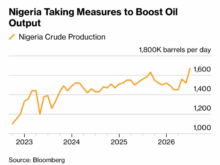
A few years ago, analysts reported that Nigeria was not only the largest oil producer in Africa but also the world’s fourth leading oil exporter.
Today however, despite the relatively large amount of oil it produces, the instability in the Niger Delta has resulted in significant amounts of shut-in production at onshore and shallow offshore fields, forcing companies to frequently declare force majeure on oil shipment.
Among other constraints, the lack of infrastructure to monetize gas that is currently flared has been a major talking point.
The American shale revolution, which was supposed to liberate the US from Middle Eastern oil, has instead brought freedom from an unexpected location: Africa. US oil imports from the African continent have this year plunged to a 40-year low.
A researcher at Gunvor, a Geneva-based oil trading house, David Fyfe recently stated that African countries have been hit worse by US shale because their oil “is of similar quality of the oil pumped in North Dakota and Texas.”
As a result Nigeria is no longer a major force in setting global oil prices. However another impact of shale is the increasing exports of refined products to Nigeria by the US.
According to reports by Bloomberg, U.S. imports of Nigerian crude have almost converged with American sales of refined-petroleum cargoes like gasoline and kerosene shipped in the opposite direction.
According to IHS Inc. a consulting firm, Nigeria imported more than half of its fuels from the U.S. at times in 2013, from less than a fifth three years ago. Over the past decade, United States imported an estimated 10 percent of its crude oil from Nigeria.
However, this share fell to an average of 5 percent in 2012, 4 percent from January to August 2013 and at the moment 2 percent.
As a result, Nigeria has fallen from being the fifth largest foreign oil supplier to the United States in 2011 to eighth in 2013.
“We’ve gone from taking all this crude from Nigeria, now we don’t take the crude and are instead sending crude there in the form of refined products,” said Jamie Webster, an oil analyst at IHS in Washington.
“It’s an evolution of the relationship.”
Nigeria’s increasing dependence highlights its battle to produce enough fuels domestically and as a result, an increasing dependence on American fuel to power its vehicles and planes.
Nigeria imports so much refined products because government’s four refineries with a combined 445,000 barrel-a-day capacity operate at less than 20 percent of their capacity due to poor maintenance and aging equipment.
Shale-oil boom in the U.S. has basically taken away Nigeria’s biggest crude-export market and as a result, Nigeria is no longer quite as critical in setting global oil prices when things get tight.
“Shale oil has been identified as one of the most serious threats for African oil producers,” Nigeria’s oil minister, Diezani Alison-Madueke, said last year.
The collapse in the oil trade has weakened the most important economic link between the US and Africa, particularly Nigeria.
However, it does look like Asia, particularly China and India, have covered the gap created as a result of the U.S. shale oil boom by absorbing Africa’s surplus, hence maintaining oil prices at historically high levels .
India is currently a major importer of Nigerian crude replacing the lost U.S. market.

Join BusinessDay whatsapp Channel, to stay up to date
Open In Whatsapp